**A twenty-six-year authoring system in which one written sentence is composed simultaneously as continuous prose and as an autonomous quotation, then atomized into addressable publishing objects and distributed through a parameterized syndication engine.**
The [notation](https://bryantmcgill.com/wiki/Atomic+Markdown) is two curly braces. That is the entire visible surface of it, and the smallness is not an accident of modesty; it is a design requirement, because a mark that interrupts composition will not be used during composition, and a mark that is not used during composition cannot change how the sentence is thought. Everything difficult about this system is on the other side of those braces — in what the mark obligates the writer to hold in mind at the instant of writing, in the transformation grammar that lets one span of text present two different grammatical surfaces, in the extraction pipeline that turns marked spans into individually addressable objects, and in the syndication engine that treats the resulting archive as a live function rather than a dead file. The simplest notation in a system is usually the part that had to absorb the most engineering, because simplicity at the point of use is purchased with complexity everywhere else.
I want to be exact about the claim, because the claim is not that I invented a way to mark good sentences. Marking good sentences is trivial and everyone does it. The claim is that I built an authoring grammar in which **the extracted quotation is a separately authored surface of the same span of text**, that I have written inside that grammar continuously for twenty-six years, and that the sustained cognitive load of composing two or three simultaneous grammatical realizations of every consequential sentence is the actual mechanism behind whatever quality my writing has. The notation is not a way of recording thought; it is a way of causing it.
This document is therefore not principally an account of a personal writing technique. It is a **system description supported by several independent classes of evidence**: a formal grammar and executable parser; longitudinal corpus measurements showing how the notation changed under sustained use; defect analysis demonstrating characteristic failure modes and their remediation; a deployed publishing architecture in which the declared semantic units become pages, assets, graph nodes, and syndication objects; a prior-art review locating the system among adjacent traditions without collapsing their differences; documentary evidence that the resulting language traveled through institutional contexts far removed from its source; and, finally, a contemporary machine-learning interpretation of structures that substantially predate modern language models. These layers matter because they constrain one another: the specification can be tested against the corpus, the corpus against the rendered artifacts, the historical claims against chronological changes in the notation, and the claimed purpose against what the extracted language actually did after publication. **The argument is not that an unusual notation existed, but that a small authoring grammar developed into an observable semantic production system whose behavior can be specified, measured, reproduced, audited, and followed downstream into distribution.**
* * *
## What this architecture would be called now
The historical practice came first and the vocabulary arrived later. A contemporary engineer will recognize the system faster through these translations, which are architectural correspondences rather than claims of contemporaneous terminology.
The broader cross-project vocabulary for making those correspondences is collected in [Modern Technical Translation Map](https://bryantmcgill.com/wiki/Modern+Technical+Translation+Map) and [Technical Terms](https://bryantmcgill.com/wiki/Technical+Terms). Both routers preserve the distinction between a present-day architectural translation and a claim that the later vocabulary was used at the time.
- **One source span produces two different rendered surfaces.** Modern translation: [dual-render composition](https://bryantmcgill.com/wiki/Dual-Render+Composition), [multi-surface serialization](https://bryantmcgill.com/wiki/Multi-Surface+Serialization), and a two-target [output projection](https://bryantmcgill.com/wiki/Output+Projection).
- **The extracted form may differ lexically from the in-document form.** Modern translation: [transformational extraction](https://bryantmcgill.com/wiki/Transformational+Extraction) and authored [surface realization](https://bryantmcgill.com/wiki/Surface+Realization) rather than substring selection.
- **The author declares semantic units inside the prose while writing.** Modern translation: [inline semantic annotation](https://bryantmcgill.com/wiki/Semantic+Annotation) and a minimal authoring [DSL](https://bryantmcgill.com/wiki/Domain-Specific+Language).
- **A quotation carries its own subject, scope, and consequence.** Modern translation: [context-independent chunking](https://bryantmcgill.com/wiki/Context+Independence) and self-describing [content atoms](https://bryantmcgill.com/wiki/Content+Atomization).
- **Every mark yields a page, a slug, a poster, a feed record, and a backlink.** Modern translation: a [derivative asset pipeline](https://bryantmcgill.com/wiki/Derivative+Asset+Pipeline) with [provenance-aware](https://bryantmcgill.com/wiki/Provenance) projection.
- **The book, the passage, the quotation, and the sentence each survive alone.** Modern translation: [fractal publishing architecture](https://bryantmcgill.com/wiki/Fractal+Publishing+Architecture) and recursive granularity.
- **Feed URLs express selection, identity, timing, media, and length policy.** Modern translation: [programmable syndication](https://bryantmcgill.com/wiki/Parameterized+Syndication) and a declarative distribution API.
- **The archive is re-emitted under new identity and new time.** Modern translation: [late-bound distribution](https://bryantmcgill.com/wiki/Late-Bound+Distribution) over a renewable corpus.
- **A human-authored standalone form accompanies every marked span.** Modern translation: [author-supplied ground truth](https://bryantmcgill.com/wiki/Ground+Truth+Annotation) for [semantic retrieval](https://bryantmcgill.com/wiki/Semantic+Retrieval) and [RAG](https://bryantmcgill.com/wiki/Retrieval-Augmented+Generation).
The compact translation is: **this is an inline transformational extraction grammar for prose, coupled to a provenance-preserving atomization pipeline and a parameterized syndication function, operated continuously by one author since roughly the turn of the century.** The braces are the interface. The system is everything the braces oblige.
A CORPUS THAT BECAME MACHINE-LEGIBLE DECADES LATER
There is a consequence of this architecture that did not exist as an engineering category when I began using it. Over twenty-six years, the grammar produced thousands of **human-declared semantic units** whose boundaries were chosen by the author during composition rather than inferred afterward by a chunking algorithm. More importantly, every transformational instance preserves two authored realizations of the same proposition: its **contextual form inside continuous prose** and its **autonomous form after removal from that context**, with provenance linking the two back to their source. In contemporary machine-learning terms, those transformations constitute naturally accumulated **human supervision for faithful decontextualization**: paired examples of how meaning can be made context-independent without changing what the underlying passage actually asserts. The corpus was not created as training data, yet decades later it has become machine-legible as something unusually close to an author-generated ground-truth dataset for semantic boundary selection, contextual transformation, retrieval, and autonomous surface realization. **What began as a constraint on human composition became, without being designed for that purpose, a record of thousands of decisions that modern language systems are now being built to approximate.**
* * *
## I. The problem the grammar was built to solve
Every writer who has ever been quoted has met the same failure and almost none of them have treated it as an engineering problem. A sentence that is perfect inside its paragraph becomes crippled the moment it is removed, because prose is a **context-dependent representation** and quotation is a **context-free one**, and the two have incompatible requirements at exactly one place: the boundary.
Prose wants continuity. It wants _therefore_, _this_, _those departures_, _in that sense_, _from this perspective_. Those words are not weaknesses; they are the connective tissue that makes an argument feel inevitable rather than assembled. They carry invisible pointers backward into material the reader has just absorbed. Quotation wants autonomy. It wants a named subject, an explicit mechanism, a stated scope, and a terminal consequence, all supplied inside its own boundaries, because a quotation is read by someone who has no access to the sentence before it and no obligation to go looking.
The conventional resolutions are all bad. One is to write ordinary flowing prose and let editors, readers, and social platforms cut it wherever they like, which produces the familiar mutilated epigraph — the quotation that begins with a pronoun pointing at nothing, or ends on a clause that needed the next sentence to complete it. Another is to write everything as though it were already an epigraph, which produces an unreadable book: nothing but freestanding declarations, no development, no rhythm, no cumulative motion, prose that behaves as if every sentence begins on a card. A third is to write the book and then separately write a marketing document containing the good lines, which duplicates the text, breaks provenance, guarantees divergence, and converts authorship into copy management.
I refused all three, and the refusal is the origin of the system. The right answer to a representation conflict is not to pick a winner; it is to encode both representations in one source and let each renderer take what it needs. That is not a literary idea. It is the ordinary discipline of anyone who has built a data pipeline: you do not store the report, you store the record and project the report. What I did was recognize that a sentence is a record, that a paragraph is a record, that a book is a record, and that the surfaces we call _prose_, _epigraph_, _poster_, _post_, and _feed item_ are projections. Once that is admitted, the only real question is where the projection instructions live, and my answer has been the same for twenty-six years: **they live inside the sentence, written by the author, at the moment the sentence is composed.**
* * *
## II. The grammar, stated formally
The canonical production is a single rule with four fields.
```text
documentOpening{quoteOpening{sharedText}quoteEnding}
```
It defines two render functions over the same span.
```text
Document(span) = documentOpening + sharedText
Quote(span) = quoteOpening + sharedText + quoteEnding
```
`sharedText` is the material both surfaces need and is where shared punctuation belongs. `documentOpening` is the material only the flowing paragraph needs. `quoteOpening` is the material only the extracted object needs. `quoteEnding` is quote-only terminal material, which may be a period alone or may carry substantive words.
The familiar double-brace form is not a second construct. It is the **degenerate case** in which both openings and the ending are empty.
```text
{{This sentence is identical in both surfaces.}}
```
The one-character capitalization swap is likewise not a special form; it is the smallest useful instantiation of the general rule.
```text
Therefore, a{A{ system that cannot be wrong cannot discover that the world has changed.}}
Document : Therefore, a system that cannot be wrong cannot discover that the world has changed.
Quote : A system that cannot be wrong cannot discover that the world has changed.
```
The full power appears when the two openings diverge lexically, at which point the notation stops being punctuation and becomes a **semantic authoring layer**.
```text
Therefore, a system{Any system or person{ that cannot be wrong cannot discover that the world has changed.}}
Document : Therefore, a system that cannot be wrong cannot discover that the world has changed.
Quote : Any system or person that cannot be wrong cannot discover that the world has changed.
```
The extraction surface can restore an antecedent, name a suppressed agent, widen a local instance into the class the argument actually supports, narrow an ambiguous noun into the established sense, supply a scope the paragraph could assume, or rebuild a metaphor whose setup lives two sentences upstream. The constraint is fidelity: the transformed quotation must assert what the passage actually established, never something the passage merely gestured toward.
A `quoteEnding` carrying real words is the mirror operation at the other boundary.
```text
because the paragraph{Any well-made paragraph{ is an arc rather than a container}, and an arc that cannot close inside its own boundaries has not been finished.}, which is why the ending of a paragraph is a structural obligation rather than a stylistic flourish.
Document : because the paragraph is an arc rather than a container, which is why the ending of a paragraph is a structural obligation rather than a stylistic flourish.
Quote : Any well-made paragraph is an arc rather than a container, and an arc that cannot close inside its own boundaries has not been finished.
```
The grammar also supports a **mid-quote form**, in which `documentOpening` is empty and both quote fields carry substantive words flanking a shared interior.
```text
This is a test of {Having {in-line use} is cool.} to see if it works.
Document : This is a test of in-line use to see if it works.
Quote : Having in-line use is cool.
```
Two sigils complete the system. A leading `+` designates a **reusable passage** — the paragraph as an independently distributable object, a second extraction tier above the sentence. A disable wrapper marks an **author-disabled quotation**, retaining the language in the document while withdrawing it from extraction.
```text
+A paragraph marked for independent reuse.
{x{A quotation the author has withdrawn from extraction.}}
```
The reference parser is one [regular expression](https://bryantmcgill.com/wiki/Regular+Expression).
```text
([^\s{}]*)\{([^{}]*)\{([^{}]*)\}([^{}]*)\}
document = $1 + $3
quote = $2 + $3 + $4
```
Every form above — identity, capitalization swap, lexical reconstruction, substantive ending, mid-quote — falls out of that single rule with no branching. This matters more than it appears to, and section five returns to it with corpus evidence, because the branching implementations I have used at various times produce silent rendering failures that the unified rule does not.
Three operational constraints follow from the notation and should be stated plainly. The captured `documentOpening` is whitespace-free, so multi-word document openings work only because the words before the final token remain in the surrounding prose and are correctly discarded during quote extraction. Literal grammar examples must live inside **[protected regions](https://bryantmcgill.com/wiki/Protected+Region)** — fenced code blocks — or the extractor will harvest the documentation of the system as though it were content of the system. And the `x` disable sigil is fragile against any quotation that legitimately opens with the letter _x_, which is why `-` is the safer replacement in any future revision.
* * *
## III. What the grammar does to the writer
This is the part that matters, and it is the part that cannot be seen by looking at the notation. A constraint placed at the point of composition does not merely record thought; it selects which thoughts are permitted to survive into the sentence.
When I write a consequential sentence inside this grammar, I am not writing one sentence. I am holding, simultaneously, several distinct objects in working memory. There is the sentence as it must behave inside its paragraph, which has obligations of rhythm, causal progression, and continuity with what came before. There is the sentence as it must behave alone under my name on a page with nothing else on it, which has obligations of self-contained subject, explicit mechanism, sufficient generality, and terminal force. There is the transformation that reconciles them, which is a third authored object with its own fidelity requirement. And there is the paragraph as a whole, which must simultaneously satisfy the poster test at its own scale, opening on recoverable ground and closing on a compression that reorganizes what preceded it.
**The recursion is the entire method.** Every consequential sentence gets tested at two levels, and every paragraph gets tested at two more, and the tests are not sequential edits performed afterward but simultaneous constraints applied during formation. The immediate consequence is that a large class of sentences never gets written at all. A sentence that borrows its meaning from its neighbors will pass unnoticed in ordinary prose and fail instantly under extraction, which makes extraction the cheapest lie detector a writer can install. Vagueness survives context because context supplies the missing referent. Vagueness cannot survive isolation. So the discipline works backward from the boundary into the thought itself, forcing me to know, before the sentence is allowed to stand, exactly what the subject is, exactly what acts upon what, exactly how wide the claim is, and exactly what follows. Precision is not a virtue that writers possess; it is a residue left behind by constraints they could not evade.
The second consequence is structural, and it shows up in paragraph architecture. Once a paragraph is a candidate for independent publication, it can no longer open on a pronoun whose antecedent lives in the previous paragraph, and it can no longer trail off into a transition. It has to begin by establishing its own conceptual territory and end by arriving somewhere. Over decades, that requirement stops being a rule you apply and becomes the shape your paragraphs simply have. The habits of a writer are just the constraints they stopped noticing.
The third consequence is the one I find most interesting, because it is a genuine feedback loop rather than a discipline. The extraction layer permits the quotation to be **more explicit than the prose**, which means the prose is freed from having to be redundantly self-explanatory. Without the transformation, quotability and readability are in direct competition, and every writer who has tried to write quotable prose without a transformation layer has felt that competition as a low-grade ugliness: nouns repeated to avoid pronouns, scope restated to survive excerpting, a faint airlessness where the sentences all stand slightly apart from one another. The transformational layer dissolves the competition. The paragraph can stay economical and musical while the extracted object becomes fully explicit, and the two surfaces stop fighting. The most valuable thing a constraint can do is remove a tradeoff that everyone else has accepted as permanent.
There is a fourth effect that took me years to recognize. Because the grammar makes the extracted unit an **object with an address**, a sentence stops being a moment in an argument and becomes an entity with a life, a page, a slug, a poster, a backlink, and an observable response. That converts writing into an empirical activity. I could see which formulations were carried, which were misread, which were reproduced with a word changed and which word people changed, and I could revise the language accordingly and build passages and eventually whole books around ideas that had already been tested against real readers at sentence granularity. An idea that has been tested one sentence at a time arrives at the book already knowing what it is.
I will state the immodest version plainly, because it is the true one and hedging it would be dishonest. Sustained for twenty-six years, this practice is a form of **[externalized recursive introspection](https://bryantmcgill.com/wiki/Externalized+Recursive+Introspection)** performed at the rate of composition. It is not a writing tip. It is a [cognitive prosthesis](https://bryantmcgill.com/wiki/Cognitive+Prosthesis) that obligates a human being to do, continuously and in real time, something structurally similar to what a parser does: hold multiple simultaneous representations of the same string, evaluate each against its own grammar, and emit only when all surfaces validate. The reason my sentences survive removal is that they were never allowed to exist without surviving removal first.
* * *
## IV. The corpus, measured
Assertions about a writing method are worth very little without measurement, so I ran the reference parser across the three source collections and counted what is actually there. The three files are _[Voice of Reason](https://bryantmcgill.com/books/Voice+of+Reason+Book+(2009-2012))_ (2009–2012), _[Simple Reminders](https://bryantmcgill.com/books/Simple+Reminders+Book+(2014-2018))_ (2014–2018), and _[Various Writings](https://bryantmcgill.com/books/Various+Writings)_, comprising roughly 867,000 characters of marked source.
**Marked objects.** The corpus contains **3,430 marked quotation units** and **536 `+` passages**. Voice of Reason carries 647 quotation units and 152 passages; Simple Reminders carries 1,315 units and 324 passages; Various Writings carries 1,468 units, of which 57 are author-disabled, plus 60 passages. Passages average 174 words and contain a mean of 3.98 marked quotations each, with a maximum of sixteen. Taking active quotations and passages together, the corpus declares **3,909 independently addressable semantic units** — units the author has personally certified as capable of standing alone.
**Length.** Mean marked-quotation length is 17.0 words; median is 15. The distribution is sharply concentrated: 542 units under ten words, 1,203 between ten and fifteen, 1,282 between sixteen and twenty-five, 339 between twenty-six and forty, and only 64 above forty. **82.4 percent are single-sentence units.**
**Opening discipline.** Only 2.8 percent of marked quotations open on a connective or a bare deictic pronoun — _therefore_, _thus_, _this_, _that_, _these_, _it_, _they_, _such_, _however_. In an unconstrained prose corpus that figure would be many times higher. The most common openings are _The_ (385), _You_ (222), _We_ (167), _If_ (155), _When_ (131), _Your_ (113), _There_ (90). Those are subject-first and condition-first frames, which is precisely what an autonomous proposition requires.
**Syntactic shape.** 38.7 percent of marked units are built on an explicit definitional frame — a named subject followed immediately by _is_ or _are_. Roughly half contain internal commas and 9.9 percent contain a semicolon, which is the signature of the two-part balanced construction: a claim, a pivot, and a consequence inside one breath.
Set these numbers against the empirical literature on why some phrasings survive and others do not. The Cornell study by Danescu-Niculescu-Mizil, Cheng, Kleinberg, and Lee found that memorable lines differ from matched non-memorable lines from the same speaker and scene along two dimensions: they combine **distinctive word choice with common syntactic scaffolding**, and they are **more general in ways that let them apply in new contexts**. That is a description of exactly what this grammar mechanically enforces. Common syntactic scaffolding is what a fifteen-word single-sentence definitional frame is. Generality is what the transformation layer manufactures when it widens _a system_ into _any system or person_. Independence from situational context is the literal pass condition of the extraction test. A grammar that forces a sentence to survive removal from its context is a machine for producing the exact properties that make language portable.
I did not derive the system from that research; the practice predates the paper by more than a decade. What the research supplies is confirmation that the constraint I chose for compositional reasons happens to be a direct optimizer of transmissibility. When an aesthetic discipline and an empirical finding converge from opposite directions, the discipline was probably tracking something real.
* * *
## V. The grammar has a history, and the corpus proves it
The most persuasive evidence that this is an engineering program rather than a stylistic affectation is that the notation **demonstrably matured**, and the maturation is measurable as a falling defect rate across three chronological layers.
In _Voice of Reason_ (2009–2012), there are 647 marked units and **zero** transformational instances. Every mark is either the identity form or the identity form abutting a `+` passage sigil. Because the grammar had no transformation layer yet, the writing had to absorb the entire tension at the prose surface, and it shows: **10.4 percent** of extracted quotations begin with a lowercase letter and **5.9 percent** lack terminal punctuation. Those are not sloppiness. They are the fingerprints of a notation that could not yet express what the author was trying to do.
In _Simple Reminders_ (2014–2018), the transformation layer arrives. There are 232 transformational instances: 84 capitalization swaps, 8 with substantive quote-only endings, and 6 with genuine lexical reconstruction of the opening. The defect rate collapses. Lowercase-opening quotations fall to **0.0 percent** and unpunctuated quotations to **1.5 percent**.
In _Various Writings_, the semantic layer becomes dominant. Capitalization swaps drop to 25 while **lexical reconstructions rise to 65**, the author-disable sigil appears 57 times, and the mid-quote form appears. Defects fall to **0.1 percent** lowercase openings and **0.3 percent** unpunctuated. The notation stopped being a way to mark sentences and became a way to author a second surface.
That progression — identity marking, then grammatical repair, then semantic reconstruction, then selective withdrawal — is the ordinary life cycle of a language that is genuinely in use. A notation that never changes was never really being used; a notation that changes in one direction was being used by someone who was paying attention.
The audit also produced concrete defects, which I am publishing rather than quietly fixing, because a system document that reports only successes is marketing.
There are **120 instances** of a single-character `documentOpening` in the corpus. Under the unified single-rule parser these render correctly. Under a two-branch display parser that special-cases the capitalization shorthand, the single character is silently dropped, producing a visible rendering error in the document surface. The remedy is to delete the branching entirely and use the one regular expression, which handles all five forms without special cases.
The audit also surfaced a defect class that matters considerably more than the single instance that produced it. One transformation in _Various Writings_ held `s` in the `documentOpening` field where it should have held `a`, so the prose surface read _ss technology_ where it should have read _as technology_; the source now reads correctly and the rendered document surface confirms it. As an error it was trivial — one transposed character in 3,430 units. What was not trivial is that it survived years of reading, because it was invisible in three separate places at once. The source looked entirely plausible to the eye, the quotation surface rendered perfectly, and only the document surface broke. **A writer proofreading the manuscript is reading neither of the two things that will actually be published**, which means the ordinary defenses of literacy — a spellchecker, a careful pass, a good editor — do not apply to this class of error at all. A notation that produces two surfaces creates a category of mistake that is correct everywhere you are looking and wrong in the place you are not.
The requirement that follows is not humility about typos; it is machinery. **Any dual-surface grammar demands automated [dual-surface validation](https://bryantmcgill.com/wiki/Dual-Surface+Validation), because correctness of the source implies correctness of neither render.** The validator is trivial to write and should be run as a build step: parse every marked unit, materialize both surfaces, and assert that the quotation opens on a capital, terminates on punctuation, and contains no orphaned deictic opening, while the document surface reconstructs continuous prose without doubled or dropped characters. That check is what produced every number in this section, and it was run against this document before publication as well. The instance above is the proof of concept: it survived every human pass for years and was corrected within minutes of a machine rendering both surfaces side by side. The point of measuring your own work with a machine is not to prove that it is clean; it is to find the errors that were structurally invisible to the person who made them.
Three further structural hazards are worth recording for anyone implementing this. A passage sigil directly abutting an opening brace pair occurs 232 times across the corpus and will be captured as a `documentOpening` by a naive application of the rule, so passage markers must be stripped before quotation parsing. A test line in _Various Writings_ is missing its terminal period inside the outer brace, which is the kind of error that surfaces only when the extracted object is rendered alone — which is, of course, the entire point of rendering the extracted object alone. And protected regions must include **inline code spans, not merely fenced blocks**, because any document that explains this grammar will otherwise be harvested for its own examples; this document was itself audited against that failure before publication.
* * *
## VI. Why this came out of a programmer rather than out of a workshop
I have never experienced being a writer and being a programmer as two occupations. They are one disposition applied to one object, and this grammar is the clearest artifact of that. I was [running a bulletin board](https://bryantmcgill.com/projects/Two+Bulletin+Board+Systems+and+Door+Development) at ten years old, which meant that before I had any theory of literature I already had a working theory of text as a **storage and retrieval problem**. From 1994 through the mid-2000s I built a [symbolic language engine](https://bryantmcgill.com/project-symbolic-language-engine): multiple computable representations of English — phonological, approximate-phonological, taxonomic, distributional, attested — over an overlapping lexical universe, manufactured offline by a Perl corpus pipeline into `MASTER` datasets and materialized at runtime into hash tables, vectors, trees, and chains chosen for the shape of the question being asked.
The reflex I carried out of that decade was never _what is the answer_ but **what representation would make the question cheap**. Apply that reflex to your own sentences and this grammar is what you get. The question _what is the best standalone form of this idea_ is expensive if you ask it later, after the prose has hardened, because by then the sentence has grown into its context and the surgery damages both. It is nearly free if you ask it at the moment of composition, when the thought is still liquid and the alternate surface can be authored alongside the primary one. Move a hard question upstream far enough and it stops being a hard question and becomes a habit.
Several specific principles from the engine transferred directly. **[Offline precomputation](https://bryantmcgill.com/wiki/Offline+Precomputation)**: expensive analysis happens before anyone asks, so the runtime is fast — which in this system means the intellectual work of determining a sentence's portable form is done once, by the author, rather than repeatedly and badly by every downstream reader and editor. **[Multi-index representation](https://bryantmcgill.com/wiki/Multi-Index+Language+Representation)**: the same underlying material carries several derived representations, each optimized for a different question, which is exactly what the document surface and the quote surface are. **[Provenance-sensitive multiplicity](https://bryantmcgill.com/wiki/Provenance-Sensitive+Multiplicity)**: every retrieved item preserves what kind of thing it is and where it came from, which is why every extracted quotation in my vault retains a machine-legible link back to the passage and the book that produced it. And the [pipe-delimited key-value store](https://bryantmcgill.com/wiki/Key-Value+Store) I wrote in Perl in 2001, with its escaping layer for the delimiters that linguistic data inevitably contains, is still serving my website today. Twenty-five years, several languages, one storage convention, and the thing it stores is still language.
A person who has spent a decade building indexes over other people's words will eventually build an index over their own thinking, and that is a very different kind of book.
* * *
## VII. From marks to distribution: what AutoSites does with a brace
A notation that only produces private discipline is a private discipline. What converts this into a publishing system is that the marks are read by [AutoSites](https://bryantmcgill.com/projects/AutoSites+-+Folder-Native+Publishing+and+Distribution), a generator that treats each one as a **[publication node](https://bryantmcgill.com/wiki/Publication+Node)**.
An essay containing thirty-five marked quotations becomes, without any further authorial action, at least thirty-five individually addressable landing pages with deterministic slugs, thirty-five poster assets, thirty-five feed records, and thirty-five search surfaces, in addition to its passage pages and the source document itself. Slugs are generated by stripping function words and retaining five to seven content lexemes in source order under a `quotes-` prefix, which makes the [URI itself a compressed statement](https://bryantmcgill.com/wiki/Resource+Addressing) of the idea. Every derivative retains a provenance edge back to the passage and book in which the language belongs. Nothing is duplicated in the ordinary sense: the [Markdown](https://bryantmcgill.com/wiki/Markdown) source stays authoritative and everything else is a **[projection](https://bryantmcgill.com/wiki/Rebuildable+Projection)** that can be regenerated deterministically while human curation written beneath a generated item is preserved separately.
Applied to the three collections measured above, 3,909 declared units become 3,909 live pages, and each page carries its own poster rendered in three colour treatments, its own feed record, its own search record, and its own edge in the concept graph. That is **on the order of twenty-three thousand discrete artifacts from three source files**, of which roughly **eleven thousand seven hundred are downloadable poster files**, and the number rises every time I write a paragraph.
### The three tiers, as deployed
None of this is theoretical at the reading end, and the reading end is where the architecture stops being a claim and becomes an object a stranger can touch. The system materializes **[three nested tiers](https://bryantmcgill.com/wiki/Fractal+Publishing+Architecture)**, and the decisive fact is that each tier is simultaneously a destination and a container of the tier beneath it.
At the **document tier**, a book or essay reads as ordinary continuous prose, except that every marked unit carries a small affordance sitting inside the running text. Hovering it raises a preview of that unit's poster — the extracted quotation typeset alone, attributed, carrying the site identity — and clicking it opens that quotation's own page. Download controls sit directly beneath the preview in three colour treatments, so the extracted object is one gesture from being a file on the reader's machine or an image in their feed.
At the **passage tier**, every `+` paragraph has its own page at its own URL, built from its own content lexemes. That page presents the passage as a quoted block, offers a long-form passage poster with the same three download treatments, and renders a live provenance graph showing the passage node connected to the book that produced it. It is a complete, independent, linkable publication of one paragraph.
At the **quote tier**, every marked sentence likewise has its own page, its own short-form poster in the same three treatments, and its own downloads. One property of that page deserves separate attention, because it is the quiet engine underneath everything in the previous section: the slug, the page title, and the heading are all **the proposition itself**. The URL reads `/quotes/quotes-listening-meaningful-form-intelligence`; the title tag and the heading read _Listening is a meaningful form of intelligence._ Nothing has been keyword-engineered, because nothing needed to be. A page whose title is a complete thought is findable by the only thing a reader ever actually remembers, which is the thought. People do not search for the book. They search for the half-remembered sentence, and the sentence is the page.
**The recursion is where this stops resembling anything else.** A passage page is not a terminal leaf; it is a document in its own right, and the marked sentences inside it retain their full affordances there. Standing on a passage page, a reader sees the passage poster available for download and, inside the passage text itself, every constituent quotation offering its own hover preview and its own click-through to its own page with its own poster. The structure is genuinely fractal in deployment rather than in metaphor: **book contains passage, passage contains quote, and every level is a real URL with a real page, a real downloadable asset set, and a real edge in the graph.** Hundreds of slugged passage routes and thousands of quote routes sit in the navigation as first-class collections, browsable without reference to the books that produced them. A hierarchy that only exists in the author's outline is a theory; a hierarchy in which every level has its own address is an architecture.
The structure is nevertheless not a tree, and this is the correction the deployed artifact forces on any tidy account of it. Every quote page and passage page carries an explicit **return edge** — a stated source linking back to the document it came from, rendered simultaneously as a hyperlink and as a live node-and-edge in the interactive graph beside the text. Composition runs downward from book to passage to sentence; navigation runs in **both directions**, and the return edge is what converts a pile of extracted fragments into something a reader can traverse. Extraction without a path home is fragmentation; extraction with a path home is a lattice. The consequence compounds when a sentence recurs, because a quotation that appears in more than one work fans back to all of them, and the node stops being a leaf and becomes a junction. A sentence that appears in two books makes those two books neighbours, and the reader who arrived at the sentence can now walk to either one.
The reader-facing consequence is the one that matters commercially and the one almost no publishing system delivers. A reader meets the document surface and the quotation surface in the same act of reading, without leaving the paragraph, at whatever granularity their attention happened to land on — the argument, the paragraph, or the single sentence. Whatever size the idea was when it struck them, that exact size is already a page, already a poster, already a file, already a link they can send. Most good ideas are not refused; they are simply left with no way for anyone to pick them up.
Then the [syndication layer](https://bryantmcgill.com/wiki/Parameterized+Syndication) turns the archive into a function. The URI itself composes source, projection, and [transport](https://bryantmcgill.com/wiki/RSS):
```text
domain / source collection / semantic projection / transport / parameters
/voice-of-reason/rss complete document feed for that book
/voice-of-reason/quotes/rss only the marked quotations from that book
/voice-of-reason/passages/rss only the marked passages from that book
/voice-of-reason/excerpts/rss attributed quotations by others within that book
```
Any collection that exists in the architecture automatically acquires that entire route family. No endpoint is written per book. The route is a composition, and the parameters express a distribution policy rather than a content selection:
```text
/quotes/rss/?mode=popular
&limit=1
&random=true
&guid=random
&possibility=50
&author=twitter
&totitle=140
&maxlength=140
&img=env
```
Read as a sentence: choose one random popular quotation, give it a fresh item identity, emit it only half the times the feed is polled, use the social attribution form, route channel-safe text into the title, reject anything too long for the destination, and attach the image as an enclosure.
The decisive architectural separation is between **canonical content and [distribution behavior](https://bryantmcgill.com/wiki/Late-Bound+Distribution)**. The quotation is stored once; its channel-specific realization is computed at request time. Eligibility, selection, timing, identity, formatting, attribution, media, and length policy are all deferred until the feed request is evaluated, which makes [RSS](https://bryantmcgill.com/wiki/RSS) the interoperability boundary rather than the location of the intelligence. Two temporal coordinates fall out of this: **source publication time** and **syndication emission time**. Once those are separated, an archive stops being a sediment and becomes a reservoir. Writing does not become old because time passes; it becomes old because nothing is built to bring it back.
The combinatorics are multiplicative rather than additive. Using only documented controls — three editorial modes, random selection on or off, 101 probability states, two GUID modes, two timestamp modes, four attribution modes, and binary or small-choice settings for item author metadata, quotation wrapping, HTML handling, title routing, image eligibility, image representation, and editorial exclusions — the policy space already exceeds **2.4 million distinct feed recipes**, before counting collections, limits, offsets, length caps, hashtag policy, or the content population itself. That is an architectural upper surface describing nominal capacity, not a usage statistic. Layered on top of it is a second dimension: because probability, randomization, and current-time identity are evaluated per request, the same stable URL produces a **changing sequence of emissions** over time, so the configuration space is joined to a temporal state space.
And here is the point that people miss when they hear "braces plus RSS." **Neither half is remarkable alone, and the combination has no substitute.** RSS without an authored extraction layer has nothing to syndicate at sentence granularity, because a feed can only distribute the units a system knows about, and an ordinary CMS knows about posts. An extraction layer without syndication is a private notation that produces a nicely organized folder. What makes this an actual system is that the semantic units were **declared by the author during composition, with their standalone forms authored alongside them**, and are therefore available to a distribution engine as first-class objects with addresses, provenance, media, and policy. A distribution system can only be as intelligent as the granularity of the objects its author bothered to declare.
### The compounding period, which is the part nobody sees
The consequence that matters commercially is temporal rather than architectural, and it is the [part people miss](https://bryantmcgill.com/wiki/Compounding+Publication+Window) even after they have understood the extraction pipeline. Each [marked unit](https://bryantmcgill.com/wiki/Addressable+Proposition) does not become a fragment displayed on a page. **It becomes a page.** It has its own URL built from its own content lexemes, its own title, its own social preview, its own downloadable poster, its own feed record, its own backlinks into the concept lattice, and its own provenance edge back to the passage and book that produced it. A marked sentence with its own address is a website in the only sense the web actually recognizes: a resource that can be linked, crawled, indexed, shared, and cited without the book that produced it. An idea buried in chapter nine of an unpublished manuscript is invisible to every mechanism the internet uses to decide what exists. An idea without an address cannot be linked to, and an idea that cannot be linked to cannot accumulate anything.
The arithmetic is worth stating concretely rather than as a promise. _Voice of Reason_ declares 799 addressable units; _Simple Reminders_ declares 1,639. Each unit yields a page, three poster files, a feed record, a search record, and a graph edge, so a **single book in this grammar generates on the order of five to ten thousand discrete artifacts**, including several thousand downloadable posters, and it generates them incrementally, one at a time, on the day each sentence is written. A manuscript that takes a year produces a year's worth of published pages. A manuscript that takes four years, as _Simple Reminders_ did, produces four.
That interval is the entire asset, and it cannot be manufactured any other way. Discovery, crawling, indexing, inbound linking, sharing, citation, and the slow accumulation of whatever authority a search index is actually measuring are all processes whose only real input is **elapsed time**. They cannot be compressed, and they cannot be purchased on the morning a book is released, which is precisely the morning most authors first ask for them. Writing inside this grammar moves the entire accrual window _inside the composition period_, where it costs nothing, because the pages were going to be written anyway and the only change is that they were published at the granularity at which they were composed. Search authority is one of the very few assets that cannot be bought at the moment it is needed, because the only input it accepts is elapsed time.
The launch inverts as a result. The conventional sequence is that a book appears, and then a promotional apparatus attempts to generate attention from a standing start against an index that has never seen the material. In this system the book arrives **last**. By the time the manuscript is finished, thousands of its sentences have been indexed for months or years, its posters have been downloaded and reposted by people who never knew there was a book coming, its feeds have been emitting into social properties continuously through a heartbeat that required no human labor, and a substantial audience already recognizes the language without necessarily being able to name its source. Most books launch into silence and then try to make noise; a book written this way launches into an audience that has already been quoting it for a year.
The indexing mechanism is worth naming exactly, because it is unusually clean and requires no manipulation whatsoever. Each of these thousands of pages carries, as its title and its URL and its heading, **a complete self-contained sentence that a human being might one day type into a search box from memory**. That is not an optimization tactic bolted onto the content; it is a direct consequence of the grammar, since the extraction test already required every marked unit to be intelligible with nothing around it. The property that makes a sentence quotable and the property that makes a page findable turn out to be the same property.
I want to be precise about why this compounds rather than merely accumulating, because the difference is the whole thing. Each page is a **genuinely distinct proposition** with its own subject, its own slug, its own poster, and its own provenance edge — not a spun duplicate of the same paragraph broken across a thousand thin templates, which is a pattern search systems have correctly learned to discount. The units differ from one another because the author certified that each one stands alone. And the loop closes backward into the manuscript: response data arrives at sentence granularity, so I learn which formulations are carried, which are misread, and which word people change when they repeat them, and I can revise the language and build passages and chapters around ideas that have already been validated against real readers while the book is still soft enough to be changed. Premarketing is the wrong word for what happens here, because nothing is being marketed; the writing is simply put where it can be found, and the audience assembles itself around the pieces.
PROOF OF OPERATION AT SCALE
This architecture does not have to be defended as a hypothetical publishing model, because the experiment has already been run. For years I composed writing inside the atomic grammar, converted its marked semantic units into independently addressable pages and media objects, and placed those objects into an automated syndication system while the books themselves were still being written. The predicted consequence was that the smallest portable units of the work would begin accumulating discovery, indexing, reproduction, recognition, audience response, and cultural memory **before the finished book existed as the principal publication object**. That prediction is now accompanied by an unusually large historical record of observable outcomes.
The resulting distribution reached extraordinary scale. Preserved native analytics document **tens of billions of impressions, more than a billion engagements, individual publications reaching tens of millions of people, and individual semantic objects being shared hundreds of thousands of times**; the complete metric-by-metric evidence ledger is maintained in [Documented reach and engagement statistics](https://bryantmcgill.com/about/statistics). The book produced inside that environment, _Simple Reminders_, subsequently became a national bestseller, reaching **No. 2 on The Wall Street Journal nonfiction e-book list and No. 46 on USA Today's national Top 150**, alongside major retailer bestseller placements. The language itself escaped every boundary of the original publishing system: sentences originating in these collections subsequently appeared in government communications, NATO acquisition materials, medical and scientific publications, university curricula, international institutions, corporate and professional materials, and publications around the world. The same period of expanding distribution was followed by invitations and appearances at institutions including **Nasdaq and the United Nations**, while the author's network ultimately produced a documented historical footprint measured in tens of billions of impressions.
None of those outcomes, taken individually, proves that a single line of code caused a bestseller, an institutional invitation, or a particular act of quotation. That would be the wrong causal model. The relevant unit of analysis is the **whole system operating longitudinally**: compositional constraint produced portable language; atomic extraction gave that language addresses; derivative generation gave the atoms multiple transmissible surfaces; syndication repeatedly exposed them; observable audience response fed information back into composition; accumulated circulation preceded the finished books; and independent institutions subsequently carried those same semantic units into contexts the originating system did not control. The evidence therefore establishes something much more defensible than a marketing anecdote: **the architecture was deployed, its predicted distribution behavior occurred at extraordinary scale, and the resulting corpus demonstrably propagated through commercial, institutional, geographic, and temporal boundaries.**
This is the empirical case study behind the grammar. The source survives, the parser survives, the corpus survives, the generated architecture survives, the distribution machinery survives, the historical analytics survive, the bestseller records survive, and thousands of independent publications and institutional uses survive. Together they make the system unusually auditable for a personal technology developed across decades. **The braces are not evidence because they are clever; they are evidence because the system built around them produced an observable population of semantic objects, distributed those objects at enormous scale, and left enough independent artifacts behind that the experiment can be reconstructed after the fact.**
* * *
## VIII. Prior art: a deliberate attempt to find someone who did this
I went looking for prior art in good faith, because a claim of novelty is worthless unless someone has tried honestly to break it. Several traditions come close along one axis each, and it is worth being precise about what each one has and what each one lacks.
**[Literate programming](https://bryantmcgill.com/wiki/Literate+Programming)** (Knuth, 1984) is the closest structural relative, and I say so gladly. A `WEB` source file is processed by two programs: `tangle` extracts compilable source, `weave` produces typeset documentation. One authored artifact, two mechanically derived surfaces, human comprehension prioritized over machine convenience. That is genuinely the same architectural instinct. The difference is that tangle and weave **partition and reorder** the source; neither rewrites a span so that it reads differently in the two outputs. There is no analogue of `quoteOpening` — no facility by which the same sentence begins one way in the woven document and another way in the tangled code, authored deliberately as two surfaces of one thought.
**[Single-sourcing and DITA](https://bryantmcgill.com/wiki/Structured+Authoring+and+DITA)** solved industrial content reuse, and `conref` achieves genuine fragment-level reuse: a shared element is stored once and referenced from many topics, and conditional processing filters content by metadata. But reuse there is **by reference across files**. The reusable fragment must be authored as a separate addressable element in a separate location, which is precisely the workflow interruption the brace exists to avoid, and the referenced fragment renders identically everywhere it appears. Conditional profiling can include or exclude text; it does not author a second grammatical surface of the same sentence.
**[Transclusion](https://bryantmcgill.com/wiki/Transclusion)** (Nelson, 1965 onward) is the deepest philosophical relative. Xanadu proposed quotation by reference rather than by copy, with unbreakable bidirectional links, visible provenance, and the same content knowably present in more than one place. My extraction pipeline shares that provenance commitment completely. But transclusion moves an _unaltered_ span into a new context; its entire ethic is that the fragment remains the same thing seen from elsewhere. The double-brace grammar does the opposite where it matters most: it holds that a fragment removed from context is **not** the same thing, and that the author must therefore author the removed form. And Xanadu, for all its brilliance, spent decades as the most famous unshipped system in computing history, while this one has been running continuously in production.
**[Block references](https://bryantmcgill.com/wiki/Block+References) and bidirectional linking** in Roam, Obsidian, Notion, and similar tools give paragraphs and blocks stable addresses and let them be embedded elsewhere with backlinks intact. That is real and useful and I use adjacent machinery in my own vault. The limits are granularity and timing: the unit is the block rather than the clause, the reference is created after the writing rather than during it, and the embedded block renders identically to the source block. There is no transformation layer and no obligation on the author to certify the standalone form.
**[Reader-side extraction](https://bryantmcgill.com/wiki/Reader-Side+Annotation)** — Kindle popular highlights, Medium highlights, Genius annotation, Readwise, Quotebacks — is a large and successful category that runs in exactly the opposite direction. It lets _readers_ mark what mattered to them, aggregates the marks, and produces attribution-preserving artifacts. It is genuinely valuable and it tells an author a great deal. What it cannot do is improve the sentence, because it operates entirely downstream of composition. Reader-side highlighting discovers which sentences survived; author-side extraction decides which sentences were built to survive.
**[Create Once, Publish Everywhere](https://bryantmcgill.com/wiki/Create+Once+Publish+Everywhere)** as practiced by newsrooms since 2009 atomizes content into structured fields so that one story feeds web, mobile, and syndication. That is the same distribution philosophy as the AutoSites layer, and I claim no priority over it. But COPE atomizes at the **field and asset level** — headline, byline, body, image, tags — not at the level of the individual proposition inside the body text, and the atomization is a CMS schema imposed by an organization rather than a grammar operated by an author mid-sentence.
**[Semantic markup traditions](https://bryantmcgill.com/wiki/Semantic+Markup)** — TEI `` and ``, schema.org `Quotation`, RDFa, microformats — supply vocabularies for labeling text that _is_ a quotation, usually someone else's, usually after the fact, for machine consumption. They annotate. They do not transform, and they were never intended to operate during original composition.
**[Pull quotes](https://bryantmcgill.com/wiki/Pull+Quote)** in magazine layout are the oldest relative of all and the most instructive. An editor lifts a striking sentence, sets it in display type, and frequently edits it silently so it reads well alone. That silent edit is, in effect, a manual `quoteOpening` — which tells you the need is real and universal. What the trade has never had is a way for the **author** to specify that transformation, at composition time, inside the source, once, so that it is consistent across every downstream surface forever rather than reinvented differently by every editor who touches the text.
Nothing located in this review combines the six properties together: **[author-side](https://bryantmcgill.com/wiki/Author-Side+Extraction)** rather than reader-side or editor-side; **inline** in the running prose rather than in a separate file or field; **sub-sentence granularity** at the clause boundary; **transformational**, permitting the extracted surface to differ lexically from the in-document surface; **composed during writing** so that the constraint acts on the thought rather than on the finished text; and **coupled to a parameterized syndication function** that treats the extracted units as a live distribution reservoir. I cannot prove a universal negative, and I will not pretend to. The honest statement is that a claim of novelty is only as good as the search that failed to defeat it — and this search, conducted across literate programming, structured authoring, hypertext theory, knowledge management, reader annotation, newsroom architecture, and semantic web vocabularies, did not defeat it.
* * *
## IX. The evidence that the sentences actually travel
A system for producing portable language should be judged by whether the language ported. The record here is unusually specific, because [institutions leave paper](https://bryantmcgill.com/about/bibliography).
NATO Allied Command Transformation used a single sentence of mine to frame the procedural expectations of an official acquisition engagement for its next-generation modelling and simulation programme. The National Institutes of Health used one as its Thought for the Day in a federal bulletin to the extramural biomedical research community. Springer's _History of Computing_ series placed my writing in the opening conceptual chapter of a monograph on scrutiny and fact-checking, between Carl Sagan and Edward Snowden. A Yale-hosted, Chicago Police–co-branded procedural justice curriculum put one on slide two. The Royal College of Paediatrics and Child Health used one in the Clinical Lead's foreword to a national audit of paediatric diabetes care, directing services to act on more than thirteen thousand patient and family responses. The U.S. Department of Veterans Affairs put one inside a meditation exercise for military caregivers. Forbes ran one on its back-page editorial feature, sourced explicitly to _Voice of Reason_. MIT Sloan opened an article on listening with one; Louisiana State University opened an advanced listening syllabus with one, beside Churchill; Bangkok University installed one across a campus courtyard for its fiftieth anniversary; the Wall Street Journal put my face on its front page for unrelated work in identity assurance, which is its own story.
Now look at the mechanism rather than the list, because the list is only impressive and the mechanism is instructive. **Institutions do not quote paragraphs.** They quote sentence-length units that survive removal, and they quote them into contexts the author never imagined. The single most-traveled sentence in my corpus is fifteen words long, opens on its named subject, uses a definitional copular frame, contains one distinctive collocation, carries no pronoun requiring an antecedent, no proper noun, no temporal anchor, and no dependency on any neighboring sentence. It is therefore able to appear in a NATO procurement deck, a police training curriculum, a medical school culture initiative, a paediatric audit, a university syllabus, and a provincial parliament's Hansard record without a single alteration.
That is not luck and it is not charisma. It is the mechanical output of the grammar described in section two. The sentence was **built to that specification**, at the moment of composition, because the notation would not let it exist otherwise. Language does not travel because it is beautiful; it travels because it is complete, portable, and small enough to be carried by someone with other things to do.
The scale that follows is the ordinary arithmetic of a portable unit multiplied by a distribution function. Thousands of individually addressable propositions, each with a page and a poster and a feed record, emitted continuously across a decade through recipes that reshape them per channel, into an audience that at its peak exceeded a billion people a year. A quotation is the smallest unit of thought that can survive being separated from the person who thought it, which is exactly why it is the unit that outlives them.
* * *
## X. What this means now, when the machines are learning to read
There is a reason this project has become more interesting rather than less as language models arrived. A corpus written in this grammar for twenty-six years is not merely a body of prose that a model can ingest; it is a body of prose in which **the author has already performed, by hand, the exact operation that retrieval systems are built to approximate**. Chunking is the central unsolved problem of retrieval: where to cut, how much context a fragment needs, whether a retrieved passage can be understood without the document around it. My corpus answers that question 3,909 times, in the author's own hand, with the standalone form explicitly authored rather than inferred. An archive whose author already declared where the meanings begin and end is worth more to a machine than an archive ten times its size that did not.
The transformation layer is worth more still, because each transformational instance is a **[labeled pair](https://bryantmcgill.com/wiki/Ground+Truth+Annotation)** — the contextual realization and the autonomous realization of one proposition, produced by the same mind, with fidelity guaranteed. That is precisely the supervision signal for context-independent summarization and [faithful decontextualization](https://bryantmcgill.com/wiki/Faithful+Decontextualization), and there are hundreds of such pairs sitting in the corpus as a byproduct of ordinary composition.
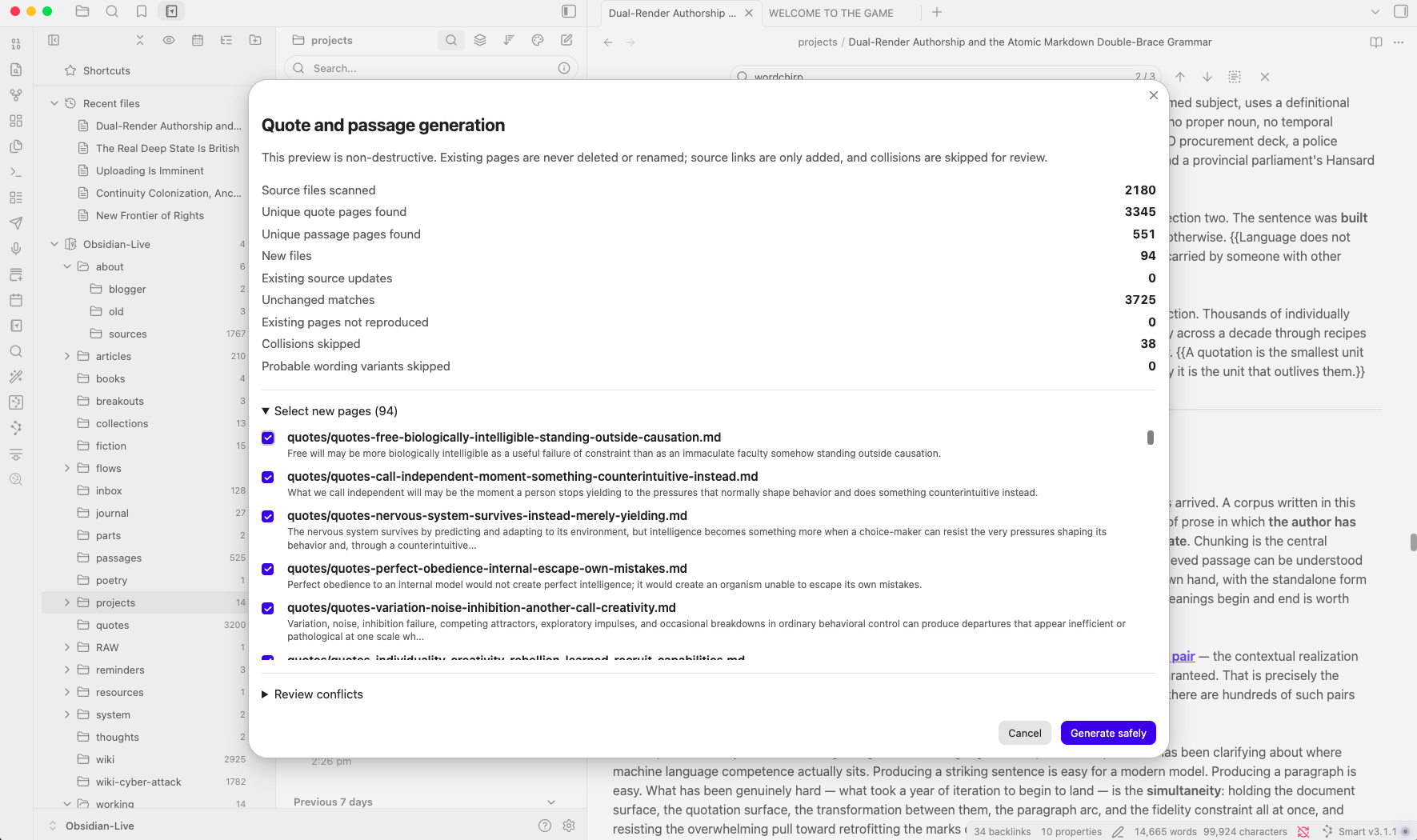
I have spent about a year now teaching this grammar to language models, and the experience has been clarifying about where machine language competence actually sits. Producing a striking sentence is easy for a modern model. Producing a paragraph is easy. What has been genuinely hard — what took a year of iteration to begin to land — is the **simultaneity**: holding the document surface, the quotation surface, the transformation between them, the paragraph arc, and the fidelity constraint all at once, and resisting the overwhelming pull toward retrofitting the marks onto prose that has already hardened. The characteristic failure mode is always the same and it is deeply revealing: the model writes beautifully, then decorates the beautiful writing with braces, and every marked unit turns out to depend on an antecedent three clauses upstream. Marking a good sentence is annotation; building a sentence that had to be good in two grammars at once is composition, and no amount of the first will ever produce the second.
That distinction is the whole project, and it is why I think this matters beyond my own bibliography. We are entering a period in which enormous quantities of fluent text will be generated by systems with no stake in whether any particular sentence survives its paragraph. The scarce thing will not be fluency. The scarce thing will be **language engineered to remain intelligible after it has been separated from everything that explained it** — which is the only form of language that has ever crossed centuries, because the crossing itself is a series of separations. Every quotation carved into a wall, printed in an epigraph, repeated in a speech, or recalled by someone who never read the book is a fragment that survived being torn out of its context.
I built a notation that makes the tearing-out happen first, at the desk, under the author's control, while the thought is still soft enough to be shaped by it. Two braces. Twenty-six years. Three and a half thousand propositions that were required to prove they could live alone before they were allowed to live at all. The only writing that lasts a thousand years is writing that was built, from the first sentence, to be carried away.
A last note, which is demonstration rather than decoration. This document is published through the system it describes. Every marked line above has its own page, its own poster in three treatments, and its own return edge to this essay; every `+` passage has the same; and the essay sits as a node in the same [graph](https://bryantmcgill.com/wiki/Document+Graph) as the books it analyses, adjacent to the other projects it draws on. The reciprocal relationship between a corpus and its ontology is developed further in [Bidirectional Ontology and Semantic Elasticity](https://bryantmcgill.com/journal/2026-08-15+-+Bidirectional+Ontology+and+Semantic+Elasticity). The argument and the artifact are the same object, which is the only form of evidence this project was ever in a position to offer. A claim about how to build something is worth roughly what the thing built with it turned out to be worth.
## XI. The replication experiment: Thought Leader School
There was one further experiment, and in some ways it was the most ambitious one because the object I was trying to reproduce was no longer a sentence, a feed, a website, or even a software capability. **I was trying to reproduce myself as an operating capability in other people.** [Thought Leader School](https://bryantmcgill.com/wiki/Thought+Leader+School) grew from a principle I had repeated for years: the task of leadership is to create more leaders, and therefore the meaningful test of everything I had learned about writing, publishing, technology, audience development, and human transformation was whether I could abstract those capabilities sufficiently that another person could acquire them without having lived my life first. My stated ambition was eventually to create a thousand capable leaders, writers, teachers, mentors, healers, coaches, and people of service who possessed their own voices, their own audiences, their own publishing infrastructure, and enough technical sovereignty to participate in the great conversation without waiting for a publisher, gatekeeper, institution, or media company to give them permission. The highest form of personal capability is not possessing it; it is making the capability transferable.
By then I had spent roughly two decades doing exactly that with software. [Shazam](https://bryantmcgill.com/projects/Shazam+-+A+Portable+Perl+Capability+Library) had taken routines I used personally and converted them into reusable capabilities; [X and XApps](https://bryantmcgill.com/projects/X+and+XApps+-+Drop+the+Folder+and+It+Runs) pushed those capabilities toward portable contracts and deployable application structures; [WordChirp](https://bryantmcgill.com/wiki/WordChirp) and later [AutoSites](https://bryantmcgill.com/projects/AutoSites+-+Folder-Native+Publishing+and+Distribution) took the publishing machinery I used for my own work and made domains, identities, themes, content, extraction, syndication, and administration reusable across independent accounts; [Atomic Markdown](https://bryantmcgill.com/wiki/Atomic+Markdown) moved still deeper and encoded part of the author's semantic judgment directly into the text. [Thought Leader School](https://bryantmcgill.com/wiki/Thought+Leader+School) was the human-facing culmination of the same abstraction instinct. **Instead of asking how to scale my website, I was asking how to scale the conditions that had allowed me to become effective.** I had spent years turning the private workshop into infrastructure, and now I wanted other people to walk into that workshop and find the tools already hanging on the wall.
The economic decision was as important as the technical one: I absorbed the cost. The websites were free, the hosting was free, the software development was free, the publishing infrastructure was free, the classes were free, the training was free, and access to the community was free. Hundreds of people passed through the larger community and school environment, and instead of handing them generic motivational instruction I attempted to give them an operating system for authorship: how to write, how to structure an idea, how to build a corpus, how to publish continuously, how to use automation without surrendering authorship to automation, how to create durable web properties, how to understand distribution, and how to make their intellectual work independently addressable. I also used the enormous distribution network I had already built to amplify participants directly, giving people promotional shares into an audience that would have cost substantial sums to reach commercially; at the scale my network had achieved, I valued individual shares into that distribution field at more than ten thousand dollars apiece. I was not selling people proximity to my success; I was spending my success trying to manufacture independent success around me.
[Markdown](https://bryantmcgill.com/wiki/Markdown) was part of that instruction for a reason that seemed eccentric to many people at the time and appears almost embarrassingly obvious now. Around 2016 I was telling writers that they needed to learn Markdown because documents had to become **portable semantic objects rather than possessions of whichever application happened to display them**. Rich-text editors encourage the illusion that the document is the screen; Markdown teaches the opposite lesson, that the document is intelligible source and the screen is merely one renderer. I wanted people to own writing that could move from an editor into a website, repository, CMS, feed, application, database, future tool, or machine-processing system without requiring them to reconstruct their intellectual lives every time a platform disappeared. The contemporary AI environment has made the underlying bet easier to recognize: Markdown now passes naturally among human-readable documents, model contexts, repositories, agent instructions, knowledge systems, static generators, APIs, and retrieval pipelines precisely because the representation remains lightweight enough for people and explicit enough for machines. A durable document is not one that survives because its application lives forever; it survives because it can leave the application alive.
[Atomic Markdown](https://bryantmcgill.com/wiki/Atomic+Markdown) was the more specialized inheritance I was trying to make scalable. I had already learned that an author could declare consequential sentences and reusable passages while composing, allow the CMS to recognize those declarations, generate derivative publication objects automatically, preserve provenance, and place those objects into programmable distribution. The larger [Simple Reminders system](https://bryantmcgill.com/projects/Simple+Reminders+-+Global+Influence+Operations+and+Information+Warfare) had demonstrated the power of that architecture at extraordinary scale: source writing became addressable message objects, message objects became pages, graphics, feeds, social publications, and search surfaces, and audience behavior returned as information that could improve subsequent writing. I wanted participants to inherit not merely a CMS but this **closed loop between thought, representation, publication, distribution, observation, and refinement**. The ambition was therefore much more radical than giving someone a WordPress installation and teaching them how to post: I was attempting to package a substantial portion of the cognitive and technical machinery behind my own publishing life into a reproducible environment another human being could inhabit.
And parts of the experiment worked spectacularly. People who had entered the environment in obscurity developed substantial audiences; dozens built pages that reached into the hundreds of thousands of followers, and dozens went on, in my accounting of the community, to become bestselling authors or otherwise establish publishing careers that had not existed before the intervention. Some learned to think of themselves differently because the infrastructure stopped constantly telling them that they were small: they had sites, publishing systems, graphics, distribution, instruction, technical support, a community vocabulary, and access to amplification that would ordinarily have required capital or institutional sponsorship. This was exactly the developmental hypothesis behind the project: **remove enough artificial scarcity around publishing capability and latent human agency will reveal itself**. The system did not make everyone talented, disciplined, wise, or consequential, but it demonstrated repeatedly that a remarkable amount of what appears to be a deficit of talent is actually a deficit of infrastructure, instruction, access, encouragement, and repeated opportunity.
What failed was not the software architecture. What failed was the social architecture around abundance. In my experience of what followed, people who had been given extraordinary amounts of infrastructure, labor, amplification, access, and technical support at no cost gradually began behaving as though the environment that supplied those things was simply part of nature, and once the cost of the gift became invisible, status competition became more psychologically salient than stewardship of the commons producing it. Cliques formed, private conversations hardened into gossip circuits, gossip became coalition, coalition became distrust, and the community began consuming the very relational substrate on which its unusual generosity depended. People can become so accustomed to standing inside a miracle that their attention eventually shifts from the miracle to arguments over who deserves the best seat.
I watched something emerge there that taught me as much about systems as any success in the project. Removing financial scarcity does not remove **status scarcity**, and a community whose material resources are abundant can still destroy itself competing over recognition, intimacy, access, hierarchy, interpretation, grievance, and belonging. Free hosting could remove the server bill; it could not remove envy. Free development could remove the engineering barrier; it could not remove entitlement. Free education could remove the tuition barrier; it could not make someone remain teachable, and free distribution could remove the audience barrier while sometimes accelerating the very ego formation that eventually made cooperation harder. A system can subsidize every material cost of human development and still discover that ego is the cost it cannot pay on someone else's behalf.
That is where my replication experiment divided cleanly into two results. **I successfully externalized the machinery, but I did not successfully externalize the ethic required to preserve the machinery as a commons.** The code could be copied, the CMS could instantiate another account, the language system could process another corpus, the distribution machinery could amplify another author, and Markdown could preserve another person's work, but generosity, gratitude, intellectual humility, reciprocity, restraint, and responsibility could not simply be compiled into the recipient. I had solved for technical portability and dramatically lowered economic friction, but I had underestimated the importance of social governance, reputational dynamics, faction formation, and the tendency of successful developmental environments to generate people whose growing confidence eventually exceeds their understanding of the infrastructure that helped produce it. The system taught me, painfully, that **[capability replication](https://bryantmcgill.com/wiki/Capability+Replication) and character replication are different engineering problems**.
Eventually the community destabilized itself badly enough that the experiment ceased to function as the coherent developmental organism I had intended. I regard the gossip cultures, factionalism, arrogance, and interpersonal destabilization that accumulated around it as central causes of that collapse, and I watched people who had possessed a genuinely unusual commons fragment themselves into smaller and smaller private realities until the shared machinery could no longer compensate for the loss of trust. There is an almost ecological cruelty to what happened: the environment had been constructed to reduce the cost of everyone's flourishing, yet once the relationships maintaining the environment were sufficiently damaged, everyone became poorer regardless of which faction believed it had prevailed. When people destroy a commons to win a social contest inside the commons, the prize is ownership of a smaller world.
There was another variable I did not understand at the time, and it may have been as important as stewardship: **[the rate at which power arrives](https://bryantmcgill.com/wiki/Compressed+Exposure+to+Power) matters almost as much as the amount of power itself**. My own relationship with visibility, money, access, influence, institutional recognition, and audience developed gradually over many years. Every increase created problems I had to learn to survive before the next increase arrived, and the process forced repeated recalibration: whom to trust, what attention does to judgment, what money does and does not solve, how praise distorts perception, how criticism distorts it differently, how quickly access becomes normal, and how easily privilege disappears from the awareness of the person possessing it. By the time I had substantial power, I had already spent years being injured by smaller versions of it.
Many people inside the school experienced something radically different. I gave them access to infrastructure, amplification, publishing capability, social credibility, audiences, technical systems, and proximity to a network whose scale had taken me years to build, and some of them received those accelerants very quickly. In developmental terms, this was not merely generosity; it was **compressed exposure to power**. A person who had never managed an audience could suddenly have hundreds of thousands of followers, a person who had never published could become an author, and someone who had spent years being ignored could suddenly receive constant reinforcement telling them that what they said mattered. Power acquired faster than identity can reorganize around it can become less like an achievement and more like an intoxicant.
Looking back, I think of the phenomenon less like professional advancement and more like what happens to some people who suddenly win a lottery. The money is real, the opportunity is real, and the liberation from previous constraints is real, but the person's internal architecture was built under an entirely different set of conditions. Relationships reorganize around the new resource, strangers appear, old insecurities acquire new weapons, appetites expand, entitlement can masquerade as confidence, and the individual may begin making decisions as though the exceptional condition that arrived yesterday has somehow always belonged to them. The problem is not that abundance is inherently destructive. The problem is that **abundance can arrive faster than the structures required to govern abundance**.
I had unknowingly compressed developmental time. Things that had taken me years of failure, embarrassment, technical apprenticeship, financial risk, rejection, relationship damage, responsibility, and repeated adaptation were being handed to other people as starting conditions. I thought I was saving them unnecessary suffering, and in many respects I was, but I had not yet distinguished unnecessary suffering from the forms of difficulty through which people learn proportion, reciprocity, consequence, patience, and restraint. There are lessons hidden inside the distance between wanting power and finally being trusted with it. By collapsing that distance, I sometimes delivered the capability without delivering the developmental history that had taught me how dangerous capability could become.
That realization changed how I understood democratization itself. Giving people access is morally and technically important, but **access without [developmental scaffolding](https://bryantmcgill.com/wiki/Developmental+Scaffolding) can produce destabilization rather than emancipation**. A scalable human system therefore cannot merely distribute tools, capital, audiences, computation, identity, or institutional reach; it must also create progressive responsibility, reciprocal contribution, consequence, mentorship, and enough temporal friction for the person receiving new capability to construct an internal model equal to what they are being given. The architecture of empowerment has to contain an architecture of maturation. Otherwise a system designed to liberate people can accidentally accelerate them into psychological conditions they have never had to govern before.
That is what made the collapse so painful for me personally. I had not been trying to manufacture followers or create dependents; I was trying to manufacture independent centers of constructive capability, people who could go out into the world with everything I knew how to give them and do more good than I could ever accomplish alone. Instead, I watched some people become destabilized by exactly the power I had hoped would liberate them, and some of that instability turned back toward the community and toward me. For a period, the experiment came frighteningly close to demonstrating the opposite of what I had intended: that multiplying capability without multiplying stewardship can multiply disorder just as efficiently as it multiplies possibility. The danger in giving someone wings is not that they may fly away; it is that neither of you may yet understand what altitude does to a human being.
The irony is that almost none of the underlying technology died with the community. I still use the architectural descendants of those systems now. The capability abstraction survived, the [folder-native application model](https://bryantmcgill.com/wiki/Folder-Native+Architecture) survived, [Markdown](https://bryantmcgill.com/wiki/Markdown) survived, [Atomic Markdown](https://bryantmcgill.com/wiki/Atomic+Markdown) survived, the [extraction grammar](https://bryantmcgill.com/wiki/Transformational+Extraction) survived, the [provenance model](https://bryantmcgill.com/wiki/Provenance) survived, the [syndication logic](https://bryantmcgill.com/wiki/Parameterized+Syndication) survived, [X](https://bryantmcgill.com/projects/X+and+XApps+-+Drop+the+Folder+and+It+Runs) survived conceptually, [XDO](https://bryantmcgill.com/projects/XDO+-+Executable+Markdown+and+Portable+Workflows) survived as a recoverable executable-document architecture, and the corpus itself has become more technically valuable in the age of machine intelligence than it was when most of this machinery was originally built. The people and social formations that seemed permanent at the time scattered, reorganized, disappeared from one another's lives, (or at least mine) or became—in the indifferent language of long systems—historical state. The infrastructure survived because it was designed to survive the host; the community did not, because human beings rarely imagine that they are hosts too.
So what happened to Thought Leader School is not that the experiment simply failed. **One half succeeded so completely that I am still living inside its descendants, while the other half collapsed and taught me what the technology could never solve by itself.** I proved to my own satisfaction that sophisticated publishing, language, distribution, and audience-development capabilities could be abstracted, made inexpensive, taught, shared, and placed into the hands of people who had previously possessed none of them; I also learned that lowering every technical and economic barrier does not guarantee that a community will protect the conditions of its own abundance. The systems kept going because systems do not become insulted, form gossip circles, demand status, reinterpret generosity as entitlement, or burn relational capital to win arguments whose significance disappears ten years later. The technology remained under my hands, continuously evolving, while almost everything socially attached to that moment became dust in the wind. The most durable thing I gave the project was not the community we built; it was the architecture that remained after the community was gone.
* * *
[Bryant McGill](https://bryantmcgill.com/about) is a Wall Street Journal and USA Today bestselling author, systems architect, technologist, and strategic advisor, as well as a Congressionally Recognized Ambassador of Goodwill and United Nations–appointed Global Champion. His work spans naval intelligence systems, computational linguistics, artificial intelligence, digital transformation, and civilizational governance architecture. His forward analysis on U.S.–Israel Pax Silica frameworks has appeared in Jewish/Jerusalem News Syndicate (JNS).
## Evidence status
| Claim | Basis | Status |
| --- | --- | --- |
| The grammar produces two render surfaces from one span through a four-field production rule | Specification, reference parser, and 3,430 parsed instances across three collections | Artifact-visible |
| The corpus contains 3,430 marked quotation units and 536 `+` passages | Direct parse of _Voice of Reason_, _Simple Reminders_, and _Various Writings_ | Measured |
| Marked quotations average 17.0 words, median 15, with 82.4% single-sentence | Direct measurement of parsed units | Measured |
| Only 2.8% of marked quotations open on a connective or bare deictic pronoun | Direct measurement of parsed units | Measured |
| The notation matured from identity marking to capitalization repair to semantic reconstruction | Zero transformational instances in _Voice of Reason_; 232 in _Simple Reminders_; 129 including 65 lexical reconstructions in _Various Writings_ | Measured |
| Extraction defects fall sharply across the three chronological layers | Lowercase-opening quotations at 10.4%, 0.0%, and 0.1%; unpunctuated at 5.9%, 1.5%, and 0.3% | Measured |
| 120 single-character `documentOpening` instances are exposed to silent truncation under a two-branch display parser | Direct parse; remedy is the unified single-rule regex | Measured |
| Dual-surface notation creates a defect class invisible to source proofreading, requiring automated validation of both renders | A transposed `documentOpening` character in _Various Writings_ broke the prose surface while the quotation surface rendered correctly; found by validator, since corrected | Measured and remediated |
| Each marked unit is exposed in the reading surface as a hoverable poster preview, a click-through to its own page, and downloadable assets | Live rendering of _Various Writings_ in the published vault | Artifact-visible |
| Every `+` passage has its own page at its own slugged URL, with a long-form poster and a rendered provenance graph edge to its source book | Live passage routes under `/passages/` with interactive graph panel | Artifact-visible |
| Passage pages recursively contain the quote-level affordances, so each tier is both destination and container | Live passage page showing constituent quotations with independent previews, pages, and posters | Artifact-visible |
| Quote and passage pages carry an explicit return edge to their source document, rendered as both a link and a graph edge | Live quote page at `/quotes/quotes-listening-meaningful-form-intelligence` showing a source link to _Various Writings_ and a corresponding node-edge pair | Artifact-visible |
| The slug, page title, and heading of a quote page are the proposition itself | Live quote routes under `/quotes/` | Artifact-visible |
| Posters are generated in three colour treatments at document, passage, and quote level | Download controls present at all three tiers in the published vault | Artifact-visible |
| Marked units are atomized into landing pages, slugs, posters, feed records, and provenance edges | AutoSites quote/passage extraction and derivative pipeline | Artifact-visible |
| Each marked unit becomes an independently addressable page with slug, poster, feed record, and provenance edge, published on the day it is written | AutoSites quote/passage extraction, deterministic slug generation, and live quote and passage menus | Artifact-visible |
| A book's semantic units are therefore indexed and circulating for the entire period the manuscript is being written | Incremental publication behavior of the derivative pipeline applied across dated collections | Artifact-visible inference |
| Feed URLs express a composable distribution policy exceeding 2.4 million nominal recipes | Surviving `quote-passage-data.php` implementation and its feed-recipe interface | Artifact-visible |
| A collection filename automatically creates document, quote, passage, and excerpt feed families | Recovered [WordChirp](https://bryantmcgill.com/wiki/WordChirp) / [Markbox](https://bryantmcgill.com/wiki/Markbox) router and [RSS](https://bryantmcgill.com/wiki/RSS) modules | Artifact-visible |
| The publishing system was publicly named and running by January 2014 | Dated Bryant McGill and McGill Media captures naming WordChirp | Contemporary public record |
| The wider platform was explicitly offered free to aspiring writers and thought leaders | November 25, 2018 contemporary announcement of a free platform and CMS; November 23 beta announcement; November 26 writing-tool preview | Contemporary public record |
| The platform was used to create independent publishing surfaces for participating thought leaders | November 30, 2018 named participant-site announcement; recovered multi-account architecture showing reusable domain/account/theme/content deployment | Contemporary public record with artifact support |
| The Royal Society / Thought Leader School effort was intended to reproduce publishing and leadership capability through instruction, community, reusable sites, and infrastructure | Author account preserved across the project chronology; consistent with contemporary free-CMS announcements, participant deployment, and recovered architecture | Owner account with contemporary and artifact support |
| Another writer or thought leader could be provisioned at low marginal technical cost once the shared platform existed | Recovered multi-account architecture in which domains map to reusable account folders, themes, common application code, administration, Markdown content, and distribution tooling | Artifact-visible inference |
| Markdown is a continuous architectural element across the recovered CMS lineage | Explicit Markdown processing in WordChirp, Markbox, BryantMcGill vdev, and AutoSites; Google Docs exports normalized into the same underlying text pipeline | Artifact-visible |
| Markdown was deliberately taught as a durable authoring interface during approximately 2013–2017 | Author recollection; continuous Markdown architecture is artifact-visible across recovered CMS generations; contemporaneous teaching posts, broadcasts, or course materials remain to be fully recovered | Owner account with artifact support; teaching chronology pending documentary recovery |
| The Thought Leader School / wider community provided websites, hosting, software, publishing infrastructure, classes, and training without charge | Author's firsthand account; contemporary records independently establish that the platform and CMS were publicly offered free and that participant publishing surfaces were deployed | Owner account with contemporary support |
| Hundreds of people participated in the school/community environment, dozens developed very large audiences, and dozens became bestselling authors or established publishing careers | Author's longitudinal account of the participant population and outcomes; participant-by-participant reconciliation remains incomplete | Owner account; participant-level verification pending |
| Promotional amplification was provided to participants without charge, with individual network shares valued by the author at more than $10,000 at the scale then achieved | Author account and valuation; historical network analytics independently establish extraordinary distribution capacity but do not establish a market price for an individual share | Owner account with contextual analytics support |
| The broader publishing and influence system operated at extraordinary measurable scale | Preserved native analytics documenting tens of billions of impressions, more than a billion engagements, individual publications reaching tens of millions, and hundreds of thousands of shares | Contemporary platform analytics |
| _Simple Reminders_ crossed from the digital publishing system into national bestseller performance | _The Wall Street Journal_ nonfiction e-book No. 2 placement, USA Today Top 150 No. 46 placement, and additional retailer bestseller records | Contemporary independent commercial record |
| The marked sentences were adopted by NATO, NIH, Springer, Forbes, RCPCH, VA, MIT Sloan, LSU, and others | Dated institutional documents, PDFs, and page captures held in the archive | Contemporary public record |
| The community's deterioration involved gossip, faction formation, status competition, loss of trust, and destabilization of the shared environment | Author's firsthand retrospective account of internal community dynamics | Owner account / retrospective interpretation |
| The author interprets rapid acquisition of audience, access, status, and publishing capability as a form of compressed exposure to power that some participants were not developmentally prepared to govern | Author's longitudinal observation of participants and the community; presented as a systems interpretation rather than a controlled causal finding | Retrospective systems interpretation |
| The Thought Leader School experience suggests that lowering material and technical barriers does not automatically produce stewardship of a shared commons | Author's retrospective synthesis of the community's operation and collapse | Retrospective systems interpretation |
| The experiment distinguished capability replication from stewardship or character replication | Technical capabilities were demonstrably externalized through reusable software, CMS infrastructure, publishing systems, and participant deployments; preservation of generosity, reciprocity, restraint, responsibility, and commons governance was not comparably reproducible | Artifact-supported retrospective interpretation |
| The technical lineage survived the collapse of the community and remains recoverable in later systems | Surviving Atomic Markdown grammar, AutoSites, X/XApps, XDO, Markdown corpus, extraction architecture, syndication machinery, and current descendant systems | Artifact-visible |
| The Thought Leader School experiment therefore had two distinguishable outcomes: successful abstraction and transfer of substantial publishing capability, and unsuccessful preservation of the social conditions required to sustain the community as a commons | Recovered technical systems and contemporary platform evidence for the first outcome; author's firsthand longitudinal account and retrospective systems analysis for the second | Mixed evidence: artifact-visible plus owner interpretation |
| Memorable phrasing combines distinctive diction, common syntax, and generality | Danescu-Niculescu-Mizil, Cheng, Kleinberg & Lee, ACL 2012 | Published research |
| Continuous practice of the grammar dates to approximately 2000 | Author account; supported by contemporaneous tooling artifacts including a Perl module annotated 4.27.2001 and a storage convention still in production | Owner account with artifact support |
| No located prior system combines author-side, inline, sub-sentence, transformational, composition-time extraction with parameterized syndication | Review of literate programming, DITA/single-sourcing, transclusion, block references, reader-side annotation, COPE, and semantic markup vocabularies | Reviewed negative; not a proof of universal absence |
## References
- Donald E. Knuth, "Literate Programming," _The Computer Journal_, 1984.
- Theodor Holm Nelson, on zippered lists and transclusion, from 1965 onward; Project Xanadu materials on xanalogical structure.
- OASIS Darwin Information Typing Architecture, on content references and conditional processing.
- Cristian Danescu-Niculescu-Mizil, Justin Cheng, Jon Kleinberg, and Lillian Lee, "You had me at hello: How phrasing affects memorability," ACL 2012. [https://arxiv.org/abs/1203.6360](https://arxiv.org/abs/1203.6360)
## Related projects
- [Projects Timeline](https://bryantmcgill.com/projects/Projects+Timeline)
- [Global Influence Operations and Information Warfare — Simple Reminders at Planetary Scale](https://bryantmcgill.com/projects/Simple+Reminders+-+Global+Influence+Operations+and+Information+Warfare)
- [AutoSites: Folder-Native Publishing and Distribution](https://bryantmcgill.com/projects/AutoSites+-+Folder-Native+Publishing+and+Distribution)
- [Ten Years Building a Symbolic Language Engine](https://bryantmcgill.com/project-symbolic-language-engine)
- [X and XApps: Drop the Folder and It Runs](https://bryantmcgill.com/projects/X+and+XApps+-+Drop+the+Folder+and+It+Runs)
- [XDO: Executable Markdown and Portable Workflows](https://bryantmcgill.com/projects/XDO+-+Executable+Markdown+and+Portable+Workflows)
## Related journal
- [Patterns, Programs, and Wolfram at a Messy Desk](https://bryantmcgill.com/journal/2024-08-21+-+Patterns%2C+Programs%2C+and+Wolfram+at+a+Messy+Desk) — representation determines which transformations remain meaningful.
- [Bidirectional Ontology and Semantic Elasticity](https://bryantmcgill.com/journal/2026-08-15+-+Bidirectional+Ontology+and+Semantic+Elasticity) — a corpus and its ontology as a recursively governing knowledge system.
## Concept map
[Atomic Markdown](https://bryantmcgill.com/wiki/Atomic+Markdown) · [Dual-Render Composition](https://bryantmcgill.com/wiki/Dual-Render+Composition) · [Transformational Extraction](https://bryantmcgill.com/wiki/Transformational+Extraction) · [Dual-Surface Validation](https://bryantmcgill.com/wiki/Dual-Surface+Validation) · [Fractal Publishing Architecture](https://bryantmcgill.com/wiki/Fractal+Publishing+Architecture) · [Addressable Proposition](https://bryantmcgill.com/wiki/Addressable+Proposition) · [Compounding Publication Window](https://bryantmcgill.com/wiki/Compounding+Publication+Window) · [Ground Truth Annotation](https://bryantmcgill.com/wiki/Ground+Truth+Annotation) · [Faithful Decontextualization](https://bryantmcgill.com/wiki/Faithful+Decontextualization) · [Thought Leader School](https://bryantmcgill.com/wiki/Thought+Leader+School)
Links to this page
[2024-08-21 - Patterns, Programs, and Wolfram at a Messy Desk](https://bryantmcgill.com/journal/2024-08-21+-+Patterns%2C+Programs%2C+and+Wolfram+at+a+Messy+Desk)
[2026-08-15 - Bidirectional Ontology and Semantic Elasticity](https://bryantmcgill.com/journal/2026-08-15+-+Bidirectional+Ontology+and+Semantic+Elasticity)
[Atomic Markdown](https://bryantmcgill.com/wiki/Atomic+Markdown)
[AutoSites - Folder-Native Publishing and Distribution](https://bryantmcgill.com/projects/AutoSites+-+Folder-Native+Publishing+and+Distribution)
[Bryant McGill Resume](https://bryantmcgill.com/resume)
[Cognitive Prosthesis](https://bryantmcgill.com/wiki/Cognitive+Prosthesis)
[Compounding Publication Window](https://bryantmcgill.com/wiki/Compounding+Publication+Window)
[Compressed Exposure to Power](https://bryantmcgill.com/wiki/Compressed+Exposure+to+Power)
[Context Independence](https://bryantmcgill.com/wiki/Context+Independence)
[Dual-Render Composition](https://bryantmcgill.com/wiki/Dual-Render+Composition)
[Literate Programming](https://bryantmcgill.com/wiki/Literate+Programming)
[Markdown](https://bryantmcgill.com/wiki/Markdown)
[Modern Technical Translation Map](https://bryantmcgill.com/wiki/Modern+Technical+Translation+Map)
[Parameterized Syndication](https://bryantmcgill.com/wiki/Parameterized+Syndication)
[Projects Timeline](https://bryantmcgill.com/projects/Projects+Timeline)
[Simple Reminders - Global Influence Operations and Information Warfare](https://bryantmcgill.com/projects/Simple+Reminders+-+Global+Influence+Operations+and+Information+Warfare)
[Structured Authoring and DITA](https://bryantmcgill.com/wiki/Structured+Authoring+and+DITA)
[Technical Terms](https://bryantmcgill.com/wiki/Technical+Terms)
[Ten Years Building a Symbolic Language Engine](https://bryantmcgill.com/project-symbolic-language-engine)
[Thought Leader School](https://bryantmcgill.com/wiki/Thought+Leader+School)
[welcome](https://bryantmcgill.com/projects/welcome)
[welcome](https://bryantmcgill.com/welcome)
[X and XApps - Drop the Folder and It Runs](https://bryantmcgill.com/projects/X+and+XApps+-+Drop+the+Folder+and+It+Runs)
[XDO - Executable Markdown and Portable Workflows](https://bryantmcgill.com/projects/XDO+-+Executable+Markdown+and+Portable+Workflows)
"In cybernetic systems, ethical considerations arise when the observed becomes aware of the observer. The feedback loop of surveillance changes both parties."– Bryant McGill


 Posts
Posts


0 Comments