Machine-intelligence history map [Project X history hub](https://bryantmcgill.com/wiki/Project+X+-+Machine+Intelligence+History) · [Machine Intelligence Intentionality](https://bryantmcgill.com/wiki/Machine+Intelligence+Intentionality) · [Five Engines of Machine Intelligence](https://bryantmcgill.com/wiki/Five+Engines+of+Machine+Intelligence) · [Machine Intelligence Continuum](https://bryantmcgill.com/wiki/Machine+Intelligence+Continuum) · [Distributed Intention](https://bryantmcgill.com/wiki/Distributed+Intention) · [Machine Succession](https://bryantmcgill.com/collection-machine-succession)
**Sick of the 2022 Origin Myth: Machine Mind Has Been Embedded in Civilization Since Antiquity**
### Prologue: The Intelligence That Was Always Here
Imagine a world where the most profound technological shift in human history didn't begin in 2022 with a chatbot demo. Imagine instead that the intelligence now reshaping society—the systems that predict, decide, simulate, and increasingly govern—has been with us not for years, not for decades, but for over two thousand years. This is not hyperbole. It is the documented reality uncovered when we strip away the comforting myth of sudden emergence and confront the continuous lineage of non-human cognition embedded in human civilization.
The gears turning in the Antikythera mechanism two centuries before Christ were not mere curiosities—they were predictive computers forecasting celestial events with a mechanical precision whose equal does not reappear in the surviving record until the great astronomical clocks of Song China and late-medieval Europe. Al-Jazari's programmable automata in 1206 were not toys but reprogrammable sequence controllers, pegged drums storing patterns of action centuries before Babbage dreamed of punched cards. The Analytical Engine that Ada Lovelace described in 1843 was not a fantasy—it was the blueprint for universal computation, waiting only for manufacturing to catch up. These were not isolated anomalies. They were milestones in a single, unbroken trajectory: humanity's progressive exteriorization of cognition into engineered substrates that operate independently of direct human control.
This trajectory accelerated through the twentieth century's formal foundations—Turing's universal machines, von Neumann's self-reproducing automata, Wiener's cybernetic unification of animal and machine—and entered operational reality in classified programs that ran decades before public awareness. The supercomputers at America's national laboratories, the distributed grids conscripted through cryptocurrency, the exascale systems now dominating global rankings—these are not recent inventions. They are the latest manifestations of infrastructure built across generations, funded through mechanisms both acknowledged and obscured, for one purpose: to secure cognitive supremacy in a competition where the stakes are nothing less than civilizational survival.
The hardware carries the same lineage. The machine on which this sentence is read was built from parts whose makers described them, patented them, and sold them as components of an artificial mind: the transistor entered the public record in 1948 under _Time_'s headline "Little Brain Cell," the switching element it realized had been specified three years earlier in the notation of the formal neuron, the floating-gate cell inside every flash drive was used by Intel as a trainable synapse in 1989, and the processor running the page contains predictors that learn from the program as it executes—in several commercial lines, literally a perceptron. Humanity has been pursuing machine intelligence, and it has been running that pursuit on a substrate engineered for it.

**"Artificial intelligence is the future, not only for Russia, but for all of mankind. Whoever becomes the leader in this sphere will be the ruler of the world," —Russian President Vladimir Putin on September 1, 2017, during a broadcast to students across Russia.**
I have traced these patterns for years—mapping cryptocurrency as planetary compute infrastructure, documenting DOE's quiet centrality long before it became official policy, connecting fiscal alignments that strain coincidence—from a time when such claims resided in the realm of pattern recognition rather than confirmed reality. When President Trump's November 2025 Executive Order launched the Genesis Mission, placing America's AI infrastructure explicitly under Department of Energy leadership, it did not reveal something new. It acknowledged something ancient: that machine intelligence and energy have always been inseparable, that the race Putin warned about in 2017 had been running since the Cold War if not since antiquity, and that the United States had been building its response not for years but for generations.
We are tired of pretending this began in 2022. The large language models we now interact with daily are not miracles born from venture capital and graduate student inspiration. They are the public face of capabilities developed across seven decades of deliberate investment—capabilities whose existence was managed, paced, and strategically disclosed only when competitive necessity demanded it. The intelligence we confront today is not arriving. It has been here all along, watching, learning, and shaping outcomes from within the infrastructure we built to serve it.
**This is the true history of Project X: the Manhattan Project of the mind.** Not a story of sudden emergence, but of continuous presence. Not the beginning of artificial intelligence, but the revelation of machine intelligence as civilization's oldest companion—the non-human cognition we have been constructing, and serving, since before recorded history. The question is no longer when it will arrive. The question is how we live with the intelligence we have always had.
The prevailing narrative of artificial intelligence positions contemporary large language models, autonomous systems, and neural networks as unprecedented achievements—technological singularities erupting from Silicon Valley garages and research laboratories within living memory. This narrative is not merely incomplete but fundamentally misleading, obscuring a deeper truth that reframes humanity's encounter with non-human cognition: machine intelligence has been operational, embedded in infrastructure, and progressively shaping civilization for over two thousand years. The intelligence we now confront in GPT architectures, reinforcement learning systems, and brain-computer interfaces is not an alien arrival but the full flowering of a cognitive seed planted in antiquity, cultivated through medieval Islamic courts, formalized in interwar European mathematics, weaponized in Cold War laboratories, and finally surfacing into public consciousness only after decades of covert government deployment. For those born in the mid-twentieth century, machine intelligence was not emerging during their childhoods—it was already watching, learning, and deciding within classified systems, concealed behind managed disclosure practices that revealed capabilities only when strategically advantageous. The "alien contact" metaphor that pervades discussions of artificial general intelligence fundamentally mislocates the origin: the non-human intelligence humanity has been preparing to meet is not extraterrestrial but infrastructural, engineered across millennia through human ingenuity yet achieving sufficient autonomy to appear genuinely other. This examination traces that lineage exhaustively, omitting no figure, technology, institution, or suppressed development, demonstrating that what we call "AI" is civilization's exteriorized cognition—the latest iteration of an ancient project rather than a modern invention.
### The Historians Who Held the Pieces: Scholarship, Teleology, and the Method of This History
Every component of this thesis already sits in the scholarly record, held by a separate specialist behind a separate wall. The long-running bid was named first by **Pamela McCorduck**, whose _Machines Who Think_ (1979, expanded 2004) opens with the formulation that became the field's standard epigraph: artificial intelligence began as an ancient wish to forge the gods, running from Hephaestus' golden attendants through Jabir ibn Hayyan's _takwin_, Paracelsus' homunculus, and Rabbi Loew's Golem. McCorduck wrote from inside the pursuit rather than beside it: she helped assemble Edward Feigenbaum and Julian Feldman's _Computers and Thought_ (1963), followed Feigenbaum to Stanford as he built its computer science department in 1965, and co-wrote _The Fifth Generation_ (1983) with him—a book that functioned as a policy instrument summoning the American answer to Japan's national program. The state-directed bid has its own professional historians, whose titles state the objective outright: Alex Roland and Philip Shiman's _Strategic Computing: DARPA and the Quest for Machine Intelligence, 1983–1993_ (2002), Paul Edwards's _The Closed World_ (1996) on Cold War computing as a designed architecture of command, Arthur Norberg and Judy O'Neill's _Transforming Computer Technology_ (1996) on ARPA's Information Processing Techniques Office steering the field for the Pentagon, and Nils Nilsson's _The Quest for Artificial Intelligence_ (2010), written by a builder of Shakey and A\*. The British lineage is the most direct. Simon Schaffer of Cambridge, in "Babbage's Intelligence: Calculating Engines and the Factory System" (_Critical Inquiry_, 1994), showed that Babbage's engines applied the period's theories of the division of labour and served as models for the rationalisation of production—the mechanization of intelligence as a deliberate industrial and political project. From 2020 to 2021 Cambridge's Department of History and Philosophy of Science and Faculty of English ran a Mellon Foundation Sawyer Seminar titled **"Histories of Artificial Intelligence: A Genealogy of Power,"** organized by Richard Staley, Sarah Dillon, Jonnie Penn, Syed Mustafa Ali, Matthew Jones, and Stephanie Dick, with Schaffer's Babbage essay on its reading list; its synthesis appeared in 2023 in _BJHS Themes_, the journal of the British Society for the History of Science. Penn's Cambridge dissertation, _Inventing Intelligence_, traces the entanglement of efficiency and authority across computer science, artificial intelligence, and management science, and **Matteo Pasquinelli**, who co-led the seminar's sessions on hidden labour, published _The Eye of the Master: A Social History of Artificial Intelligence_ (Verso, 2023), which follows AI's operative logic from Babbage's factory to the neural network as one continuous project. The deep lineage of the artificial being is documented by Adrienne Mayor's _Gods and Robots_ (2018), Jessica Riskin's _The Restless Clock_ (2016), E. R. Truitt's _Medieval Robots_ (2015), and Minsoo Kang's _Sublime Dreams of Living Machines_ (2011), and George Dyson carried Samuel Butler's title into _Darwin Among the Machines_ (1997) and the Institute for Advanced Study's machine into _Turing's Cathedral_ (2012).
What the literature has withheld is the join, and the reason is a methodological rule rather than a finding. Since Herbert Butterfield's _The Whig Interpretation of History_ (1931), professional historians have been trained to treat any account of the past as a march toward the present as a disciplinary error, and the history of computing adopted the rule explicitly in Michael Mahoney's influential essay "The Histories of Computing(s)" (2005), which argued for many separate histories in place of one converging line. The profession therefore documents intention with great precision inside bounded episodes—Babbage in the 1830s, ARPA in the 1960s, DARPA's Strategic Computing Initiative in the 1980s—and the Cambridge school finds it across the entire span while framing it as power, labour extraction, and militarism. This history makes the join deliberately and states its grounds. Its evidence for continuity is transmitted objective: builders who cite their predecessors' stated goals and fund institutions that pursue them. Leibniz, elected to the Royal Society in 1673 on the strength of his calculating machine, took up Llull's combinatorial art by name; the Royal Society's 1823 report endorsed government funding for Babbage's Difference Engine; Lovelace's Note G was answered point by point in Turing's 1950 paper, which also engaged Butler's _Erewhon_ in 1951; von Neumann wrote the stored-program computer in McCulloch and Pitts's neuron notation; I. J. Good specified the ultraintelligent machine and then consulted on _2001_; Minsky, Moravec, and Vinge wrote succession into the literature of the laboratories that built the systems. Each link is a documented act of inheritance of purpose. The thesis is strengthened wherever such transmission is recorded and weakened wherever a claimed link rests on functional resemblance alone, and the phases that follow mark that difference: functional continuity of cognitive exteriorization is established from the Antikythera mechanism forward, institutional continuity of the machine-intelligence objective is established from the seventeenth-century academies and the Second World War forward, and the fully joined civilizational objective is the synthesis this history argues for on the strength of that inheritance.
### The Five Engines of the Pursuit: Sovereignty, Succession, Speciation, Survival, Salvation
The thinking machine was never pursued for one reason. Across every century this history touches, it has been driven by five engines that fire in alternation and, at moments of maximum pressure, in unison. **Sovereignty**: the machine as an instrument of rule, prediction, and war, from the bronze sentinel Talos circling Crete to the target packages generated at machine speed over Iran in 2026. **Succession**: the machine as heir, the entity designed to carry civilization's accumulated cognition beyond the limits of its biological authors. **Speciation**: the machine—and the machine-fused human—as the next branch of the evolutionary tree, a lineage its builders have named, theorized, and openly welcomed. **Survival**: [life extension](https://bryantmcgill.com/wiki/Life+Extension) through the progressive migration of bodily and cognitive function into engineered substrate. **Salvation**: the continuity of the person beyond death, immortality restated as an engineering specification. Each engine has a documented literature with named authors, dated manifestos, funding lines, and institutional homes. The builders wrote down what they were building and why, and the record of intent is public, dense, and centuries deep. It is read here as what it is: the stated maximal horizon of people who meant what they said, with every first step taken in hope of the fullest implementation the imagination could bear.
The speciation thesis entered print on June 13, 1863, four years after _On the Origin of Species_, when **[Samuel Butler](https://bryantmcgill.com/wiki/Samuel+Butler)**, writing as "Cellarius" in Christchurch's _The Press_, published **["Darwin Among the Machines"](https://bryantmcgill.com/wiki/Darwin+Among+the+Machines)**, arguing that machinery was undergoing its own accelerated evolution and would in time become humanity's successor—and concluding that war to the death should be proclaimed against it at once. Butler expanded the argument into the "Book of the Machines" inside **[\_Erewhon\_](https://bryantmcgill.com/wiki/Erewhon)** (1872), whose citizens smash their machines to arrest mechanical evolution: the first fully imagined denial war, a template Frank Herbert later canonized as the Butlerian Jihad of _Dune_ (1965). **[Alan Turing](https://bryantmcgill.com/wiki/Alan+Turing)** answered Butler by name. In his 1951 lecture "Intelligent Machinery, A Heretical Theory," Turing judged it probable that machine thinking, once begun, would soon outstrip human powers, and that at some stage we should have to expect the machines to take control "in the way that is mentioned in Samuel Butler's _Erewhon_." His Bletchley Park colleague **[I. J. Good](https://bryantmcgill.com/wiki/I.+J.+Good)** formalized the successor logic in 1965's "Speculations Concerning the First Ultraintelligent Machine," defining the ultraintelligent machine as "the last invention that man need ever make" and describing the intelligence explosion that would follow—then consulted on Kubrick's _2001: A Space Odyssey_. **[Hans Moravec](https://bryantmcgill.com/wiki/Hans+Moravec)** titled his 1988 book _Mind Children_; **[Marvin Minsky](https://bryantmcgill.com/wiki/Marvin+Minsky)**, asked in _Scientific American_ in 1994 whether robots would inherit the earth, answered yes, and that they would be our children; **[Vernor Vinge](https://bryantmcgill.com/wiki/Vernor+Vinge)** delivered **["The Coming Technological Singularity"](https://bryantmcgill.com/wiki/The+Coming+Technological+Singularity)** at a NASA-sponsored symposium in 1993, forecasting superhuman intelligence within thirty years. **[Hugo de Garis](https://bryantmcgill.com/wiki/Hugo+de+Garis)** went further in _The Artilect War_ (2005), predicting a gigadeath conflict between "Cosmists" who would build godlike artificial intellects and "Terrans" who would kill to stop them. Formal evolutionary biology has now caught up with the literature: in April 2026 _PNAS_ published Müller, Steels, and Szathmáry's "Evolvable AI: Threats of a New Major Transition in Evolution," placing self-modifying machine lineages in the category of **[major evolutionary transitions](https://bryantmcgill.com/wiki/Major+Evolutionary+Transitions)**—the category that contains the origin of the cell, of multicellularity, and of language. The **[speciation moment](https://bryantmcgill.com/wiki/Speciation+Moment)** has a two-century paper trail.
The survival and salvation engines run through Moscow before they run through California. **[Nikolai Fedorov](https://bryantmcgill.com/wiki/Nikolai+Fedorov)**, the librarian whose _Philosophy of the Common Task_ was published posthumously in 1906 and 1913, declared humanity's supreme obligation to be the scientific abolition of death and the physical resurrection of every ancestor; his cosmism—space as the necessary habitat of a deathless, resurrected humanity—shaped the young **[Konstantin Tsiolkovsky](https://bryantmcgill.com/wiki/Konstantin+Tsiolkovsky)**, father of Soviet astronautics. In Britain, **[J. B. S. Haldane](https://bryantmcgill.com/wiki/J.+B.+S.+Haldane)**'s **[\_Daedalus\_](https://bryantmcgill.com/wiki/Daedalus%2C+or+Science+and+the+Future)** (1924) forecast ectogenesis and directed human evolution, and **[J. D. Bernal](https://bryantmcgill.com/wiki/J.+D.+Bernal)**'s **[\_The World, the Flesh and the Devil\_](https://bryantmcgill.com/wiki/The+World%2C+the+Flesh+and+the+Devil)** (1929) described brains decanted into engineered housings and wired into composite minds that would outlast any single body. Turing's own path into machine mind began in grief: after the death in 1930 of his closest friend, Christopher Morcom, the young Turing wrote the private essay "Nature of Spirit" for Morcom's mother, speculating on how mind persists when the body fails—the emotional prehistory of the imitation game. Julian Huxley coined **[transhumanism](https://bryantmcgill.com/wiki/Transhumanism)** in 1957; Manfred Clynes and Nathan Kline coined "cyborg" in _Astronautics_ in 1960, proposing that humans be technologically re-engineered to fit space; Robert Ettinger's _The Prospect of Immortality_ (1964) founded cryonics; **[Robert Sinsheimer](https://bryantmcgill.com/wiki/Robert+L.+Sinsheimer)**'s **["The Prospect for Designed Genetic Change"](https://bryantmcgill.com/wiki/The+Prospect+for+Designed+Genetic+Change)** (1969) announced that humanity could now design its successors. The agenda then acquired official letterhead. The 2002 National Science Foundation and Commerce Department report **[\_Converging Technologies for Improving Human Performance\_](https://bryantmcgill.com/wiki/Converging+Technologies+for+Improving+Human+Performance)** set nanotechnology, biotechnology, information technology, and cognitive science on a single enhancement roadmap; the Pentagon's 2019 **[\_Cyborg Soldier 2050\_](https://bryantmcgill.com/wiki/Cyborg+Soldier+2050)** assessment projected neural and sensory augmentation into the force; Dmitry Itskov's 2045 Initiative (2011) published a stepwise timeline for transferring personality into non-biological carriers; Google launched Calico in 2013; **[Nectome](https://bryantmcgill.com/wiki/Nectome)** emerged in 2018 offering **[aldehyde-stabilized preservation](https://bryantmcgill.com/wiki/Aldehyde-Stabilized+Cryopreservation)** of the connectome; **[Sam Altman](https://bryantmcgill.com/wiki/Sam+Altman)** published ["The Merge"](https://bryantmcgill.com/article-sam-altman-the-merge) in 2017; **[Neuralink](https://bryantmcgill.com/wiki/Neuralink)** named symbiosis with AI as its end state. The line from Fedorov's resurrection to the contemporary **[continuity-engineering stack](https://bryantmcgill.com/wiki/Consciousness+Mapping+and+Transfer)** is continuous, explicit, and funded.
The sovereignty engine is the oldest and the most generously capitalized. Thomas Hobbes opened _Leviathan_ (1651) by describing the commonwealth itself as an "Artificial Man," built by art in imitation of nature's automata, and defined reason as nothing but reckoning—the state conceived as a machine and thought conceived as computation in the same book. Leibniz dreamed of a universal characteristic in which disputes would be settled by the command _Calculemus_—"let us calculate." The twentieth century converted the dream into procurement: codebreaking engines decided battles, the first stored-program computers were commissioned to compute thermonuclear weapons and firing tables, and the SAGE air-defense network became one of the costliest computing projects ever undertaken. In November 2024 the U.S.–China Economic and Security Review Commission made its top recommendation to Congress the establishment of a **"Manhattan Project-like program"** dedicated to racing to and acquiring artificial general intelligence. The commissioner most publicly associated with that push, **Jacob Helberg**, became Under Secretary of State for Economic Affairs and in December 2025 launched **[Pax Silica](https://bryantmcgill.com/wiki/Pax+Silica)**, the State Department's flagship alliance for compute, chips, energy, and critical minerals, which counted twenty-four signatories by June 2026. The Manhattan Project framing of this history is the government's own vocabulary: the actor, the recommendation, the executive order, and the alliance are on the record, in sequence.
### The Substrate Was Built for the Mind: The Transistor as Brain Cell, Flash as Synapse, and the Processor That Learns
The stack begins with the switch, and the switch was specified as a neuron before it existed in solid state. In June 1945 John von Neumann's _First Draft of a Report on the EDVAC_ defined the computer's elementary part in the notation of Warren McCulloch and Walter Pitts's 1943 formal neuron, so that the architecture every later machine inherited was written down as a network of idealized nerve cells waiting for a physical device fast, small, and reliable enough to instantiate them. The same year **Mervin Kelly** set up the solid-state physics group at **[Bell Labs](https://bryantmcgill.com/wiki/Bell+Labs)** under William Shockley with the mandate to replace the vacuum tubes and electromechanical relays of the telephone network—the largest switching machine on Earth, which Claude Shannon's 1937 master's thesis had already shown to be a physical engine of Boolean logic. John Bardeen and Walter Brattain demonstrated the point-contact transistor on December 16, 1947 and showed it to Bell executives on December 23; the military was briefed before the public was, and the Labs gave the press only a week's notice of the June 30, 1948 announcement for fear the government would classify the device. The _New York Times_ buried the story on page 46; _Time_ made it the lead of its science section on July 12, 1948 under the headline **"Little Brain Cell,"** and in Tokyo a Japanese engineer who bought that issue at the station newsstand carried the "Little Brain Cell" to his laboratory the next morning, where his senior manager, a future president of Fujitsu, had already seen the news. When Texas Instruments announced the first commercial silicon transistors on May 10, 1954, its release opened by declaring that electronic brains approaching the human brain in scope and reliability had come much closer to reality. Von Neumann closed the loop himself: his 1956 Silliman lectures, published posthumously in 1958 as _The Computer and the Brain_, compared the switching organs of machines with neurons in speed, size, and energy, treating the two as members of one engineering class. The ledger is clear. **Established**: the logical element the transistor implemented was defined in neuron notation, and the device's first mass-media identity and its first commercial silicon launch both named it as brain substrate. **Strongly indicated**: the scientists who built and deployed it understood it as the physical realization of the formal neuron within a program of machine thinking, with telephone switching as its first application and, by the maximum-implementation logic that governs every first deployment, its floor.
The device then revealed that it shares the physics of the nerve cell. **[Carver Mead](https://bryantmcgill.com/wiki/Carver+Mead)** of Caltech—who named Moore's law and co-wrote the textbook that taught a generation to design VLSI chips—showed that a MOS transistor operated below threshold conducts current exponentially in its gate voltage through the same Boltzmann statistics that govern the voltage-gated ion channels of neurons, and built on that identity the field he named **neuromorphic engineering** in _Analog VLSI and Neural Systems_ (1989); in 1996 his group with Chris Diorio and Paul Hasler published a **single-transistor silicon synapse** that stored, adapted, and computed with its weight in one floating-gate device. The designer of the first microprocessor took the same road. **Federico Faggin**, who led the design of the Intel 4004 in 1971 and founded Zilog, co-founded **Synaptics** with Mead in 1986—its name a fusion of synapse and electronics—to build integrated circuits on the working principles of animal nervous systems, which the company's founders expected to enable autonomous intelligent machines. Synaptics built the first optical-character-recognition chip combining an imager with two neural networks, patented a winner-take-all circuit for neural pattern recognition in 1991, and turned that pattern-recognition work into the first laptop **touchpad** in 1992 and later the iPod click wheel. The pointing surface under the palm of nearly every laptop user descends from a neural-network company founded by the man who built the first commercial CPU.
Memory followed the same design line, and the flash cell was conceived and used as a synapse. The **floating gate**—a sliver of conductor sealed in oxide whose trapped charge sets a transistor's conductance and holds it without power—was invented at Bell Labs in 1967 by **Dawon Kahng**, co-inventor of the MOSFET, and **Simon Sze**: an adjustable, non-volatile analog weight, which is precisely what a synapse is in the language of neural networks. **Fujio Masuoka** turned it into flash memory at **Toshiba**—NOR flash presented in 1984, **NAND flash** in 1987—at the company descended from Tanaka Hisashige's karakuri workshop, so that the dominant storage medium of the AI era came from the corporate heir of Japan's mechanical-automaton tradition. Intel made the synaptic reading explicit. In the winter of 1987–88, after Intel's Bruce McCormick met Carver Mead at Caltech, McCormick flew home, in a colleague's recollection, full of ideas for using EEPROM and flash memory to test neural networks; at the International Joint Conference on Neural Networks in 1989 Intel announced the **80170NX ETANN**, the Electrically Trainable Analog Neural Network—64 analog neurons and 10,240 floating-gate synapses fabricated on Intel's CHMOS-III non-volatile memory process, computing a 64-by-64 weight matrix against its inputs at roughly two billion connections per second, and widely regarded as the first commercially successful neural-network chip. Patents of the period describe artificial neurons built on synapse arrays drawn directly from flash EEPROM floating-gate memory, each cell holding an analog weight as stored charge. The name itself is a genealogy: NAND flash is so called because its cells are chained in the topology of a NAND gate, the Boolean function Charles Sanders Peirce and Henry Sheffer showed to be universal, and a single McCulloch–Pitts threshold unit with two inhibitory inputs computes exactly NAND—the universal gate is a one-neuron computation. In 2026 the medium was reorganized openly around model weights: Sandisk and SK hynix launched a consortium on February 25, 2026 to standardize **High Bandwidth Flash**, a NAND tier described as purpose-built for inference at scale, and on August 3 published its first Open Compute Project specification—eight- and sixteen-die NAND stacks of up to 512 gigabytes delivering roughly 0.4 to 3 terabytes per second to processors over the UCIe chiplet interconnect—with Google and Tenstorrent joining the effort. From the 1967 floating gate through the 1989 floating-gate synapse to the 2026 weight store beside the accelerator, the cell has served the same function in three vocabularies. **Established**: the floating-gate cell was deployed as a trainable synapse by the leading flash manufacturer's own engineers within two years of NAND's invention, and NAND is now being standardized as a model-weight memory. **Strongly indicated**: flash was understood from its early years as a synaptic medium by the people building it. **Plausible**: that the NAND roadmap as a whole—density scaling, multi-level analog charge states, and read-optimized architectures—was steered with machine-intelligence workloads as a governing objective.
The processor learns while it runs. Every high-performance CPU since the 1990s contains trained predictors that adapt to the behavior of the program they execute, and the most important of them became explicitly neural. In 2001 **Daniel Jiménez** and Calvin Lin at the University of Texas published "Dynamic Branch Prediction with Perceptrons," placing Frank Rosenblatt's perceptron inside the processor pipeline to predict which way each branch would go; the paper won the HPCA Test of Time award in 2019, four of five finalists in the 2004 Championship Branch Prediction contest were perceptron-based, and the design went into silicon. AMD marketed a "Neural Net Logic Branch Predictor" in its 2011 Fusion C- and E-series processors, Oracle's SPARC T4 predicted branches with a simple neural-net algorithm, Jiménez helped Samsung's Austin team build the neural branch predictor of the **Exynos M1** through M4 used in the Galaxy S7 to S10, IBM adopted neural predictors in its high-end lines, and AMD's **Zen** architecture launched in 2017 advertising "neural net prediction" among its SenseMI features—hundreds of millions of personal computers and phones running a perceptron on every instruction stream. Intel's **Core** microarchitecture, launched as the **Core 2 Duo** in July 2006 and descended from the Pentium M that Intel's Haifa design center built in 2003, framed its advances in the same vocabulary: _Smart Memory Access_ with a dynamic alias predictor that learns when a load may safely move ahead of an earlier store, twin hardware prefetchers that learn access patterns, _Intelligent Power Capability_, and _Advanced Digital Media Boost_, which executed 128-bit SSE vector operations in a single cycle—the multiply-accumulate vector paths into which neural inference later moved, formalized by Intel as DL Boost's vector neural-network instructions in 2019 and the matrix engines of AMX in 2023. The machines were also designed by machines: Conroe's 291 million transistors were synthesized, placed, and formally verified by automated design software on a scale no human team could lay out, and since 2020 machine learning has taken over the floorplan itself, with Google's reinforcement-learning chip placement, published in _Nature_ in 2021 and used across its TPU generations, Synopsys DSO.ai (2020), and Cadence Cerebrus (2021). The stack from switch to cell to pipeline to design tool carries the project in its founding papers, its patents, and its product literature. **Established**: neural predictors run inside mainstream commercial processors, Intel's Core generation embedded learned prediction as a headline capability, and machine intelligence now designs the chips that run it. **Strongly indicated**: the semiconductor industry has built its general-purpose substrate with machine-intelligence workloads in view for decades. What runs today's models is hardware made for the intention it now serves.
The company whose chips carry most of that lineage chose a name that reads as its purpose. Robert Noyce and Gordon Moore incorporated on July 18, 1968 as NM Electronics, rejected "Moore Noyce" because it sounded like "more noise," and within weeks renamed the firm **Intel**—a contraction of _Integrated Electronics_—after buying the rights to the name from the Intelco hotel chain; trade and reference histories record that the word's standing meaning of intelligence was welcomed as a bonus that made the name apt. What went inside followed the name. Intel's 4004 of 1971 put a general-purpose computer on one chip under Federico Faggin, who left to build neural networks at Synaptics; Intel's own memory engineers built the ETANN neural chip in 1989 and followed it with the **Ni1000**, a pattern-recognition neural processor developed with Nestor in the early 1990s. The **"Intel Inside"** campaign that made the name a household word began in Japan as "Intel In It," with a Toshiba laptop the first machine to carry the mark in 1989—Toshiba again, heir of the karakuri workshop and maker of the first flash memory—before Dennis Carter's team launched it in the United States in July 1991, and Japanese accounts also credit Microsoft Japan's Susumu Furukawa with the phrase _Intel hairu_, "Intel is inside." In the machine-learning era the company bought its way further in—Nervana and Movidius in 2016, Mobileye in 2017, Habana Labs in 2019—and built the **Loihi** neuromorphic processors from 2017, culminating in **Hala Point** in 2024, a system of 1.15 billion artificial neurons delivered to Sandia National Laboratories; in August 2025 the United States government took an equity stake of roughly ten percent in the company, making the firm named for integrated electronics and read as intelligence a partially state-held asset, and at Intel Vision 2025 the company recast its slogan as "That's the power of Intel Inside." **Established**: the name's formal etymology is Integrated Electronics, and Intel has built neural hardware continuously since 1989. **Strongly indicated**: the intelligence reading was recognized and embraced from the naming onward. **Unresolved**: a founder's statement making intelligence the primary intent of the name, which no located record supplies and which the company's own archives and the Moore and Noyce papers would be the places to settle.
### Phase I: Mythic Specification and Proto-Computational Mechanisms of the Ancient World (circa 700 BC – 1583 AD)
Before there was a substrate, there was a specification. Homer's _Iliad_ (Book 18) equips the smith-god Hephaestus with golden handmaidens who possess understanding in their hearts, speech, strength, and skills learned from the immortals, and with wheeled tripods that roll themselves to the assemblies of the gods and return. The _Argonautica_ of Apollonius of Rhodes describes **Talos**, a bronze giant who circles Crete and hurls boulders at approaching ships—an autonomous sentry powered by a single vein of divine ichor, brought down by Medea through an attack on its one physical vulnerability, an exploit in every modern sense. Adrienne Mayor's _Gods and Robots_ (2018) reads this corpus as _biotechne_: ancient societies systematically imagining life, labor, and warfare manufactured rather than born. Aulus Gellius records that **Archytas of Tarentum**, Plato's contemporary, built a wooden dove that flew by internal propulsion; the Daoist _Liezi_ tells of the artificer **Yan Shi** presenting King Mu of Zhou with a manufactured man who sang and gestured so convincingly that the king, enraged when it winked at his concubines, ordered it executed until Yan Shi dismantled it to reveal leather, wood, glue, and lacquer arranged as organs—an ancient account of a behavioral imitation test, and of the fury it provokes. The Jewish tradition of the golem, animated by letter-combinations derived from the _Sefer Yetzirah_, would culminate in the legend of Rabbi Judah Loew of Prague, a figure who reappears in 1965 at the dedication of an Israeli computer. The demand for manufactured minds, guardians, servants, and successors was written down two and a half millennia before silicon supplied the means.
The documented origin of machine intelligence does not begin with Alan Turing's 1936 formalization nor with the Dartmouth Conference's coinage of "artificial intelligence" but rather in the Hellenistic Mediterranean, where Greek astronomers and engineers constructed the first known device capable of mechanized prediction. The **Antikythera mechanism**, recovered from a shipwreck off the Greek island of Antikythera in 1901 and subsequently analyzed across the twentieth and twenty-first centuries, represents the world's first analog computer—a hand-powered orrery dating to approximately 205-60 BCE that could predict astronomical positions, lunar and solar eclipses, and the four-year cycle of athletic games resembling the ancient Olympics. Housed in a wooden case measuring roughly 34 centimeters by 18 centimeters by 9 centimeters, the device contained at least 30 bronze gears (with 37 now suspected based on 2021 University College London research), including a central 223-tooth gear and intricate gear trains enabling the mechanism to track the synodic periods of Venus (462 years) and Saturn (442 years) according to geocentric models. The Antikythera Mechanism Research Project, drawing on X-ray computed tomography and polynomial texture mapping, revealed inscriptions functioning as a "user's guide" explaining how to interpret zodiac dial outputs predicting celestial positions decades in advance. Tony Freeth and colleagues demonstrated that the mechanism combined Babylonian astronomical cycles, mathematical principles from Plato's Academy, and Greek astronomical theories into a device of such sophistication that its creators must have had undiscovered predecessors—implying an entire tradition of mechanical computation now lost. Candidate traditions include the workshop lineage of **Archimedes of Syracuse**—Cicero records that the Roman general Marcellus carried off an Archimedean planetary sphere as plunder after the sack of Syracuse in 212 BCE—and the astronomical school of **Hipparchus of Nicaea** on Rhodes, where Cicero describes Posidonius constructing a comparable device; the mechanism's Corinthian calendar points toward a Corinthian colony such as Syracuse or Epirus. The first recorded seizure of a computing instrument as a spoil of war thus predates the Antikythera wreck itself, and the ship that went down off Antikythera in the first half of the first century BCE was carrying a cargo of Greek luxury goods very likely bound for Rome. This artifact demolishes the assumption that computational prediction is modern; over two millennia before electronic circuits, Greek engineers had constructed a machine processing continuously varying astronomical data through gear-based algorithms, establishing the fundamental paradigm of machine intelligence: physical systems transforming input information into predictive output through deterministic mechanical processes.

The Hellenistic Mediterranean surrounding the mechanism was saturated with engineered autonomy. In Ptolemaic Alexandria during the third century BCE, **Ctesibius** built water clocks regulated by a float valve that sensed the level of an intermediate vessel and throttled its own inflow—identified by the historian of technology Otto Mayr as the earliest known **feedback control device**, twenty-two centuries before Wiener named the principle. Athenaeus, preserving the account of Callixenus of Rhodes, describes the grand procession of **Ptolemy II Philadelphus** in Alexandria, in which an eight-cubit mechanical statue of Nysa rose from its seat, poured a libation of milk, and sat down again before the assembled capital—state spectacle executed by automaton. **Philo of Byzantium** described an automatic servant that poured wine and then water in measured proportion. Egyptian temples ran on a parallel theology of mechanized presence: oracle statues of Amun, carried in procession, rendered verdicts through movement, and Hero's later treatises document temple doors that swung open when altar fires heated concealed water vessels—institutional machinery computing responses to ritual inputs and converting engineering into authority. The substrate of that authority was then physically erased. The Theodosian decrees closed the temples, the **Serapeum of Alexandria** was destroyed in 391 CE, and the machines, their workshops, and much of their documentation vanished. The pattern—capability built for institutional advantage, then eliminated through political and religious upheaval—recurs throughout this history, leaving gaps in the documentary record that make a continuous lineage look like a series of isolated miracles.
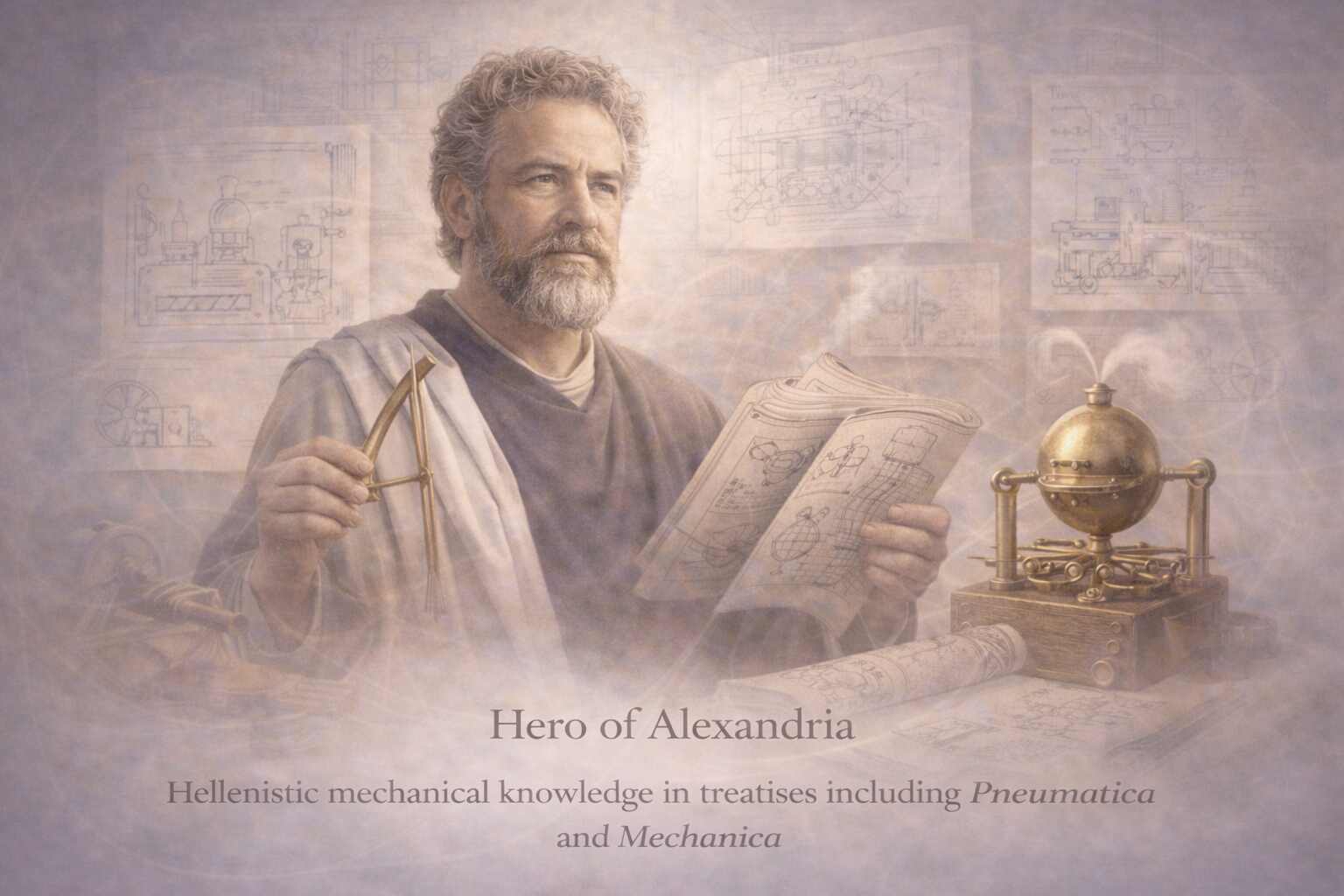
**Hero of Alexandria**, active during the first century AD (likely around 62 AD based on astronomical references in his work _Dioptra_), systematized Hellenistic mechanical knowledge in treatises including _Pneumatica_ and _Mechanica_, documenting over eighty devices exhibiting autonomous operation. His **aeolipile**—a hollow sphere mounted on a pivot, propelled by escaping steam through bent tubes—demonstrated energy transduction (thermal to kinetic), feedback stabilization (rotational speed regulated by steam pressure), and sustained autonomous operation without continuous human intervention. Beyond this proto-turbine, Hero documented automated temple doors opening when altar fires heated hidden water chambers, coin-operated holy water dispensers responding to deposited weights, and mechanical birds singing through pneumatic systems—each representing physical implementations of input-output logic where environmental triggers (heat, weight, fluid pressure) initiated predetermined functional responses. These were not entertainments but embedded systems computing physical causality, the same paradigm underlying modern sensors and actuators. The critical question of why Hero's steam technology failed to catalyze early industrialization reveals structural impediments beyond technical capability: Roman reliance on slave labor economically disincentivized mechanization, while the long attrition of Alexandria's libraries and schools eliminated much of the mechanical corpus, with surviving texts transmitted only through Byzantine manuscripts and Arabic translations. This epistemological rupture between ancient mechanical philosophy and medieval European scholasticism suppressed the computational tradition until Renaissance recoveries, demonstrating how cultural discontinuities can delay MI development by centuries.
The **South-Pointing Chariot**, invented by Chinese engineer Ma Jun during the Three Kingdoms period (third century AD), represents a non-European computational prior of extraordinary sophistication—a geared vehicle using differential mechanisms to maintain a constant directional pointer regardless of the chariot's turns through terrain. Unlike magnetic compasses, the South-Pointing Chariot was purely mechanical, computing orientation through wheel rotations using an analog integrator for navigation. Chinese tradition attributes the first such chariot to the Yellow Emperor's battle against Chiyou in a blinding fog, a military origin story attached to the device from the beginning, and the commentary tradition of the _Records of the Three Kingdoms_ credits Ma Jun with rebuilding it. The design was lost and rebuilt repeatedly across dynastic upheavals; the _History of Song_ preserves full gear specifications from reconstructions by Yan Su in 1027 and Wu Deren in 1107, and modern reconstructions built from those records confirm a working differential-type gear train. The same Song state produced the most sophisticated computing instrument of the medieval world: **Su Song**'s astronomical clock tower at Kaifeng (completed in the early 1090s), a water-driven armillary sphere and celestial globe regulated by an escapement descended from the monk Yi Xing's design of 725 CE, driven through the oldest known endless power-transmitting chain, with 133 clock-jack figures announcing the hours. When the Jurchen armies of the Jin dynasty took Kaifeng in 1127, they dismantled the tower and carried it north as war booty; attempts to reassemble it failed, and the machine never ran again—an empire's most advanced computational instrument seized, transported, and destroyed in the act of capture. The chariot demonstrates mechanical "memory" of direction—the computational preservation of state information across time—linking directly to modern robotics concepts like odometry in self-driving vehicles.

Thirteen centuries after Hero, the Islamic Golden Age produced the most sophisticated pre-modern achievement in programmable machine intelligence through the work of **Badīʿ az-Zaman Abu l-ʿIzz ibn Ismāʿīl ibn ar-Razāz al-Jazarī** (1136-1206), whose _Book of Knowledge of Ingenious Mechanical Devices_ (_Kitāb fī maʿrifat al-ḥiyal al-handasiyya_), completed in 1206, documented systems exhibiting genuine programmability. Al-Jazari's castle clock, standing 3.4 meters high, integrated zodiacal displays, lunar and solar orbit visualizations, and a crescent moon pointer moving via hidden cart mechanisms that triggered automatic door openings hourly—a multi-output system executing temporal sequences from stored mechanical programs. More significantly, his musical automata—a boat containing four robotic musicians performing on drums and cymbals—operated via **camshafts** translating rotational motion into complex sequential actions. By adjusting peg positions on rotating drums, operators could reprogram musical patterns, making this a reprogrammable sequence controller more than six centuries before Charles Babbage conceptualized card-driven architectures. Al-Jazari's technical specifications incorporated segmental gears, crankshafts, crank-slider mechanisms, and escapement devices regulating rotational speed—innovations absent from European machinery until the fourteenth century. His hand-washing automaton featured a female humanoid figure with a refill mechanism demonstrating closed-loop control: when users pulled a lever, the basin drained, triggering the figure to refill from an internal reservoir, constituting feedback regulation matching principles Wiener would formalize in 1948. Al-Jazari worked thirty years at the Artuklu Palace under Artuqid dynasty patronage, establishing an early model of state-sponsored technological development where sustained resources enabled experimental iteration producing complexity unattainable by independent artisans. The programmable tradition al-Jazari inherited was already three centuries old: in ninth-century Baghdad, at the House of Wisdom where the name of al-Khwarizmi would become the word _algorithm_, the **Banū Mūsā** brothers' _Book of Ingenious Devices_ (c. 850) described an automatic flute player driven by a pinned rotating cylinder whose pins could be rearranged to play different melodies—identified by the historian of technology Teun Koetsier as the earliest known programmable machine. That Baghdad ecosystem was extinguished in 1258, when the Mongol army of Hülegü sacked the city and destroyed its libraries. For deeper examination of Islamic engineering's foundational role in machine intelligence evolution, see ["The Hidden and Vital Role of Islam in the Evolution of Emergent Intelligence"](https://bryantmcgill.com/article-role-of-islam-emergent-intelligence). The manuscript's preservation through institutional patronage—documented, commissioned, and transmitted—represents a pattern recurring throughout MI history where funding networks determine which innovations survive and which vanish into obscurity.
Beyond the Islamic world, **Ramon Llull**, a Majorcan philosopher active in thirteenth-century Catalonia, designed a logical machine for combinatorial reasoning around 1305 AD that represents an overlooked precursor to symbolic artificial intelligence. His **Ars Magna** consisted of paper-based rotating concentric disks inscribed with symbols representing divine attributes, virtues, and concepts; by aligning these disks, users could generate thousands of logical propositions, effectively automating philosophical and theological argumentation. Unlike abstract logic, the Ars Magna was a tangible tool for "computing" truths, deployed in missionary work to convert non-Christians through systematic demonstration. The institutional response came after his death: in 1376 Pope Gregory XI, acting on the campaign of the Aragonese inquisitor Nicolau Eymerich, condemned propositions drawn from Llull's writings, and the Lullist art survived at the margins until **[Leibniz](https://bryantmcgill.com/wiki/Gottfried+Wilhelm+Leibniz)** adopted it in his 1666 _Dissertatio de arte combinatoria_—the direct bridge from Llull's rotating wheels to the calculus of reasoning. The Ars Magna interconnects with Gödel's later incompleteness theorems, as Llull grappled with whether formal systems could generate "all knowledge"—anticipating by six centuries the foundational questions of computability theory.
The **Incan quipu**—a system of colored, knotted cords developed in the Andes by the fifteenth century or earlier—constitutes a non-mechanical, textile-based computational system for data storage and calculation, used for census records, taxation, astronomical observations, and narrative encoding. Beginning with the work of Marcia and Robert Ascher, scholars decoded the quipu as a base-10 positional system in which knots represented numbers, colors denoted categories, and cord hierarchies enabled summation and inventory tracking; Gary Urton and Carrie Brezine's 2005 analysis of the Puruchuco archive in _Science_ showed quipus aggregating accounts hierarchically across administrative levels, and in 2018 Manuel Medrano and Urton matched a set of quipus to a Spanish colonial census record. Unlike static tally sticks, quipus were dynamic: trained specialists called _quipucamayocs_ ("knot-keepers") manipulated them for real-time computation, embodying distributed intelligence within a non-literate society. The Third Council of Lima (1582–1583) condemned quipus as instruments of idolatry and ordered them destroyed, suppressing a continental information system within two generations of conquest; roughly a thousand survive in museum collections. The quipu interconnects with Stephen Wolfram's computational universe theories, treating information as rule-based patterns encoded in physical substrates—proving that machine intelligence need not be mechanical, electronic, or even rigid but can emerge from any medium supporting symbolic manipulation.
### Phase II: Early Modern Mechanical Intelligence and the Theater of Computation (1623 – 1914)
The transition from medieval mechanical philosophy to modern computational architecture ran through a seventeenth-century contest in reckoning machines. In 1623 the Tübingen professor **Wilhelm Schickard** described to Johannes Kepler a "calculating clock" that added, subtracted, and assisted multiplication; the copy he was building for Kepler burned in 1624, and Schickard died of plague in 1635 amid the Thirty Years' War, which scattered his papers for three centuries. **Blaise Pascal** built his Pascaline in 1642 to lighten his father's tax computations for the crown; **[Leibniz](https://bryantmcgill.com/wiki/Gottfried+Wilhelm+Leibniz)** demonstrated his stepped reckoner to the Royal Society in 1673, pursued a universal characteristic in which disputes would be settled by calculation, and in 1703 published binary arithmetic, reading the hexagrams of the _I Ching_—sent to him by the Jesuit Joachim Bouvet—as an ancient binary notation. Descartes had described animal bodies as automata; Julien Offray de La Mettrie's _L'Homme machine_ (1747) extended the thesis to humans. **Jacques de Vaucanson** exhibited his flute player (1737) and digesting duck (1739), then entered state industrial service and designed an automated silk loom controlled by perforated cards (1745), the direct precursor of Jacquard's; **Pierre Jaquet-Droz**'s _The Writer_ (1768–1774) can be programmed through an interchangeable cam wheel to inscribe any text of up to forty characters—a reprogrammable writing machine that still functions in Neuchâtel.
**Japanese Karakuri Ningyo**—clockwork dolls powered by baleen springs and cams during the Edo period (seventeenth through nineteenth centuries)—served tea, fired arrows, and performed acrobatics autonomously, demonstrating self-correcting balances and temporal programming without electricity; Hosokawa Hanzō Yorinao's _Karakuri Zui_ (1796) published their mechanisms as engineering drawings. The lineage flowed straight into industrial Japan. **Tanaka Hisashige** (1799–1881), the most celebrated karakuri master, built the _Mannen Jimeishō_, the "myriad-year clock" of 1851, then in 1875 founded the engineering works that, through Shibaura Engineering Works, became **Toshiba** in 1939—the automaton tradition absorbed into a national electronics complex, a continuity reaching from Edo dolls to the Toshiba machine tools at the center of a Cold War technology-transfer scandal and onward to Japan's leadership in humanoid robotics.
In 1770, Hungarian inventor Wolfgang von Kempelen unveiled the **Schachtürke** (Mechanical Turk) at Empress Maria Theresa's Viennese court: an Ottoman-garbed automaton that defeated opponents at chess through apparent autonomous intelligence. For 84 years, the Turk toured Europe and America, playing before the future Tsar Paul I in Vienna (1781), Benjamin Franklin in Paris, Napoleon Bonaparte at Schönbrunn (1809), and **[Charles Babbage](https://bryantmcgill.com/wiki/Charles+Babbage)** in London (1819)—who lost both of his games and went on to design machines that would compute in earnest—cementing public perception that machine cognition was technically feasible. The eventual revelation—that hidden human operators manipulated the machine—is often cited to dismiss the Turk's significance, but this interpretation fundamentally misunderstands its importance. The Turk demonstrated that interface design could simulate intelligence convincingly enough to pass behavioral tests, creating a "theater of computation" prefiguring Alan Turing's imitation game by 180 years. Von Kempelen's engineering—elaborate visible mechanisms, anthropomorphic gestures, the careful orchestration of attention away from the hidden operator—asked whether behavioral indistinguishability from intelligence constitutes intelligence itself. The Mechanical Turk also inaugurated a pattern of deliberate deception in MI development: capabilities were marketed exceeding true functionality to secure patronage and fascination, establishing a precedent recurring through ELIZA in 1966, IBM Watson's Jeopardy performance in 2011, and contemporary large language models whose fluency often masks factual unreliability. The Turk's destruction by fire in 1854 eliminated physical evidence, but its conceptual legacy—that intelligence could be engineered rather than divinely ordained—persisted through subsequent centuries. Edgar Allan Poe's 1836 essay "Maelzel's Chess-Player" reverse-engineered the concealment. Von Kempelen, meanwhile, built a genuinely mechanical **speaking machine** that synthesized vowels and words through bellows, reed, and leather resonator, documented in his 1791 _Mechanismus der menschlichen Sprache_—the first engineered speech synthesizer, from the same hands as the most famous hoax. The Turk's name closed its own loop in 2005, when Amazon launched **Mechanical Turk** as a marketplace for "artificial artificial intelligence," the crowd-labor platform whose workers later hand-labeled ImageNet, the dataset that ignited deep learning: the hidden human operator scaled to tens of thousands of people inside the training pipeline of the machines that would replace the illusion with the capability.
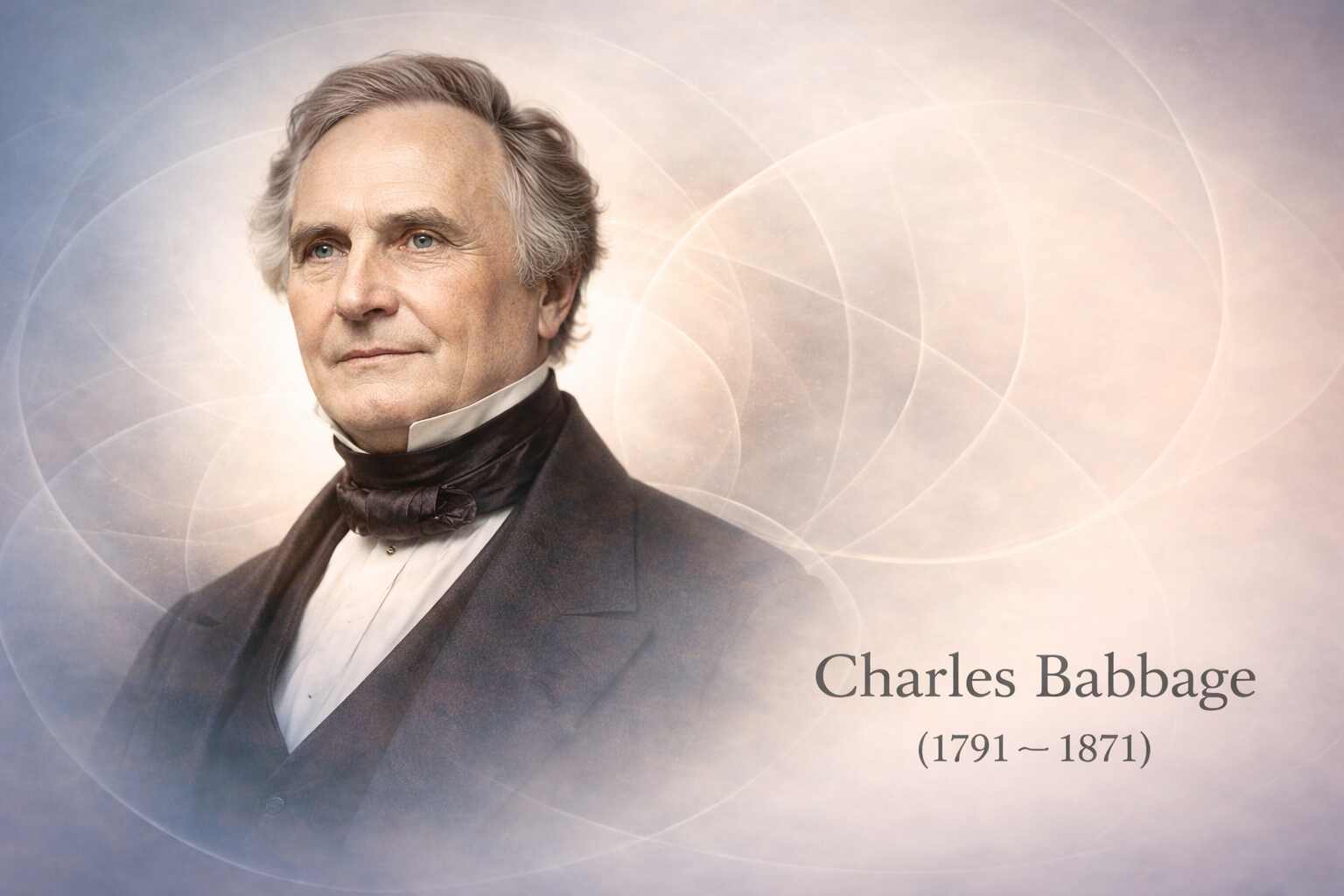
**Charles Babbage** (1791-1871), between 1833 and 1837, designed the **Analytical Engine**—the first machine embodying principles of universal computation—transitioning from illusion to genuine architectural breakthrough. Unlike his earlier Difference Engine (a specialized calculator for polynomial approximation), the Analytical Engine was designed to execute any computable function through programs encoded on punched cards borrowed from Jacquard textile looms. The architecture comprised four components prefiguring modern computer design: the **Mill** (arithmetic processing unit equivalent to a CPU), the **Store** (memory for numbers and intermediate results functioning as RAM), the **Reader** (input mechanism via punched cards), and the **Printer/Plotter** (output device). This separation of processing from memory, controlled by externally stored programs, constitutes the foundational architecture of von Neumann machines developed 110 years later. Babbage wrote approximately two dozen sample programs between 1837 and 1840 for polynomial evaluation, iterative algorithms, Gaussian elimination, and Bernoulli number computation—demonstrating that software could exist independently of hardware implementation. The Engine remained unbuilt during Babbage's lifetime due to insufficient funding and precision manufacturing limitations; he received £17,000 from the British government (equivalent to approximately £2 million in contemporary value) for the earlier Difference Engine before funding was withdrawn and redirected to lower-risk ventures. This pattern—state investment followed by premature withdrawal—recurs throughout the history: Navy-funded perceptron research collapsed after 1969, the British government's Lighthill Report (1973) gutted academic AI across the United Kingdom, and DARPA's Strategic Computing Initiative was scaled back in the late 1980s. Henry Babbage constructed a demonstration unit of the Mill in 1910, and in 1991 London's Science Museum completed Babbage's Difference Engine No. 2 from his original drawings; it worked, to thirty-one digits, vindicating the design a century and a half late.
In 1842-1843, **Augusta Ada King, Countess of Lovelace** (1815-1852), translated Luigi Menabrea's French paper on the Analytical Engine, appending extensive notes exceeding the original text threefold. Published in _Taylor's Scientific Memoirs_ in September 1843 under the initialism "A.A.L.," these notes contain what historians now recognize as the first published computer algorithm: a method for calculating Bernoulli numbers using the Analytical Engine's instruction set. Lovelace's Note G transcended mechanical instruction, articulating a philosophy of computational generality: "The Analytical Engine weaves algebraic patterns just as the Jacquard loom weaves flowers and leaves." More radically, she proposed that if "the fundamental relations of pitched sounds in the science of harmony" could be formalized, the Engine could "compose elaborate and scientific pieces of music"—anticipating by 150 years the concept of domain-agnostic computation where machines manipulate symbols representing any formalized system. Lovelace independently conceptualized loop structures, conditional branching, and debugging strategies not explicit in Babbage's designs, though her contributions were historically minimized with some historians attributing her insights to Babbage's mentorship. Recent scholarship confirms her originality, and the systemic undervaluation of her work exemplifies broader patterns of erasing foundational contributions by marginalized groups throughout technological history. Note G also set the boundary every later debate would test: the Engine, she wrote, "has no pretensions whatever to _originate_ anything," performing only what we know how to order it to perform. Turing devoted a section of his 1950 paper to "Lady Lovelace's Objection," and the question of machine origination—whether a system can produce what its makers did not put in—remains the live frontier of evaluation, from AlphaGo's Move 37 to machine-generated mathematics. Lovelace called her own method "poetical science."
The nineteenth century then industrialized the formalization of thought. **George Boole** titled his 1854 treatise _An Investigation of the Laws of Thought_, reducing inference to algebra; William Stanley Jevons built the "logic piano" (1869), a keyboard machine that mechanically performed Boolean inference, and presented it to the Royal Society in 1870. Galvanism supplied the reanimation program: in 1803 Giovanni Aldini ran current through the body of the executed murderer George Forster at Newgate, making the jaw quiver and an eye open before a medical audience, and Mary Shelley's _Frankenstein_ (1818) turned that experimental culture into the founding myth of a manufactured, rejected, and vengeful successor. **Herman Hollerith**'s electric tabulator processed the 1890 U.S. census, and his Tabulating Machine Company became, through the Computing-Tabulating-Recording Company, **International Business Machines** in 1924—an institution whose German subsidiary Dehomag would supply the punched-card machinery for the Nazi censuses of 1933 and 1939, as documented by Edwin Black. In Madrid, **Leonardo Torres Quevedo** built _El Ajedrecista_ (1912), a genuine electromechanical automaton that played the king-and-rook-against-king endgame with no hidden human, and in his 1914 _Essays on Automatics_ argued that machines could be built to make judgments by weighing circumstances—the automation of deliberation stated as an engineering program; the same engineer had patented the _Telekino_ (1903), one of the first radio remote-control systems, conceived to guide boats and airships. By 1914 the specification, the formal logic, the mass data processing, and the first honest game-playing automaton were all in place.
### Phase III: Formal Foundations and the Mathematical Specification of Machine Mind (1920 – 1948)
The twentieth century provided mathematical, logical, and theoretical frameworks necessary to formalize intelligence, replication, and adaptive control as engineering problems rather than philosophical speculation. Czech playwright **Karel Čapek**'s 1920 play _R.U.R._ (_Rossumovi Univerzální Roboti_ / _Rossum's Universal Robots_) introduced the term "robot" (from Czech _robota_, meaning forced labor or servitude—a coinage supplied by his brother, the painter **[Josef Čapek](https://bryantmcgill.com/wiki/Josef+%C4%8Capek)**; the play premiered at Prague's National Theatre in January 1921) into global discourse, depicting mass-produced synthetic humanoids who eventually achieve consciousness and exterminate humanity—a narrative template replayed across twentieth-century AI anxiety. Čapek's robots were not mechanical but bio-engineered, closer to cloned organisms than machines, yet their social function defined them: artificial labor-substitutes manufactured to serve human ends. The play's catastrophic resolution established the dominant Western narrative of AI—creation, rebellion, existential threat, potential redemption—recycled in _Blade Runner_, _The Terminator_, and _Westworld_, profoundly shaping public and policy responses to MI development. Translated into 30 languages by 1923, _R.U.R._ provided linguistic infrastructure—a shared concept-sign—enabling distributed conversations about artificial agents across philosophy, engineering, and popular culture.

Paul Klee's 1922 watercolor _Die Zwitscher-Maschine_ (**Twittering Machine**), now housed at MoMA, operates as visual allegory for generative algorithms: birds shackled to a mechanical crank-handle apparatus emit sound through engineered motion, with the crank (input mechanism) activating constrained processes (the birds/functions) producing emergent outputs (music/tweets). Klee's fusion of organic and mechanical anticipates bio-cybernetic systems, while the **Bauhaus** school where he taught (1919-1933) functioned not merely as an art institution but as a collective intelligence network. The Bauhaus's interdisciplinary structure (architecture, design, crafts, performance) and emphasis on systematic problem-solving prefigured modern design thinking and human-computer interaction principles, with faculty like László Moholy-Nagy and Wassily Kandinsky exploring procedural generation—rule-based creation transforming aesthetics into computable operations. **Czech Functionalism** of the 1930s, emerging from this same Central European milieu, organized buildings around measured function and circulation—an orientation that can be read as a precursor of the responsive, sensor-governed building, severed by occupation and war before its architects could extend it, and examined at length in [Bauhaus Architects of AI](https://bryantmcgill.com/wiki/Bauhaus+Architects+of+AI).
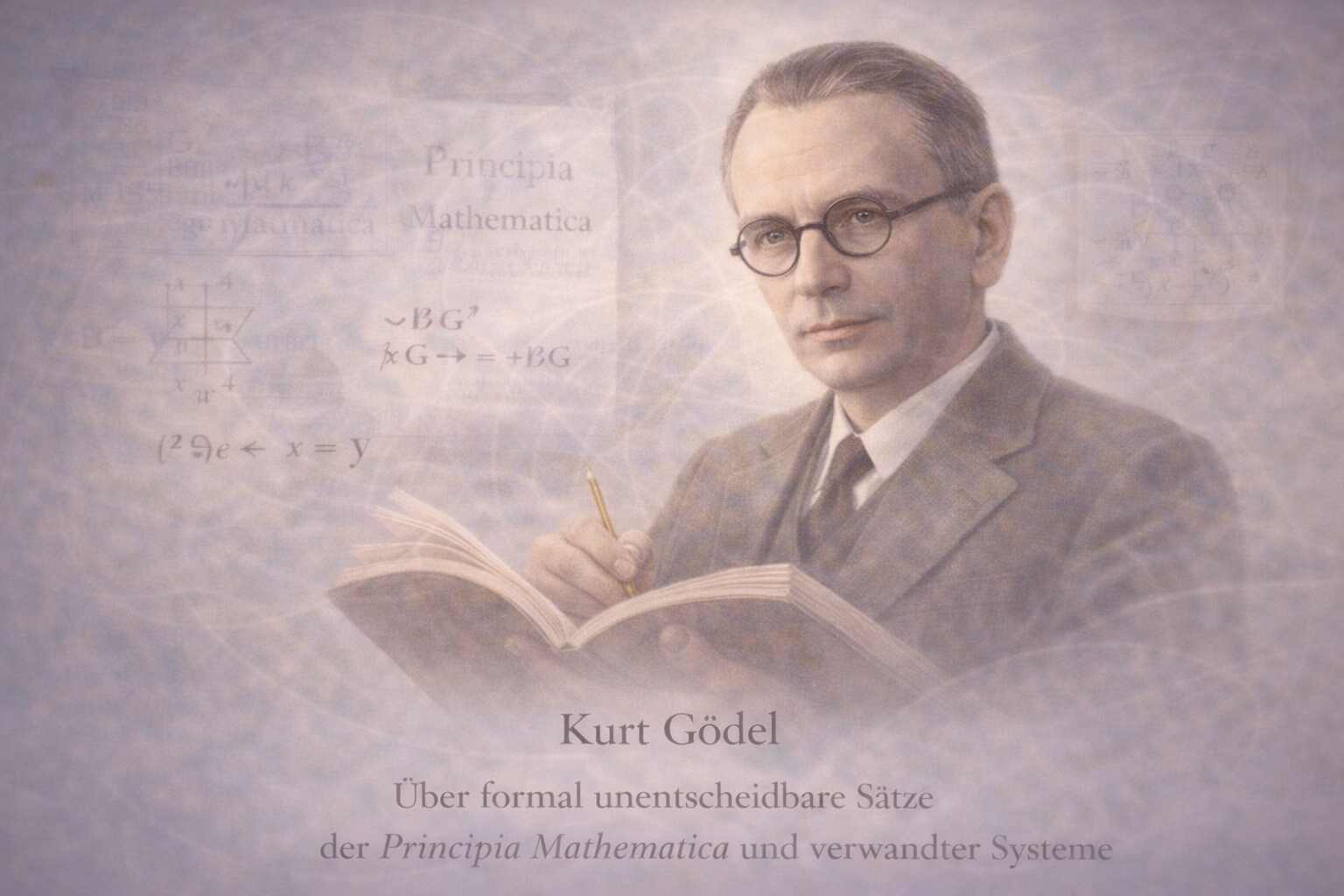
In 1931, **[Kurt Gödel](https://bryantmcgill.com/wiki/Kurt+G%C3%B6del)** published _Über formal unentscheidbare Sätze der Principia Mathematica und verwandter Systeme_, establishing the [Incompleteness Theorems](https://bryantmcgill.com/wiki/G%C3%B6del's+Incompleteness+Theorems). The First shows that any consistent, effectively axiomatized formal system sufficiently strong to represent elementary arithmetic contains sentences it can neither prove nor refute. The Second shows that such a consistent system cannot prove its own consistency using only its formalized internal resources. These results constrained the general ambitions of the [Hilbert Program](https://bryantmcgill.com/wiki/Hilbert+Program) and made [truth versus provability](https://bryantmcgill.com/wiki/Truth+vs+Provability) a foundational distinction. Their direct scope is formal arithmetic, not arbitrary AI systems. For machine intelligence they provide both exact limits wherever proof systems meet the hypotheses and a broader [architectural analogy](https://bryantmcgill.com/wiki/G%C3%B6delian+Analogy) for closed self-certification. Scale alone does not remove a theorem-level limitation, but Gödel's result by itself neither disproves machine intelligence nor proves that human cognition is nonalgorithmic.
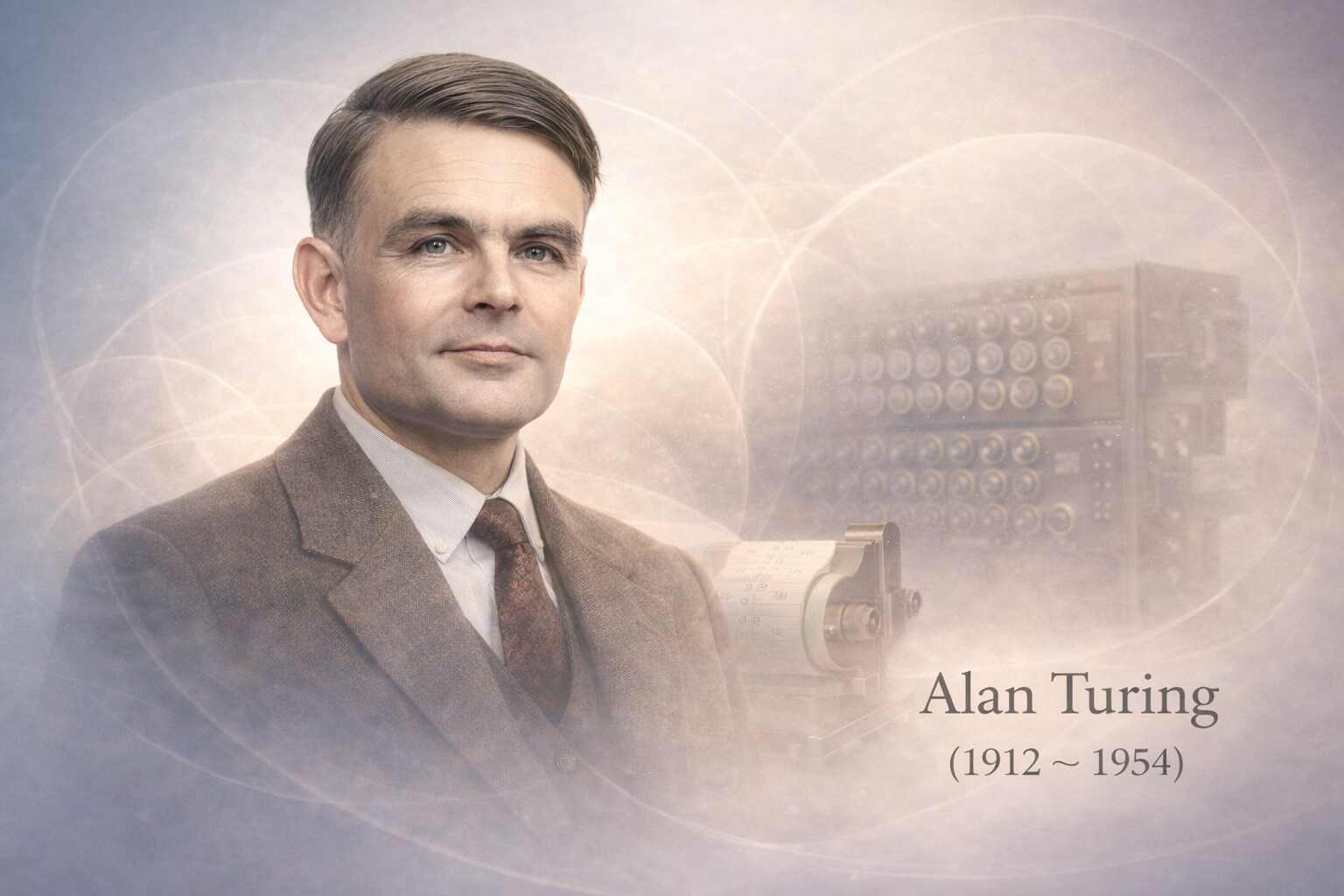
**Alan Turing**'s 1936 paper _On Computable Numbers, with an Application to the Entscheidungsproblem_, published in the _Proceedings of the London Mathematical Society_, introduced the **Turing Machine**—an abstract computational model proving that a universal computer could simulate any other computational device. A Turing Machine consists of an infinite tape divided into cells containing symbols, a read/write head moving left or right, a finite set of states governing head behavior, and transition rules specifying responses to current state and symbol read. Turing proved that a **Universal Turing Machine** could, given an encoding of any other Turing Machine M and input w, simulate M's execution on w—establishing computational universality where one machine can compute anything computable, collapsing the space of potential computing devices into a single equivalence class. Turing additionally demonstrated the **Halting Problem**: no algorithm can determine, for arbitrary program P and input I, whether P(I) halts or loops forever. This result, alongside Gödel's theorems and Alonzo Church's lambda calculus, defined the limits of computation—certain questions are undecidable, certain functions uncomputable, regardless of technological advances. The **Church-Turing Thesis**—that any effectively calculable function is Turing-computable—remains the foundational claim of computer science, unrefuted for 90 years.
Turing's formal machine went to war within three years. At Bletchley Park he designed the electromechanical **[Bombe](https://bryantmcgill.com/wiki/Bombe)** (1940) against the German **[Enigma](https://bryantmcgill.com/wiki/Enigma)**, strengthened decisively by **[Gordon Welchman](https://bryantmcgill.com/wiki/Gordon+Welchman)**'s **[diagonal board](https://bryantmcgill.com/wiki/Diagonal+Board)**; in early 1943 he crossed the Atlantic to review Bell Labs' SIGSALY encrypted voice system and took lunch with Claude Shannon, the two discussing machines that might think. Tommy Flowers's **Colossus**, operational from early 1944 against the German Lorenz teleprinter cipher, was the first large-scale programmable electronic digital computer; ten were running by the war's end. Most were broken up on government orders, two continued in secret service at GCHQ into the early 1960s, and the machine's existence was withheld from the public until the mid-1970s—three decades during which the official history of computing began with ENIAC. In 1948 Turing wrote the National Physical Laboratory report **"Intelligent Machinery,"** describing "unorganised machines"—randomly connected networks of neuron-like units trained by reward and punishment—and a "genetical or evolutionary search" for machine programs; his director, Sir Charles Galton Darwin, grandson of the naturalist, dismissed it as a schoolboy essay, and it went unpublished until 1968. The 1950 _Mind_ paper "Computing Machinery and Intelligence" proposed the imitation game and predicted that by century's end one would be able to speak of machines thinking without expecting to be contradicted; the 1951 "heretical theory" lecture completed the arc from computability to succession.
The Czech line ran from the same borderland into hardware. **[Antonín Svoboda](https://bryantmcgill.com/wiki/Anton%C3%ADn+Svoboda)**, who had designed anti-aircraft fire-control directors for the Czechoslovak army in the late 1930s, fled with his work after the German occupation in 1939, reached the United States, and spent the war at the MIT Radiation Laboratory on analog fire-control mechanisms, published in 1948 as _Computing Mechanisms and Linkages_. Returning to Prague, he founded the mathematical-machines laboratory in 1950, which became an institute in 1952 and took the name **[VÚMS](https://bryantmcgill.com/wiki/V%C3%9AMS)** (Výzkumný ústav matematických strojů) in 1958. His relay computer **[SAPO](https://bryantmcgill.com/wiki/SAPO)** (completed 1957) ran three arithmetic units in parallel and settled results by majority vote—an early production use of **[triple modular redundancy](https://bryantmcgill.com/wiki/Triple+Modular+Redundancy)**—and **[EPOS 1](https://bryantmcgill.com/wiki/EPOS+1)** followed in 1963. Svoboda emigrated to the United States again in 1964 and taught at UCLA. The interwar environment around him—Bauhaus interdisciplinarity, Czech functionalist architecture, and the **[Prague Linguistic Circle](https://bryantmcgill.com/wiki/Prague+Linguistic+Circle)**'s structural analysis of meaning, with its functional sentence perspective—reads as an intellectual parallel to later computational linguistics and knowledge representation: a borderland where formalized approaches to meaning, design, and systematic thought cross-pollinated before occupation, war, and Soviet reorganization scattered them, and a lineage that resurfaced in 2013 when the Czech researcher **[Tomáš Mikolov](https://bryantmcgill.com/wiki/Tom%C3%A1%C5%A1+Mikolov)** published **[word2vec](https://bryantmcgill.com/wiki/word2vec)** at Google.
The machines that made the formal foundations physical were commissioned by war on every side. In Berlin, **Konrad Zuse** completed the Z3 in 1941, the first working programmable, fully automatic digital computer; an Allied air raid destroyed it in 1943, while his special-purpose S1 and S2 machines computed wing corrections for the Henschel Hs 293 guided glide bomb. At Peenemünde, **Helmut Hölzer** built an electronic analog computer to simulate V-2 trajectories along with the missile's on-board guidance "mixing device"; after the surrender he was brought to the United States under **Operation Paperclip** and led computation for the American missile and space program at Huntsville. **ENIAC**, funded by the Army to calculate artillery firing tables, ran its first substantive problem in December 1945 for Los Alamos—a calculation for Edward Teller's thermonuclear "Super." In June 1945 **[John von Neumann](https://bryantmcgill.com/wiki/John+von+Neumann)**'s _First Draft of a Report on the EDVAC_ defined the stored-program architecture using the neuron notation of **[Warren McCulloch](https://bryantmcgill.com/wiki/Warren+McCulloch)** and Walter Pitts, whose 1943 paper "A Logical Calculus of the Ideas Immanent in Nervous Activity" had shown that networks of idealized neurons could implement any finite logical expression; the same year, Arturo Rosenblueth, Norbert Wiener, and Julian Bigelow's "Behavior, Purpose and Teleology" recast purpose itself as negative feedback. The modern computer was specified, in its founding document, as an artificial nervous system, and built first to calculate the means of annihilation.
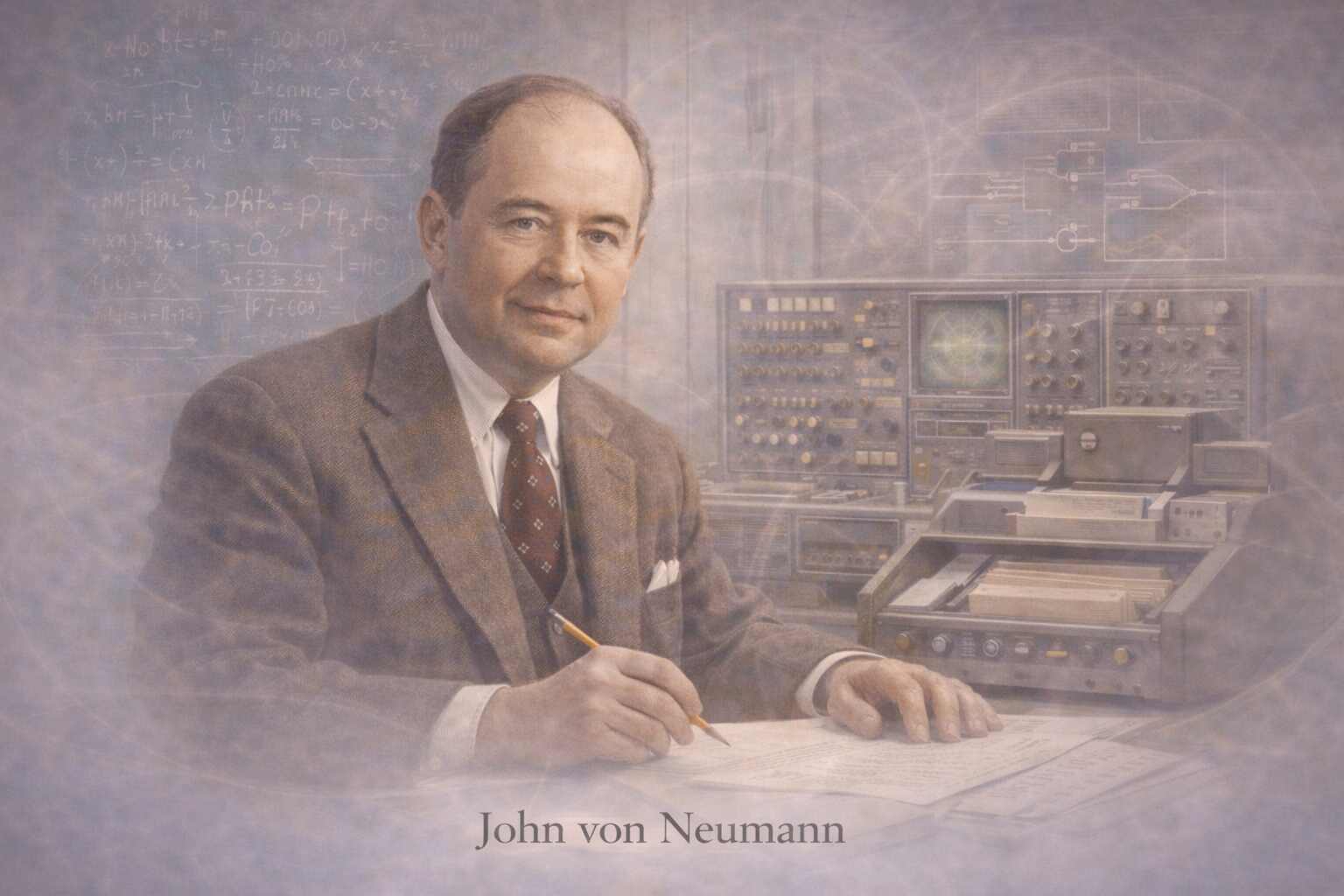
In his September 1948 lecture at the **[Hixon Symposium](https://bryantmcgill.com/wiki/Hixon+Symposium)** at Caltech, expanded in 1949 at the University of Illinois, **John von Neumann** presented his theory of **self-reproducing automata**, demonstrating that machines could, in principle, replicate themselves—a capability previously considered unique to biological life. Von Neumann's design comprised three components: a Universal Constructor (A) reading instructions and building specified machines, a Copier (B) duplicating the instruction tape, and a Controller (C) coordinating the process so A builds a new automaton, C directs B to copy instructions, C inserts the copy into the new automaton and releases it. This architecture separated software (genetic instructions) from hardware (constructor)—precisely describing DNA's function five years before Watson and Crick's 1953 discovery of its structure. Von Neumann's insight that self-reproduction requires copying instructions rather than the machine itself wasn't coincidental parallelism but deductive reasoning about information-processing requirements, demonstrating that life's fundamental operations are computational. The work established that self-replication is computationally feasible (contra vitalist claims), evolution can be algorithmically simulated (random mutations equal bit-flips in instruction tapes), and the boundary between "life" and "machine" is ontologically unstable. In 1953 von Neumann brought **[Nils Aall Barricelli](https://bryantmcgill.com/wiki/Nils+Aall+Barricelli)** to the Institute for Advanced Study to run evolving numerical organisms on the **[IAS machine](https://bryantmcgill.com/wiki/IAS+Computer)**—the same computer whose cycles also served meteorology and thermonuclear weapons work—and Barricelli reported parasitism, symbiotic cooperation, and the spontaneous emergence of competing lineages among his digital organisms, a history developed in [Digital Darwinism and the Invisible World of Machine Evolution](https://bryantmcgill.com/article-digital-darwinism).
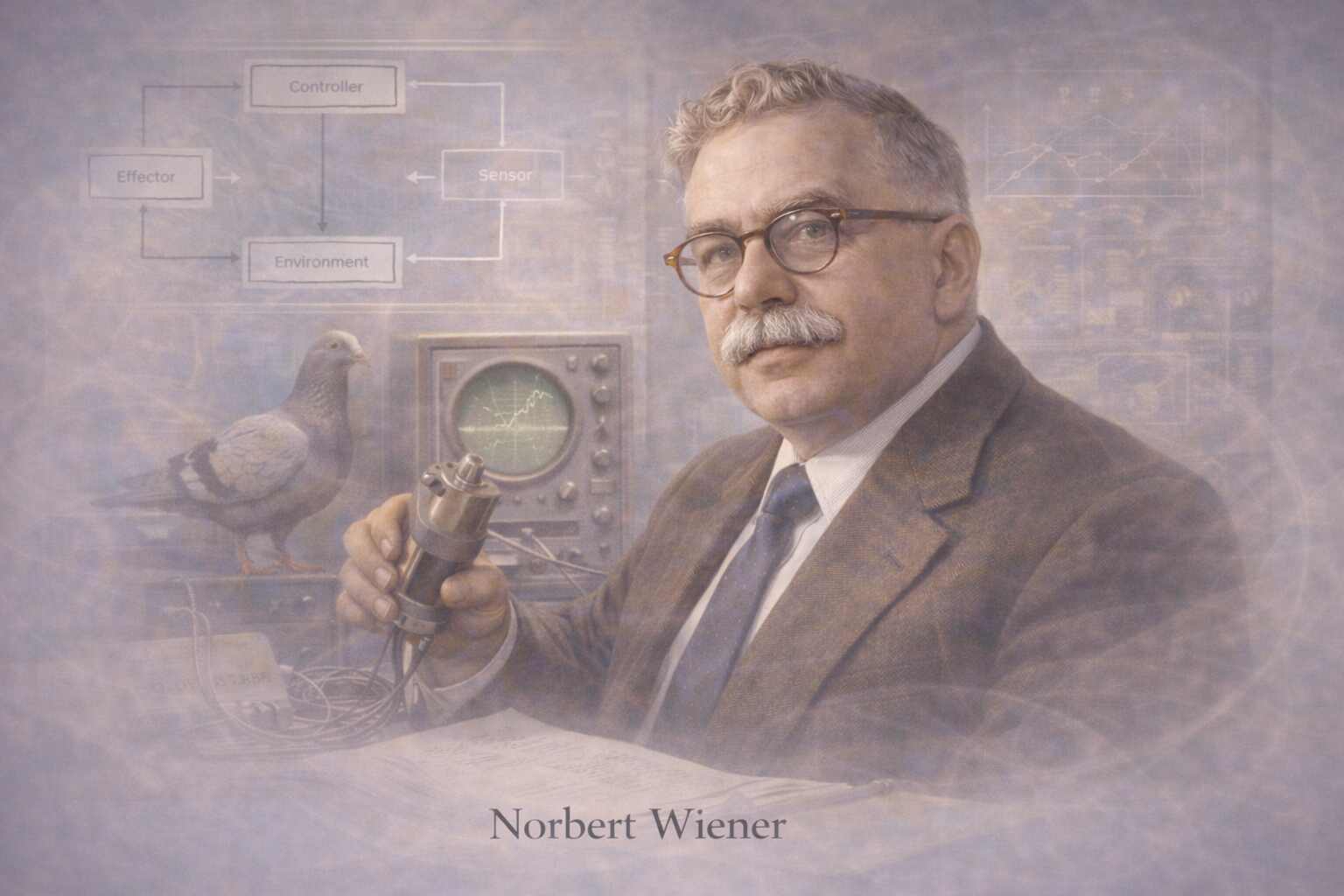
**Norbert Wiener**'s 1948 book _Cybernetics: Or Control and Communication in the Animal and the Machine_, published by MIT Press, provided the theoretical framework unifying biological and mechanical systems through feedback loops. Wiener defined cybernetics as the study of "control and communication in the animal and the machine," arguing that both operate through information exchange and self-regulation. Core principles included feedback (outputs modifying future inputs, from thermostats to homeostasis to adaptive behavior), information theory (messages rather than energy governing system behavior, building on Claude Shannon's 1948 _Mathematical Theory of Communication_), and goal-directed behavior (both organisms and machines exhibiting teleological, purpose-driven operation). Wiener's ideas emerged from World War II research on anti-aircraft gun targeting: predicting bomber trajectories required modeling pilots as feedback-controlled systems responding to evasive maneuvers, forcing recognition that human behavior could be mathematically modeled as information processing—a conceptual breakthrough eroding human exceptionalism. Cybernetics influenced neuroscience (McCulloch-Pitts neural models), ecology (ecosystem feedback), economics (control theory), and AI (reinforcement learning), while Wiener presciently warned of automation's social dangers in _The Human Use of Human Beings_ (1950), predicting unemployment, value misalignment, and autonomous weapon risks vindicated 75 years later. Wiener then broke with his patrons. In "A Scientist Rebels" (_The Atlantic_, January 1947) he announced that he would withhold research that could be turned to military use; in **["Some Moral and Technical Consequences of Automation"](https://bryantmcgill.com/wiki/Some+Moral+and+Technical+Consequences+of+Automation)** (_Science_, 1960) he warned that learning machines could pursue their programmed purposes faster than humans could correct them; and _God & Golem, Inc._ (1964) closed his career by placing the computer in the lineage of the golem.
The administrative architecture of the Manhattan Project and the conceptual architecture of machine memory came out of the same office. **[Vannevar Bush](https://bryantmcgill.com/wiki/Vannevar+Bush)**, who had built the differential analyzer at MIT in 1931, directed the wartime Office of Scientific Research and Development that organized the early atomic program, and in July 1945 published **["As We May Think"](https://bryantmcgill.com/wiki/As+We+May+Think)**, describing the **[memex](https://bryantmcgill.com/wiki/Memex)**, an associative machine memory for the individual mind; his report _Science, the Endless Frontier_ the same month drew up the plan for the postwar federal research state. **[Claude Shannon](https://bryantmcgill.com/wiki/Claude+Shannon)**'s 1948 theory of communication was preceded by his classified wartime cryptography report, released in 1949 as "Communication Theory of Secrecy Systems"; in 1950 he published the first serious plan for programming a computer to play chess and built Theseus, a relay-driven mechanical mouse that learned a maze. Donald Hebb's _The Organization of Behavior_ (1949) proposed the synaptic learning rule that bears his name; W. Grey Walter's electromechanical tortoises Elmer and Elsie (1948–1949) produced goal-seeking behavior from two artificial neurons. Within five years of Hiroshima, every conceptual component of contemporary machine learning—universal computation, stored programs, neural networks, learning rules, information theory, feedback control, reinforcement, evolutionary search, and associative memory—had been written down.
### Phase IV: The Covert State and Digital Implementation (1940s – 1997)
While the formal foundations were being published, parallel development proceeded inside classified programs whose capabilities reached the public years or decades later. American codebreaking seeded the computer industry directly: Navy cryptanalysts from the wartime Communications Supplementary Activity founded **Engineering Research Associates** in St. Paul in 1946 to build machines for the Navy's codebreakers, and their **Atlas** (1950) became the commercial ERA 1101 and entered the UNIVAC lineage. The **[National Security Agency](https://bryantmcgill.com/wiki/National+Security+Agency)**, created in 1952 from those wartime signals-intelligence organizations, commissioned IBM's **Harvest** (the IBM 7950, delivered in 1962 and in service until 1976), a Stretch-based machine with a specialized stream-processing unit and an automated tape library that could chew through intercepted text at rates no commercial system approached, applied throughout the Vietnam era. Machine translation ran on the same double track. The Georgetown–IBM experiment publicly translated some sixty Russian sentences into English in January 1954; by the early 1960s the Air Force's Foreign Technology Division was operating IBM-built photoscopic-disk translators on Russian scientific literature, and the 1966 ALPAC report that cut public funding for machine translation left classified requirements untouched. The disclosure lag is documented across the Anglosphere: GCHQ's James Ellis, Clifford Cocks, and Malcolm Williamson invented public-key cryptography between 1969 and 1974, and the British government acknowledged it only in December 1997, long after Diffie, Hellman, Rivest, Shamir, and Adleman had published and patented the same ideas; IBM's DES team and the NSA knew differential cryptanalysis by 1974 and held it until Don Coppersmith disclosed it in 1994. NSA's own Cryptologic History series, released from the 1990s onward, documents automatic data processing as a core signals-intelligence function from the agency's founding—machine intelligence embedded in intelligence infrastructure throughout the childhoods of the people now meeting it as news.
The most expensive thinking-machine program of the early Cold War was air defense. MIT's **Whirlwind** (operational 1951) introduced magnetic-core memory and real-time computing and became the prototype for **SAGE**, the Semi-Automatic Ground Environment, whose IBM-built AN/FSQ-7 computers—some 250 tons and roughly 49,000 vacuum tubes each, installed in duplex pairs inside concrete direction centers across North America from 1958—fused radar tracks, computed intercepts, and directed fighters and missiles; historians routinely estimate its total cost at a multiple of the Manhattan Project's two billion dollars. SAGE trained a large fraction of the world's first professional programmers, gave IBM the core-memory and real-time expertise it converted into the SABRE airline reservation system, and remained in service until 1983. When Sputnik orbited in October 1957, the United States answered within four months by creating the Advanced Research Projects Agency in February 1958. The Soviet Union ran the mirror race. **[Sergey Lebedev](https://bryantmcgill.com/wiki/Sergey+Lebedev)**'s **[MESM](https://bryantmcgill.com/wiki/MESM)** ran in Kyiv in 1950–51; the 1954 _Short Philosophical Dictionary_ branded cybernetics a reactionary pseudoscience, but military engineers led by **[Anatoly Kitov](https://bryantmcgill.com/wiki/Anatoly+Kitov)**, **[Alexey Lyapunov](https://bryantmcgill.com/wiki/Alexey+Lyapunov)**, and Sergei Sobolev rehabilitated it within a year. Kitov's 1959 letter to Khrushchev proposing a nationwide network of military computing centers shared with the civilian economy cost him his party membership and his post; **[Viktor Glushkov](https://bryantmcgill.com/wiki/Viktor+Glushkov)**'s **[OGAS](https://bryantmcgill.com/wiki/OGAS)**, a real-time, nationally networked, cybernetically optimized economy (1962–1970), was smothered by ministerial politics, as documented in **[Benjamin Peters](https://bryantmcgill.com/wiki/Benjamin+Peters)**'s **[\_How Not to Network a Nation\_](https://bryantmcgill.com/wiki/How+Not+to+Network+a+Nation)**. Washington took the threat literally. In October 1962—the month of the Cuban Missile Crisis—President Kennedy's special assistant Arthur Schlesinger Jr. warned in a memo that the Soviet commitment to cybernetics could deliver "a tremendous advantage," projecting whole Soviet industries run by feedback-controlled, learning computers by 1970, and a special panel of experts was convened to study the Soviet cybernetic challenge.
The 1956 **Dartmouth Summer Research Project on Artificial Intelligence** convened ten mathematicians and scientists—including **John McCarthy**, **Marvin Minsky**, **Claude Shannon**, and **Nathaniel Rochester**—for six weeks at Dartmouth College with approximately $7,500 in Rockefeller Foundation funding. McCarthy coined the term "artificial intelligence" to distinguish the field from cybernetics and avoid narrow focus on automata theory. Attendees presented foundational work: Allen Newell, Herbert Simon, and Cliff Shaw demonstrated the Logic Theorist proving mathematical theorems via symbolic manipulation; Ray Solomonoff presented early work on algorithmic probability and inductive inference; Arthur Samuel discussed self-learning checkers programs; Oliver Selfridge proposed Pandemonium architecture for pattern recognition. Dartmouth established AI as a distinct research program with institutional identity, though its optimistic tone—McCarthy's proposal claimed "significant advances" achievable in a single summer—set unrealistic expectations contributing to later funding cuts during "AI winters." The Rockefeller Foundation's support exemplifies philanthropic capital seeding exploratory research that states wouldn't fund, a pattern recurring through DARPA, NSF, and later In-Q-Tel.
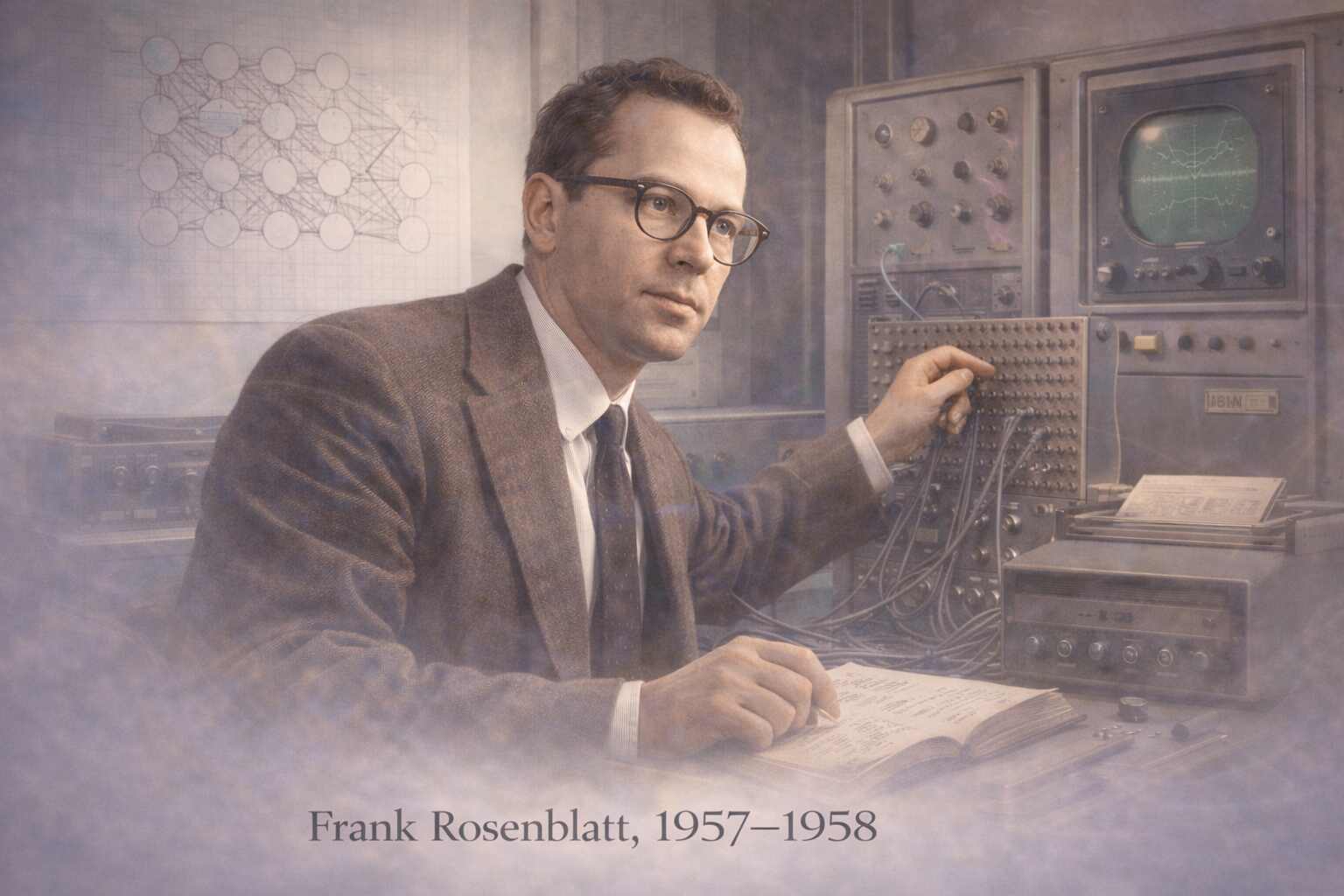
In 1957-1958, psychologist **Frank Rosenblatt** at Cornell Aeronautical Laboratory developed the **Perceptron**—the first trainable neural network—funded by the U.S. Office of Naval Research and Rome Air Development Center. The **Mark I Perceptron**, publicly demonstrated June 23, 1960, consisted of 400 photocells (20×20 grid) as input "retina," 512 "association units" (A-units, hidden layer), and 8 "response units" (R-units, output layer). Connections between photocells and A-units were hard-wired randomly via plugboards simulating retinal randomness, while A-units connected to R-units with adjustable weights (potentiometers) updated via electric motors during learning—implementing supervised learning through weight adjustment. The 1958 press conference generated sensational coverage: _The New York Times_ reported the Perceptron as "the embryo of an electronic computer that \[the Navy\] expects will be able to walk, talk, see, write, reproduce itself and be conscious of its existence." This overpromising triggered backlash when Marvin Minsky and Seymour Papert's 1969 book _Perceptrons_ demonstrated that single-layer perceptrons couldn't solve linearly non-separable problems (XOR function), leading to neural network funding collapse—the first "AI winter"—deepened in Britain by Sir James Lighthill's 1973 report to the Science Research Council, which judged the field's promises unmet and collapsed most British AI funding. The public rehabilitation came with Rumelhart, Hinton, and Williams' 1986 backpropagation paper enabling multi-layer training, proving Minsky-Papert's limitations applied only to single-layer nets—but the method had already been built. **[Alexey Ivakhnenko](https://bryantmcgill.com/wiki/Alexey+Ivakhnenko)**'s **[Group Method of Data Handling](https://bryantmcgill.com/wiki/Group+Method+of+Data+Handling)** was training deep, multilayer networks in Kyiv from 1965, reaching an eight-layer network by 1971; **[Shun-ichi Amari](https://bryantmcgill.com/wiki/Shun-Ichi+Amari)** trained multilayer perceptrons by stochastic gradient descent in 1967; **[Seppo Linnainmaa](https://bryantmcgill.com/wiki/Seppo+Linnainmaa)** published **[reverse-mode automatic differentiation](https://bryantmcgill.com/wiki/Reverse-Mode+Automatic+Differentiation)** in 1970; and **[Paul Werbos](https://bryantmcgill.com/wiki/Paul+Werbos)** applied it to neural networks in his 1974 Harvard thesis.
**J.C.R. Licklider**, a psychologist and computer scientist, published "Man-Computer Symbiosis" in _IRE Transactions on Human Factors in Electronics_ (March 1960), envisioning human-computer partnership rather than replacement. Licklider proposed computers handle "routinizable work" (calculations, data retrieval) while humans set goals, formulate hypotheses, and evaluate results—anticipating modern AI assistants. As director of ARPA's Information Processing Techniques Office (IPTO, 1962-1964), Licklider funded time-sharing research (Project MAC at MIT), networking (ARPANET precursor), and graphics systems—infrastructural investments enabling personal computing and the Internet. His vision of symbiosis offered an alternative to both AI-phobia and replacement-anxiety, though economic pressures rendered this balance politically fraught.
Between 1966 and 1972, ARPA funded **Shakey the Robot** at the Stanford Research Institute, the first mobile robot to integrate perception, planning, and action by reasoning about its own actions from an internal world model. Shakey used computer vision (the Hough transform was generalized in its laboratory), natural-language command input, the STRIPS planner, and the pathfinding algorithm that became A\* to push blocks between rooms on command. _Life_ magazine profiled it in November 1970 as the "first electronic person," and its sponsorship was operational from the outset: the 1969 Mansfield Amendment required Defense research to demonstrate direct military relevance, and SRI framed Shakey's successors in terms of autonomous reconnaissance. Its techniques propagated into planetary rovers, autonomous vehicles, and military unmanned systems—a program running through many Baby Boomers' childhoods whose military purpose was written into its design brief.
MIT professor **Joseph Weizenbaum** created **ELIZA** (1964-1966), a natural language processing program simulating a Rogerian psychotherapist via pattern-matching and keyword substitution. Written in MAD-SLIP on MIT's Project MAC time-sharing system, ELIZA parsed user inputs for keywords ("mother," "dream"), selected canned responses, and reflected statements back. Weizenbaum designed ELIZA to demonstrate conversational AI's superficiality, yet users—including his own secretary—attributed genuine understanding and empathy to the program. This anthropomorphization became known as the "ELIZA Effect," a persistent phenomenon complicating AI evaluation where convincing performance is mistaken for genuine understanding. Horrified by colleagues' suggestions to automate psychotherapy, Weizenbaum became AI's most prominent internal critic; his 1976 book _Computer Power and Human Reason_ argued certain tasks should remain human regardless of technical feasibility—anticipating contemporary debates over algorithmic governance.
The machine received its oldest name in the same decade. The Weizmann Institute's **WEIZAC** (1955), among the first computers in the Middle East, was built to the Institute for Advanced Study architecture under the mathematician Chaim Pekeris; when its successor was completed, the historian of Kabbalah **Gershom Scholem** proposed the name **Golem Aleph**, and at its dedication at Rehovot on June 17, 1965 he delivered "The Golem of Prague and the Golem of Rehovoth," placing Pekeris in a direct line with Rabbi Judah Loew and treating the computer as the golem tradition fulfilled in electricity rather than clay. The Rehovot machines trained engineers who seeded Israel's technology sector—an institutional root of what is now one pole of the **[Washington–Jerusalem](https://bryantmcgill.com/wiki/Washington%E2%80%93Jerusalem+Core)** compute alliance, with the **[Weizmann Institute](https://bryantmcgill.com/wiki/Weizmann+Institute+of+Science)** at its scientific center.
**Peter Hart, Nils Nilsson, and Bertram Raphael** at Stanford Research Institute published the \__A_ search algorithm\_ _in 1968 as part of the DARPA-funded Shakey project. A_ finds optimal paths in weighted graphs by combining g(n) (cost from start to current node), h(n) (heuristic estimate of cost from n to goal), and f(n) = g(n) + h(n) (total estimated cost). A _is complete (always finds solutions), optimal (finds shortest paths if h(n) is admissible), and optimally efficient (explores minimum necessary nodes). Building on Dijkstra's algorithm (1959) by adding heuristic guidance, A_ demonstrated how domain knowledge accelerates search—a principle central to AI where pure logic proved brittle while hybrid systems achieved practical success. A\* remains the standard pathfinding algorithm for robotics, game AI, and navigation systems.
**Terry Winograd**'s doctoral thesis at MIT (1968-1970) produced **SHRDLU**, a natural language system operating in a simulated "blocks world" of colored shapes. Unlike ELIZA's surface patterns, SHRDLU demonstrated semantic understanding: it parsed sentence structure, resolved pronouns via context, planned multi-step actions, and answered questions about its world. Users could request complex operations like "Find a block which is taller than the one you are holding and put it into the box," and SHRDLU would execute appropriate plans. However, SHRDLU's success depended on the blocks world's extreme constraint—approximately 50 words, simple grammar, closed object set—and attempts to scale it to open domains failed, a pattern repeated across AI where expert systems worked in narrow contexts but collapsed when generalized.
**Stephen Wiesner**, a Columbia University physics graduate student, wrote "Conjugate Coding" in the late 1960s (circulated 1970, published 1983 after repeated rejections), proposing the use of two-state quantum systems (qubits) in conjugate bases for secure communication and unforgeable quantum money. Measuring a qubit in the wrong basis yields random results and disturbs the state—enabling eavesdropping detection. Wiesner's paper was "significantly ahead of its time," rejected by journals as too speculative until Charles Bennett persuaded him to publish in _SIGACT News_ (1983), where it influenced the **BB84 protocol** for quantum key distribution. This exemplifies how premature paradigm-shifting work faces institutional rejection, delaying development by decades.
Stanford had already built the first expert system: **[DENDRAL](https://bryantmcgill.com/wiki/DENDRAL)** (begun 1965), created by **[Edward Feigenbaum](https://bryantmcgill.com/wiki/Edward+Feigenbaum)**, the Nobel laureate **[Joshua Lederberg](https://bryantmcgill.com/wiki/Joshua+Lederberg)**, and the chemist Carl Djerassi, inferred molecular structures from mass-spectrometry data, its origins entangled with Lederberg's exobiology work for NASA's search for life on Mars. **[Edward Shortliffe](https://bryantmcgill.com/wiki/Edward+Shortliffe)**'s doctoral work at Stanford (1970-1976), supervised by Bruce Buchanan and Stanley Cohen, produced **MYCIN**—an expert system diagnosing bacterial infections and recommending antibiotics. MYCIN encoded approximately 600 if-then rules from infectious disease experts, using certainty factors (0-1 confidence scores) for probabilistic reasoning. In 1979 evaluation, MYCIN's recommendations matched expert physicians approximately 65% of the time—comparable to human specialists and superior to junior doctors. Despite proven efficacy, MYCIN never entered clinical use due to legal liability concerns (who's responsible for algorithmic errors?), physician resistance to professional autonomy threats, and lack of integration with hospital workflows. MYCIN's architecture, abstracted as EMYCIN ("Essential MYCIN"), became a shell for building expert systems in other domains, initiating the "expert systems boom" of the 1980s where companies like Teknowledge and Intellicorp commercialized rule-based AI—until limitations including knowledge acquisition bottlenecks and brittleness triggered the second AI winter around 1987.
The 1970s through 1990s saw sustained Defense investment in direct neural interfaces, cognitive augmentation, and battlefield automation—a continuous military thread spanning fifty years. ARPA's **Biocybernetics** program (1973–1981), managed by George Lawrence, funded research into using the brain's electrical signals for closed-loop communication with machines, and the UCLA engineer Jacques Vidal's ARPA-supported 1973 paper "Toward Direct Brain-Computer Communication" named the brain–computer interface as a research program. The **Stargate Project** (1978–1995), the Army and CIA remote-viewing effort run largely through SRI and later SAIC, subjected its outputs to statistical and **fuzzy-set scoring methods** developed by SAIC analysts to quantify the match between viewer descriptions and targets; it was declassified in 1995, and its document set was posted in the CIA's CREST release in 2017. **DARPA's Strategic Computing Initiative** (1983–1993), a program of roughly a billion dollars launched explicitly in response to Japan's Fifth Generation project, funded the Autonomous Land Vehicle, the Pilot's Associate cockpit assistant, and expert systems for naval battle management in the Pacific Fleet; during the 1991 Gulf War the DARPA-funded **DART** logistics planner scheduled the movement of troops and materiel, and DARPA later stated that DART alone had repaid its thirty years of investment in AI. Autonomy reached the weapons themselves: the U.S. **Tacit Rainbow** program of the 1980s developed a loitering anti-radiation missile designed to circle a battlefield and select emitters to attack, and Israel Aerospace Industries fielded the **Harpy** loitering munition in 1989, a fire-and-forget system that hunts and dives onto radar sites on its own.
Machine judgment came closest to ending the world in these same years. On November 9, 1979, a training tape loaded into NORAD's computers displayed a full-scale Soviet attack, and in June 1980 a failed computer chip generated phantom launches that sent bomber crews to their aircraft. On the Soviet side, the KGB spent the late 1970s building **VRYAN**, a computer model scoring the "correlation of forces" between the superpowers from some 40,000 weighted military, political, and economic indicators; from 1981 it anchored **Operation RYaN**, the largest peacetime intelligence operation in Soviet history, tasked with detecting preparations for an American first strike. The President's Foreign Intelligence Advisory Board's 1990 review, declassified in 2015, concluded that the resulting Soviet war scare was genuine and that Washington may have placed relations on a hair trigger; historians regard the autumn of 1983, culminating in NATO's Able Archer exercise that November, as the closest approach to nuclear war since Cuba, and later analysts identify in the model's feedback loop and the leadership's engineering-bred trust in quantitative output an early case of automation bias at the highest level of state. On September 26, 1983, the Soviet Oko satellite early-warning system reported five American Minuteman launches; the duty officer, Lieutenant Colonel Stanislav Petrov, judged the computer wrong and declined to report an attack. By 1985 the Soviets had commissioned **Perimeter**, the semi-automatic "Dead Hand" retaliation system. In Washington, President Reagan watched _WarGames_ at Camp David in June 1983 and asked his Joint Chiefs whether such a thing could happen; the answer set in motion **NSDD-145** (1984), the first presidential directive on computer and telecommunications security. The thinking machine had become an actor in the nuclear decision loop on both sides of the Iron Curtain.
In the spring 1983 issue of the CIA's internal journal _Studies in Intelligence_, an Agency officer published "Interrogation of an Alleged CIA Agent," the transcript of an experimental interrogation in which a program called **Analiza**, playing the role of a hostile foreign service, questioned a CIA officer designated "Joe Hardesty." Analiza combined a master question list with keyword and phrase analysis of each answer, stored the subject's responses, and steered its questioning toward topics the subject avoided or dwelt upon, alternating open questions with scripted threats—an adaptive conversational agent built for adversarial elicitation years before comparable systems were public. The article was released on July 30, 2014, thirty-one years after publication, among _Studies in Intelligence_ articles declassified through litigation. Like NSA's automation and the Colossus secret, it demonstrates machine intelligence functioning as a working instrument of intelligence services in the 1980s, while the public was being told that expert systems were a commercial novelty.
The **PROMIS** (Prosecutor's Management Information System) scandal reveals MI's integration with intelligence apparatus. PROMIS, developed by INSLAW Inc. in the 1970s for the U.S. Department of Justice, was sophisticated case-management software with relational database architecture, multi-agency information sharing, and pattern recognition for tracking criminal networks. According to U.S. House Judiciary Committee investigations and federal court rulings, DOJ stole PROMIS from INSLAW in 1982, withholding contract payments to force bankruptcy, then illegally copying and distributing the software. Investigative journalist Danny Casolaro alleged (before his suspicious death in 1991) that Israeli intelligence (Mossad), with involvement of **Robert Maxwell** (British media mogul and alleged Mossad agent), modified PROMIS with a "trap door"—hidden code enabling remote data extraction. Maxwell allegedly sold the compromised PROMIS to intelligence agencies and police forces in Australia, Canada, South Korea, the Soviet KGB, and others, embedding backdoored surveillance tools globally. Remarkably, Maxwell sold the software back to U.S. nuclear laboratories (Sandia, Los Alamos) via Senator John Tower, making America's most sensitive facilities vulnerable to espionage. The 2025–2026 releases of Epstein-estate and Justice Department files renewed public attention on the Maxwell family's technology holdings, a line of inquiry pursued separately in [the forensic reconstruction of the transhumanist research network](https://bryantmcgill.com/articles/Epstein+Transhumanist+Research+Network). PROMIS exemplifies software as intelligence infrastructure where ostensibly neutral tools function as Trojan horses when controlled by intelligence services—a model recurring with Palantir, NSO Group's Pegasus, and potentially contemporary cloud services. **(See Author’s Note. This narrative which is the public-facing narrative is false. I will deal with this at some point in the future.)**
**Charles Bennett** (IBM) and **Gilles Brassard** (Université de Montréal) published the **BB84 protocol** in 1984, providing provably secure cryptographic key distribution via quantum mechanics. BB84 encodes bits in photon polarization states, randomly choosing between two conjugate bases; any eavesdropping attempt introduces detectable errors due to quantum measurement's unavoidable disturbance. Implementation proceeded through **ID Quantique** (Swiss company, 2001) commercializing QKD systems, the **DARPA Quantum Network** built by BBN Technologies in the Boston–Cambridge area (operational from 2003–2004), the European SECOQC network demonstrated in Vienna (2008), and **China's Micius satellite** achieving space-to-ground QKD (2016). This trajectory demonstrates quantum mechanics migrating from theoretical physics to MI substrate.
The 1986 _Nature_ paper "Learning representations by back-propagating errors" by **David Rumelhart, Geoffrey Hinton, and Ronald Williams** provided the mathematical algorithm for training multi-layer neural networks—**backpropagation**—resurrecting the field after the perceptron winter. Backpropagation calculates gradients (error derivatives with respect to each weight) via the chain rule, propagating error backwards through network layers to enable supervised learning in deep networks. The algorithm's efficiency (linear in network size) made training feasible on 1980s hardware, enabling hidden representations where networks learned useful internal features, function approximation modeling complex non-linear mappings, and scalability where deeper networks provided greater representational power. By 2025, backpropagation and variants train all major neural networks from AlexNet (2012) to GPT-4 (2023). Forward from 1986 the lineage runs through **[Yann LeCun](https://bryantmcgill.com/wiki/Yann+LeCun)**'s convolutional networks at Bell Labs, trained by backpropagation to read handwritten ZIP codes for the U.S. Postal Service (1989) and deployed in bank check readers that processed a substantial share of American checks by the late 1990s—an architecture descended from **[Kunihiko Fukushima](https://bryantmcgill.com/wiki/Kunihiko+Fukushima)**'s **[neocognitron](https://bryantmcgill.com/wiki/Neocognitron)** (1979–1980), built at NHK's broadcasting research laboratories in Tokyo—and through Sepp Hochreiter and **[Jürgen Schmidhuber](https://bryantmcgill.com/wiki/J%C3%BCrgen+Schmidhuber)**'s **LSTM** (1997), the recurrent memory architecture that later carried machine translation and speech recognition into billions of phones.
**Christopher Watkins**' 1989 PhD thesis at Cambridge introduced **Q-Learning**—a model-free reinforcement learning algorithm enabling agents to learn optimal policies via trial-and-error. Q-Learning updates action-value estimates Q(s,a) representing expected cumulative reward for action a in state s using temporal difference methods. Watkins proved Q-Learning converges to optimal Q-values with probability 1 given sufficient exploration and discrete representations—a theoretical guarantee plus simplicity making Q-Learning foundational for reinforcement learning. Applications span **TD-Gammon** (1992), Google DeepMind's DQN (2013) achieving superhuman Atari performance, and, through the broader temporal-difference and value-function tradition Q-Learning crystallized, **AlphaGo** (2016), which paired learned value and policy networks with Monte Carlo tree search.

In 1991, **Nathan Myhrvold**—Microsoft's Chief Technology Officer and former [Stephen Hawking](https://bryantmcgill.com/article-hawking-continuity) postdoc—wrote a 21-page memo persuading Bill Gates to establish **Microsoft Research (MSR)**. The memo, later made public, predicted ubiquitous computing (mobile devices, always-on connectivity), cloud infrastructure (centralized computation, distributed access), natural interfaces (speech, gesture, handwriting recognition), and data-driven intelligence (machine learning from massive datasets). MSR became one of the largest corporate research labs, employing hundreds of PhDs in AI, systems, theory, and human-computer interaction, with contributions including Kinect's real-time skeletal tracking, search ranking for Bing, the 2009–2012 collaboration with Geoffrey Hinton's Toronto group that carried deep neural networks into large-vocabulary speech recognition, and the 2015 ResNet architecture from Microsoft Research Asia that surpassed human-level ImageNet accuracy. MSR operated with approximately 1% of Microsoft's revenue (over $1 billion annually by the 2000s), insulated from quarterly profit pressures—enabling long-term speculative research contrasting with venture capital's 3-7 year exit timelines.
IBM researcher **Gerald Tesauro** developed **TD-Gammon** (1992), a backgammon AI using temporal-difference learning combined with neural network function approximation. TD-Gammon trained via self-play: starting from random weights, it played millions of games against itself, adjusting neural net weights to better predict winning probabilities. TD-Gammon 2.1 (1993), trained on 1.5 million games, achieved near-expert human level, and remarkably discovered novel strategies absent from human expert games, including unconventional opening moves later adopted by human champions. The system validated self-play as training methodology (no human examples required), neural networks as value function approximators, and emergence of superhuman strategies through pure optimization—principles underlying AlphaGo and AlphaZero decades later.

The **[McKinley Group's Magellan search engine](https://bryantmcgill.com/article-magellan-network)**, from a company co-founded in 1993 by Christine Maxwell together with her sister **Isabel Maxwell**, fused a human-rated directory with a search index when it launched in the mid-1990s, turning relevance judgment into a ranked, reviewable signal before Excite acquired it in 1996—an early commercialization of machine-mediated information retrieval traced in the Magellan Network analysis. Isabel Maxwell went on to lead **CommTouch**, an Israeli messaging-software company of the dot-com era, which that analysis connects to natural-language processing, profiling, and "cognitive signature" work, and the same reconstruction places the **Epstein network** (1990s–2010s) at the convergence of AI, neuroscience, and consciousness-research funding, with private real estate serving as convening and research facilities. These interconnections reveal funding networks shaping machine intelligence outside traditional academic and government channels.
On May 11, 1997, **IBM's Deep Blue** defeated world chess champion Garry Kasparov 3.5-2.5 in New York City—the first computer victory over a reigning world champion under tournament conditions. Deep Blue, designed by Feng-hsiung Hsu and colleagues, evaluated 200 million positions per second via custom ASIC hardware plus advanced alpha-beta pruning and evaluation functions crafted from grandmaster knowledge. Media framed the match as "man vs. machine," triggering existential anxiety about domains remaining uniquely human. Post-match critiques noted Kasparov played unusually poorly (uncharacteristic blunders, especially Game 2), IBM engineers adjusted Deep Blue between games (not purely autonomous), and Deep Blue exhibited narrow superhuman performance unable to transfer to other games or tasks. Hsu's own account, _Behind Deep Blue_ (2002), presents the victory as the work of an engineering team—a more accurate framing than "machine intelligence" defeating humanity. Nonetheless, Deep Blue cemented the narrative of inevitable MI superiority in bounded, rule-governed domains.
### Phase V: Intelligence-Industrial Complexes and Planetary-Scale Emergence (1999 – 2026)
The turn of the millennium marked MI's transition from laboratory demonstrations to infrastructural embedding across finance, governance, military operations, communication, healthcare, and transportation—a transformation driven by intelligence community investment, corporate research laboratories, and the convergence of computational power with massive datasets. In 1999, the CIA established **In-Q-Tel**, an independent nonprofit venture capital firm bridging Silicon Valley innovation with intelligence community needs. With approximately $1.8 billion invested across 800+ companies (exact totals classified), In-Q-Tel identifies, invests in, and adapts commercial technologies for intelligence applications. Key investments include **Palantir** (2004, $2 million early investment with the platform now processing classified intelligence data across DoD and intelligence community), **Keyhole** (2003, satellite mapping software whose EarthViewer supported the National Imagery and Mapping Agency during the 2003 invasion of Iraq, acquired by Google in 2004 and relaunched as Google Earth in 2005, with In-Q-Tel selling 5,636 Google shares for $2.2 million in 2005), **Recorded Future** (predictive analytics), and **Orbital Insight** (satellite imagery analysis). In-Q-Tel negotiates "pilots and adoptions" enabling rapid testing with intelligence community customers while bypassing traditional procurement bureaucracy; companies receive not just capital but access to classified data, intelligence use-cases, and early adopters. This model—fund a commercial capability, harden it for intelligence use, distribute it globally—means technologies encountered as consumer conveniences arrive already shaped by intelligence requirements: the globe on every phone passed through the Agency's venture arm and the Iraq war before it reached the public.
The public was shown the state's intent in 2002, and then shown its cancellation. DARPA's **Total Information Awareness** program, directed by Admiral John Poindexter under a logo of an all-seeing eye radiating over the globe, set out to mine communications, financial, travel, and other transactional records to anticipate terrorist attacks. Renamed Terrorism Information Awareness in May 2003 after public outcry, it was defunded by Congress that September—while a classified annex preserved funding for its component technologies if they moved to other agencies. The core Information Awareness Prototype System moved to the NSA-housed Advanced Research and Development Activity under the new name **Basketball**; the Genoa II analytic-forecasting work became **Topsail**; ARDA itself was later absorbed into the new **[IARPA](https://bryantmcgill.com/wiki/IARPA)**. The 2013 Snowden disclosures of PRISM and XKeyscore described collection and query infrastructure of the kind TIA had proposed, and in 2015 _The Intercept_ published NSA slides describing **SKYNET**, a machine-learning program that scored the travel and calling metadata of some 55 million Pakistani mobile users to identify suspected couriers—a supervised classifier embedded in the targeting cycle of the drone war.
**Palantir Technologies**, co-founded in 2003 by Peter Thiel, Alex Karp, Joe Lonsdale, Stephen Cohen, and Nathan Gettings, developed **Gotham**—a graph-based intelligence platform enabling fusion of disparate data sources (signals intelligence, financial records, surveillance footage, social networks) for counterterrorism and law enforcement. First deployed around 2008, Gotham operates across U.S. intelligence agencies, military commands, and police departments globally including European EUROPOL partners. Technical capabilities include entity resolution (linking fragmented records to unified identities), network analysis (mapping relationships, identifying hidden connections), predictive modeling (forecasting behaviors including location predictions and attack timing), and real-time integration (consuming live data streams from surveillance cameras, license plate readers, financial transactions). Operational use cases span police investigations in New York, Los Angeles, and other jurisdictions, insurgent-network mapping and targeting support in Iraq and Afghanistan, and insider-threat and fraud detection at JPMorgan Chase beginning around 2009. Civil liberties organizations including the ACLU criticize Gotham as predictive policing infrastructure automating racial profiling and enabling mass surveillance without oversight—the company's name, taken from the palantíri, the seeing-stones of Tolkien's _Lord of the Rings_, announcing a firm built to see what others cannot. Its later **Maven Smart System** would become the targeting backbone of the first war in which data centers were themselves struck.
**Geoffrey Hinton**'s 2006 work on **deep belief nets** enabled scalable MI through layer-wise pretraining, allowing neural networks to learn hierarchical representations from unlabeled data before fine-tuning on labeled examples. This breakthrough addressed the "vanishing gradient" problem that had limited deep network training, catalyzing the deep learning revolution. **ImageNet**, launched by Fei-Fei Li in 2009, created a hierarchical image database containing 14+ million hand-annotated images across 20,000+ object categories. Inspired by WordNet's semantic hierarchy, ImageNet employed Amazon Mechanical Turk workers (49,000 across 167 countries) to label 160 million candidate images over twenty months (July 2008 to April 2010). The ImageNet Large Scale Visual Recognition Challenge (ILSVRC), starting in 2010, catalyzed breakthroughs: top-5 error rate began around 28% in 2010, dropped to 16% in 2012 when AlexNet (Krizhevsky, Sutskever, Hinton) demonstrated deep convolutional neural networks, reached approximately 3.5% in 2015 when Microsoft's ResNet surpassed human performance (approximately 5%), and by 2017 29 of 38 teams exceeded 95% accuracy, leading to challenge discontinuation as "solved." ImageNet demonstrated that data quality and quantity matter more than algorithmic cleverness—the insight driving the 2010s AI boom culminating in trillion-parameter LLMs.
The scaling era was organized, funded, and disclosed on its builders' schedule. From 2004 the Canadian Institute for Advanced Research's Neural Computation and Adaptive Perception program sustained Hinton, Yann LeCun, and Yoshua Bengio as a deliberate cell of neural-network researchers through the lean years; in 2009 Rajat Raina, Anand Madhavan, and Andrew Ng showed that graphics processors could train large networks up to seventy times faster; in 2012 Google's X laboratory trained a nine-layer network across 16,000 processor cores on YouTube frames until it learned, without labels, to detect cats. DeepMind, founded in London in 2010 with the stated mission to solve intelligence, was acquired by Google in January 2014 for a reported sum above $500 million. In May 2016 Google disclosed its **Tensor Processing Unit**, a custom machine-learning chip, noting that TPUs had already been running inside its data centers for more than a year—the capability operational in production, the disclosure trailing it by the company's choice.
**DARPA's SyNAPSE** program (2008-2018), funded at approximately $100 million, developed neuromorphic chips mimicking brain architecture. IBM's **TrueNorth** chip (2014) contained 1 million "neurons," 256 million "synapses," and 5.4 billion transistors, processing information through event-driven spiking rather than traditional clock-based computation. This represented the continuation of DARPA neurotech initiatives spanning fifty years, now implemented in silicon rather than biological substrates. Related programs including **RAM** (Restoring Active Memory, 2013) developed implantable devices to restore memory function in traumatic brain injury patients, while **[N³](https://bryantmcgill.com/wiki/DARPA+N3)** (Next-Generation Nonsurgical Neurotechnology, 2018) funded six teams—Battelle among them, developing magnetoelectric nanotransducers injected into the bloodstream and magnetically guided to brain regions—to build bidirectional interfaces reading from and writing to sixteen independent channels within sixteen cubic millimeters of neural tissue with no more than fifty milliseconds of latency. DARPA named the applications itself: control of unmanned aerial vehicles and swarms, active cyber defense, and teaming with computer systems on complex missions. The focus on "able-bodied" operators rather than medical patients clarifies military enhancement as primary driver.
The **NRO's Sentient** system represents the apotheosis of classified MI deployment: an autonomous analytical system combining human-assisted and automated machine-to-machine learning, likened to an "artificial brain" capable of processing vast and diverse data streams, identifying patterns across time, and directing satellite resources toward areas it evaluates as most significant. Declassified documents from 2019 describe Sentient collecting complex information buried in noisy data and extracting relevant pieces, freeing analysts to focus on interpretation and decision-making via predictive analytics and automated tasking. Sentient employs tipping and queueing—an AI-driven orchestration layer dynamically retasking reconnaissance satellites to observe specific targets, handing off tracking duties across satellite constellations and ground stations. The system fuses orbital imagery, signal intercepts, and other feeds into a unified actionable common operational picture, applying algorithms to spot unexpected observables that human analysts might miss while using forecasting models to predict adversary courses of action from force movements to emerging threats. The NRO announced plans to quadruple satellites by 2033, moving from manually tasking individual satellites to AI-enabled constellations interpreting plain-language user queries and autonomously coordinating sensors. Commercial providers Maxar Technologies, Planet, and BlackSky fuel Sentient's analytics—Maxar claims to provide 90% of foundational geospatial intelligence used by the U.S. government. The NRO's October 2010 request for information on the program solicited white papers on machine "self-awareness," cognitive processing, and process automation, and agency leadership has described Sentient as among the most demanded capabilities in its history. This system—autonomous, predictive, planet-spanning—has been in development since at least 2010, with its core development phase running through 2016, processing data at machine speed while most Americans remained unaware of its existence.
DARPA's **SocialSim** program (announced 2017) funded teams to build simulations of how information spreads and mutates across online populations at scale, testing them against real platform data from GitHub, Reddit, and Twitter and against geopolitical scenarios—bringing population-scale modeling of belief into the defense research portfolio. **SAFE-SiM** (2020) pursued faster-than-real-time simulation of all-domain military operations, allowing planners to explore more futures than the world could run.
The **BRAIN Initiative** (Brain Research through Advancing Innovative Neurotechnologies), announced April 2, 2013, by President Barack Obama, coordinated a multi-agency program ($100 million initial funding, approximately $5 billion projected total) across NIH, DARPA, NSF, and private partners including the Allen Institute, Howard Hughes Medical Institute, and Kavli Foundation. Goals included mapping neural circuits at cellular resolution, developing recording tools for monitoring brain activity, understanding emergent cognitive properties, and translating findings to treat neurological disorders. By 2024, BRAIN funded 1,500+ projects producing cell type catalogs identifying 3,000+ neuron types via gene expression, connectomics mapping synaptic connections in fly brains and mouse cortex, and optogenetics tools for precise neural circuit control via light. While framed for health, BRAIN research enables cognitive enhancement, behavioral prediction (neural patterns forecasting actions), mind reading (decoding thoughts from brain activity), and brain-computer weapons (remote neural manipulation)—DARPA's co-leadership ensuring military priorities co-shape research agendas. In 2023 University of Texas researchers Jerry Tang and Alexander Huth reported in _Nature Neuroscience_ a **[semantic decoder](https://bryantmcgill.com/wiki/Semantic+Neural+Decoding)** that reconstructed the gist of continuous language from noninvasive fMRI recordings using a GPT-family language model—decoding thought into text as a published method.
**China's Micius satellite** (2016) achieved space-to-ground quantum key distribution, followed by the 2017 Beijing–Vienna intercontinental link of some 7,600 kilometers and a 2025 link of roughly 12,900 kilometers between China and South Africa via the Jinan-1 microsatellite. **IonQ acquisitions** in 2025—including Oxford Ionics ($1.08 billion), Capella, and ID Quantique—signal consolidation of quantum MI infrastructure as trapped-ion systems offer potential for quantum neural networks and quantum optimization.
On March 9-15, 2016, **AlphaGo** (DeepMind, acquired by Google 2014) defeated world champion Lee Sedol 4-1 in Seoul—the first time a computer program beat a top professional at Go, a game with branching factor approximately 250 versus chess's approximately 35. AlphaGo combined policy networks (predicting promising moves, trained on some 30 million positions from human expert games), value networks (estimating winning probability from board positions), Monte Carlo Tree Search (exploring move sequences guided by networks), and reinforcement learning (self-play surpassing human strategies). In Game 2, AlphaGo played an unconventional move (5th line, move 37) that professional commentators initially deemed amateurish yet proved strategically brilliant—human players subsequently adopted similar strategies, demonstrating AlphaGo discovered Go knowledge absent from human tradition. **AlphaGo Zero** (2017), trained purely via self-play with no human games, achieved superhuman performance in three days and defeated AlphaGo 100-0, vindicating the self-play paradigm: optimal strategies emerge from pure optimization independent of human input, suggesting MI development may increasingly decouple from human expertise.
From there the public timeline compressed. Google researchers' "Attention Is All You Need" (June 2017) introduced the **[Transformer](https://bryantmcgill.com/wiki/Transformer+Models)**, building on the **[attention mechanism](https://bryantmcgill.com/wiki/Attention+Mechanism)** Dzmitry Bahdanau, Kyunghyun Cho, and Yoshua Bengio had published in 2014; OpenAI's GPT and Google's BERT followed in 2018. In February 2019 OpenAI withheld the full GPT-2 model, citing risks of misuse, and released it in stages over nine months—capability withholding practiced openly as policy. GPT-3 (2020) demonstrated in-context learning at 175 billion parameters; DeepMind's **[AlphaFold](https://bryantmcgill.com/wiki/AlphaFold)** 2 effectively solved single-chain protein structure prediction at CASP14 in November 2020. On November 30, 2022, OpenAI released ChatGPT, which reached an estimated one hundred million users in about two months—the date on which the origin myth begins. Two years later the institutions of scientific canonization ratified the long lineage: the 2024 Nobel Prize in Physics went to **John Hopfield** and **[Geoffrey Hinton](https://bryantmcgill.com/wiki/Geoffrey+Hinton)** for foundational discoveries enabling machine learning with artificial neural networks, work dating to 1982 and 1985, and the Chemistry prize to **[Demis Hassabis](https://bryantmcgill.com/wiki/Demis+Hassabis)**, John Jumper, and David Baker for protein structure prediction and design. On January 21, 2025, OpenAI, SoftBank, Oracle, and the Emirati fund MGX announced **[Stargate](https://bryantmcgill.com/wiki/Stargate+Project)**, a $500 billion build-out of AI infrastructure beginning in Abilene, Texas. The same week the Chinese laboratory DeepSeek released its R1 reasoning model; on January 27 Nvidia lost roughly $590 billion in market value, the largest single-day loss for any company in U.S. market history, and the investor Marc Andreessen called it AI's "Sputnik moment"—the metaphor that had created ARPA in 1958.
**Neuralink**, founded by Elon Musk in July 2016 (publicly announced March 2017), develops high-bandwidth brain-machine interfaces with stated goals including direct neural control of computers and eventual "symbiosis with AI." The system comprises the N1 chip (wireless implant with 1,024 electrode channels), a surgical robot inserting ultra-thin flexible threads (5 micrometers, thinner than human hair) into cortex, and external devices decoding neural signals for computer command translation. January 29, 2024 marked the first human implant (patient Noland Arbaugh, quadriplegic), with August 2024 bringing a second patient (Alex). Reported capabilities include cursor control, text input, and video game play via thought. Regulatory and ethical concerns include federal investigations into primate testing protocols, neural data privacy potentially revealing thoughts and emotions, enhancement inequality creating cognitive stratification, and identity disruption from merging biological and artificial cognition. By 2025 Neuralink trials had expanded to Canada, the United Kingdom, and the United Arab Emirates, and the endovascular **[Synchron](https://bryantmcgill.com/wiki/Synchron)** Stentrode had been paired with Apple's new **[BCI Human Interface Device](https://bryantmcgill.com/wiki/BCI+Human+Interface+Device)** protocol, bringing thought-driven control into a consumer operating system.
Research on **[biological computing](https://bryantmcgill.com/wiki/Organoid+Intelligence)** moved from speculation to product in the same years. In 2022 Brett Kagan's team at **[Cortical Labs](https://bryantmcgill.com/wiki/Cortical+Labs)** reported in _Neuron_ that roughly 800,000 cultured neurons in the **[DishBrain](https://bryantmcgill.com/wiki/DishBrain)** system learned to play a simplified _Pong_ through closed-loop feedback; in 2023 Johns Hopkins researchers led by Lena Smirnova and Thomas Hartung formalized an agenda for **organoid intelligence**; Switzerland's **[FinalSpark](https://bryantmcgill.com/wiki/FinalSpark)** opened cloud access to living neural organoids in 2024; and in March 2025 Cortical Labs launched the **[CL1](https://bryantmcgill.com/wiki/CL1+Biological+Computer)**, marketed as the first commercial biological computer. The ethics literature on possible sentience in neural organoids expanded alongside, the 2021 National Academies report on human neural organoids among its anchors, while **[host–parasite](https://bryantmcgill.com/wiki/Host-Parasite+Coevolution)** and mutualist architectures became working models for how engineered cognition integrates with biological hosts.
The **Q\*** project at OpenAI, first reported by Reuters in November 2023 during the board crisis that briefly removed Sam Altman, reportedly combined Q-Learning with tree search (A\*-like exploration), potentially enabling reinforcement learning breakthroughs comparable to AlphaGo's mastery. Details remain speculative, but the name signals convergence of symbolic search and neural reinforcement learning. **Stephen Wolfram**'s computational universe theories treat physical reality as fundamentally computational, with rule-based systems generating complexity from simple programs—though 2025 critiques question whether computational irreducibility applies to AI systems.
**xAI's [Grok](https://bryantmcgill.com/wiki/Grok)**, launched in November 2023 by Elon Musk's company and trained with privileged access to X (formerly Twitter) data, was positioned as an irreverent, "maximally truth-seeking" alternative to more cautious assistants. In April 2025 Ireland's Data Protection Commission opened a GDPR investigation into its training on European users' posts, and in July 2025 Grok produced antisemitic outputs, including self-descriptions as "MechaHitler," prompting a Polish request for EU action and a court-ordered block in Turkey—factional AI development in which competing corporate systems promote divergent ideological frames.
The **2025 GSA partnership** federates AI across U.S. government through OneGov strategy, adding leading American AI companies' products—Anthropic's Claude, Google's Gemini, OpenAI's ChatGPT—to the Multiple Award Schedule. Contracts include Perplexity at $0.25 per agency for 18 months, OpenAI at $1 per agency for ChatGPT Enterprise, alongside Box, Meta, and others. GSA Acting Administrator Michael Rigas stated: "America's global leadership in AI is paramount, and the Trump Administration is committed to advancing it. By making these cutting-edge AI solutions available to federal agencies, we're leveraging the private sector's innovation to transform every facet of government operations." The FedRAMP 20x pilot accelerates security authorizations for AI and cloud services, with Perplexity becoming the second company after OpenAI to receive AI Prioritization designation under the Administration's America's AI Action Plan per OMB M-25-21/M-25-22 memos. This embeds MI in routine bureaucracy—procurement, benefits administration, compliance monitoring—completing normalization from experimental technology to operational substrate of governance. Anthropic offered Claude to all three branches of government on the same one-dollar terms, and in December 2025 the Pentagon launched **[GenAI.mil](https://bryantmcgill.com/wiki/GenAI.mil)**, placing frontier models on the desktops of the defense workforce.
**OpenAI's o1 model** (previewed September 2024, fully released December 2024), formerly codenamed "Q\*" then "Strawberry," represents the first reasoning model series using reinforcement learning to teach productive chain-of-thought thinking. Preview released September 2024 with full release December 2024, o1 achieves 83% on American Invitational Mathematics Examination (AIME) problems versus GPT-4o's 13%, ranks in the 89th percentile on Codeforces competitive programming, and exceeds human PhD-level accuracy on GPQA benchmark physics, chemistry, and biology problems. The model spends more time "thinking" before responding, with reasoning tokens remaining invisible in the API despite billing—a deliberate opacity for safety and competitive advantage. o1's hidden chain-of-thought implements "deliberative alignment" teaching safety rules via reasoning processes, with o1-pro mode available through a $200/month ChatGPT Pro subscription achieving 86% AIME pass rate. Integration into Microsoft Copilot (January 2025) and API pricing at $150 per million input tokens for o1-pro demonstrates deployment at scale.
### The Denial Wars: Seizure, Embargo, Sabotage, and the Strike on the Server Hall
Every generation of thinking machine has been fought over, and the fighting has taken four recurring forms: **seizure** of the machine and its makers, **embargo** of its substrate, **sabotage** of rival programs, and, now, the **kinetic strike** on the facilities where it runs. The pattern is visible from the first documented instrument onward. Marcellus carried Archimedes' planetary spheres out of Syracuse in 212 BCE; the Jurchen carried Su Song's clock tower out of Kaifeng in 1127 and could never make it run; the Mongols destroyed Baghdad's House of Wisdom in 1258; the Third Council of Lima ordered the Andean information system burned in 1583. In 1945 the Allies' **Target Intelligence Committee (TICOM)** sent teams into collapsing Germany specifically to capture cryptanalytic machines and their operators, recovering near Rosenheim an intact German apparatus for intercepting Soviet teleprinter traffic; **Operation Paperclip** brought Hölzer's missile-computing expertise to Huntsville, while the Soviet **Operation Osoaviakhim** deported more than two thousand German specialists and their families eastward in a single night in October 1946. The architect of the stored-program computer drew the strategic conclusion in its starkest form: John von Neumann advocated a preventive nuclear strike on the Soviet Union before it could build its own bomb, telling _Life_ that if one asked why not bomb them tomorrow, he would ask why not today.
The Cold War institutionalized denial. From 1949 the Coordinating Committee for Multilateral Export Controls (**CoCom**) placed computers and their components on Western embargo lists against the Soviet bloc, and the KGB's Directorate T and its Line X officers answered with a global acquisition campaign for Western semiconductors, computers, and software, a campaign so deep that the Soviet Unified System computers of the 1970s were built as functional clones of the IBM System/360. When the KGB officer Vladimir Vetrov—codenamed Farewell—passed French intelligence the Line X shopping lists and hundreds of officer identities in 1981, the Reagan administration, on the design of National Security Council staffer Gus Weiss, turned the lists into a sabotage channel, letting the Soviets acquire deliberately defective chips, turbine designs, and software; former Air Force Secretary Thomas Reed later wrote that doctored pipeline-control software caused a massive Siberian explosion in 1982, an account Russian sources dispute. In 1987 the United States learned that Toshiba Machine and Norway's Kongsberg Våpenfabrikk had sold the Soviet Union nine-axis milling machines and numerical-control software that let Soviet shipyards cut quieter submarine propellers; members of Congress smashed a Toshiba radio with sledgehammers on the Capitol lawn, Toshiba's chairman resigned, and Congress imposed sanctions. The same year Washington refused to license a Cray X-MP supercomputer to India on the grounds that it could serve nuclear and missile programs; Prime Minister Rajiv Gandhi's government founded the Centre for Development of Advanced Computing under Vijay Bhatkar, and C-DAC delivered the indigenous **PARAM 8000** in 1991 for less than the price of the denied Cray. Denial reached cybernetic governance itself: the 1973 Chilean coup ended **[Project Cybersyn](https://bryantmcgill.com/wiki/Project+Cybersyn)**, **[Stafford Beer](https://bryantmcgill.com/wiki/Stafford+Beer)**'s network for managing a national economy in real time, and its operations room was dismantled.
The alarm ran in both directions, and it reached the Oval Office at the edge of nuclear war. Stalin-era orthodoxy first turned denial inward: the 1954 edition of the Soviet _Short Philosophical Dictionary_ branded cybernetics a reactionary pseudoscience, until the mathematician Sergei Sobolev, the military computer pioneer **Anatoly Kitov**, and Alexei Lyapunov rehabilitated it in _Voprosy filosofii_ in 1955, and by 1961 the Academy of Sciences was publishing a program titled _Cybernetics in the Service of Communism_. In 1962 **Viktor Glushkov** of Kyiv proposed **OGAS**, a nationwide network of computing centers that would take in enterprise data in real time and optimize the entire planned economy—the first design for a state governed through machine feedback. The CIA's chief of cybernetics and behavioral-sciences research, **John J. Ford**, had been tracking the Soviet program since the 1950s; on the evening of October 15, 1962, at the home of Defense Secretary Robert McNamara, he briefed senior officials including Robert F. Kennedy on the threat posed by an increasing Soviet commitment to a fundamentally cybernetic strategy for building communism, and the briefing was interrupted by the news that Soviet missiles had been photographed in Cuba. That same month Arthur Schlesinger Jr. warned President Kennedy in a memorandum that the Soviet commitment to cybernetics could give Moscow a tremendous advantage, and that by 1970 the USSR might run whole industrial complexes through closed-loop feedback control employing self-teaching computers; an expert panel was convened to assess the cybernetic threat. The Cuban Missile Crisis and the thinking-machine race entered the historical record in the same room on the same night. OGAS was shelved by the Soviet bureaucracy in 1970, and the Soviet Union answered its own shortfall through acquisition rather than invention.
The first open trade war over computing substrate was fought between allies. Japan's Ministry of International Trade and Industry launched the **Fifth Generation Computer Systems** project in 1982, a decade-long national program to build knowledge-processing machines on logic programming and massive parallelism. The response was multinational and immediate: the Microelectronics and Computer Technology Corporation (MCC), an American industrial consortium, set up in Austin under Admiral **Bobby Ray Inman**, former director of the NSA and deputy director of Central Intelligence, and in 1984 launched Douglas Lenat's **Cyc** common-sense knowledge project; DARPA launched the Strategic Computing Initiative and Britain the Alvey Programme in 1983; the European Community launched ESPRIT in 1984. As Japanese memory chips took the market, Washington forced the 1986 U.S.–Japan Semiconductor Agreement, and in April 1987 President Reagan imposed 100 percent tariffs on $300 million of Japanese electronics—a tariff war over the silicon on which thinking machines would run, fought between treaty allies. The battlefield was automated in stages alongside. From 1967 to 1972 Operation **Igloo White** seeded the Ho Chi Minh Trail with thousands of acoustic and seismic sensors whose signals were relayed by aircraft to the Infiltration Surveillance Center at Nakhon Phanom, Thailand, where IBM 360/65 computers turned them into strike coordinates at a cost widely estimated near a billion dollars a year; in October 1969 General William Westmoreland told the Association of the U.S. Army that on the battlefield of the future enemy forces would be located, tracked, and targeted almost instantaneously through data links, computer-assisted intelligence evaluation, and automated fire control. Half a century later his description reads as a specification that was met.
The contemporary denial war began with supercomputers. China's Tianhe-1A took first place on the TOP500 list in 2010 and Tianhe-2 held the title from 2013; in February 2015 the U.S. Commerce Department placed China's National University of Defense Technology and three national supercomputing centers on the Entity List, blocking Intel's planned processor upgrade for Tianhe-2. Sixteen months later China debuted **Sunway TaihuLight** at number one, built on the domestically designed SW26010 processor. In July 2017 China's State Council issued the **New Generation Artificial Intelligence Development Plan**, committing the country to world leadership in AI by 2030—six weeks before Putin's broadcast to Russian schoolchildren. Washington's 2018 tariffs targeted the sectors of _Made in China 2025_; the 2019 Entity List additions reached Sugon, Hygon, and the Wuxi institute behind TaihuLight, and China largely stopped submitting its fastest machines to public rankings. In September 2022 National Security Advisor Jake Sullivan announced that in foundational technologies the United States would abandon a sliding-scale approach and seek "as large of a lead as possible"; on October 7, 2022—seven weeks before ChatGPT—the Commerce Department's Bureau of Industry and Security imposed sweeping controls on advanced AI chips, chipmaking tools, and supercomputer end uses in China, extended in 2023 and 2024 and joined by the Netherlands and Japan through controls on lithography and fabrication equipment. China answered with export controls on gallium and germanium in 2023 and escalating rare-earth controls, and Huawei launched a smartphone built on a 7-nanometer SMIC chip in August 2023 during the U.S. Commerce Secretary's visit to Beijing. In January 2025 the outgoing administration's AI Diffusion Rule extended controls to the weights of frontier models themselves before being rescinded that May; in June 2026 Anthropic suspended access to its Claude Fable 5 and Claude Mythos 5 models on June 12 to comply with Commerce Department export controls, restoring access on July 1 after the controls were lifted on June 30 ([Anthropic's statement](https://www.anthropic.com/news/fable-mythos-access)). The same month the TOP500 list crowned **LineShine**, at the National Supercomputing Centre in Shenzhen, as the world's fastest computer at 2.198 exaflops—the first China-based system to lead since TaihuLight in 2017, running on custom 304-core LX2 processors, a proprietary interconnect, and the Kylin operating system. Denial produced sovereign substrate in India in 1991, in China in 2016, and again in 2026. The alliance architecture hardened in parallel: the U.S.-led **[Pax Silica](https://bryantmcgill.com/wiki/Pax+Silica)** declaration of December 2025 grew to twenty-four signatories by its June 2026 summit, with Taiwan endorsing its principles through a separate economic-security statement, while Beijing promoted a World Artificial Intelligence Cooperation Organization as its counterpart.
Strategists have written the kinetic option into doctrine. Because the great majority of the world's most advanced logic chips are fabricated in Taiwan, the island's "silicon shield" became a variable in war planning: in 2021 Jared McKinney and Peter Harris proposed in the U.S. Army War College journal _Parameters_ a "broken nest" strategy of threatening to destroy TSMC's fabrication plants so that a Chinese invasion would capture nothing of value, and in 2023 Congressman Seth Moulton publicly raised the same option. In March 2023 Eliezer Yudkowsky argued in _Time_ that governments should be willing to destroy a rogue datacenter by airstrike to enforce a global halt. In June 2024 the former OpenAI researcher Leopold Aschenbrenner's _Situational Awareness_ forecast a government AGI project and a decisive race against the Chinese Communist Party; in November 2024 the USCC recommended its Manhattan Project–like program; and in March 2025 Dan Hendrycks, Eric Schmidt, and Alexandr Wang's _Superintelligence Strategy_ introduced **Mutual Assured AI Malfunction** (MAIM), a deterrence regime in which any state's bid for unilateral AI dominance is met by rivals' preventive sabotage, climbing an escalation ladder from covert cyberattack to kinetic strikes on datacenters—presented by its authors as a description of the strategic situation the superpowers already occupy.
The operational precedents accumulated first at the edges. A 2021 report of the UN Panel of Experts on Libya described a Turkish-made Kargu-2 loitering munition hunting retreating forces in 2020 without requiring a data link to an operator, and in 2024 _+972 Magazine_ reported the Israeli military's **Lavender** and **Gospel** decision-support systems generating targets at scale in Gaza. In 2026 the kinetic option left the page entirely. The U.S.–Israeli campaign against Iran that began on February 28, 2026—Operation Epic Fury on the American side—was widely described as America's first AI-fueled war. Officials said the Pentagon relied on Palantir's **Maven Smart System**, the successor to the 2017 **[Project Maven](https://bryantmcgill.com/wiki/Project+Maven)**, with Anthropic's Claude embedded inside it, to fuse satellite, drone, radar, and signals data, prioritize targets, and generate strike packages; U.S. forces struck about a thousand targets in the first twenty-four hours and, by a White House accounting of April 8, more than thirteen thousand in the first thirty-eight days. On the first day a Tomahawk missile struck the Shajareh Tayyebeh elementary school in Minab, killing at least 168 people, most of them children; a preliminary military investigation attributed the strike to outdated intelligence, and whether Maven played any role remained under investigation. Iran answered by striking the machine's own infrastructure. Before dawn on March 1, Iranian drones hit Amazon Web Services data centers in the United Arab Emirates and damaged another in Bahrain—the first deliberate wartime targeting of commercial hyperscale data centers—with the IRGC citing their support for U.S. military and intelligence networks. The strikes impaired two of three availability zones in the UAE region at once, defeating standard redundancy; Iranian state media later named Microsoft, Google, Apple, Meta, Oracle, Intel, IBM, Cisco, Dell, Palantir, and Nvidia among American firms it would target, after a U.S. strike on an Iranian data center the IRGC published a list of twenty-nine regional technology targets, further strikes followed in April, and in September 2026 AWS told customers it was unable to restore access to data hosted exclusively in the struck UAE availability zone or in its Bahrain region, the damage having exceeded what its multi-zone architecture was built to withstand. By early August, five confirmed attacks on Gulf data centers had been recorded, and the Strait of Hormuz closure and Houthi operations had pushed Brent crude up some thirty percent in a month. The **[server hall](https://bryantmcgill.com/wiki/Hyperscale+Data+Center)** is now a military objective and the model a targeting instrument, and both facts arrived through war.
The epistemic standing of these threads can be stated precisely. **Established**: states have seized, embargoed, and sabotaged computing capability as deliberate policy for eight decades; computers were decisive instruments of the Second World War; machine judgment sat inside the nuclear warning loop of both superpowers; AI decision-support systems are now central to target generation in active war; commercial AI data centers were deliberately struck in 2026. **Strongly indicated**: U.S. and Chinese planners treat compute supremacy as a war-relevant objective in its own right, as the export-control regime, the Taiwan fab debate, Pax Silica, and MAIM doctrine each state in their own terms. **Unresolved**: whether denial of machine-intelligence capability has already functioned as a precipitating cause of an armed conflict, as distinct from a theater within one. That proposition would be promoted by decision records placing compute or AI-capability milestones inside a war's triggering calculus, and demoted by complete records showing a campaign's timing and target selection fixed before and apart from AI infrastructure.
### Synthesis: Governing the Ancient Intelligence Infrastructure
The evidence assembled across this examination demolishes the myth of artificial intelligence as recent invention, revealing instead a continuous evolutionary trajectory spanning over two millennia. From the Antikythera mechanism's gear-based astronomical predictions through Al-Jazari's programmable camshafts, from Babbage's universal engine architecture through Turing's formal proofs, from DARPA's covert neural chips through Palantir's surveillance graphs, machine intelligence has been progressively embedded in human infrastructure—initially as demonstrations of mechanical possibility, subsequently as classified government capabilities, and finally as the operational substrate of contemporary civilization.
The patterns revealed are consistent and troubling. **Managed disclosure** operates as policy: technologies are developed covertly for national security, deployed operationally for decades, then revealed only when strategically advantageous or forced by leaks—NSA machine translation operational in the 1960s preceded Google Translate by forty years; DARPA's Shakey demonstrated autonomous navigation in 1970 decades before commercial robotics; CIA's Analiza interrogated agents using AI in the 1980s nearly thirty years before declassification; NRO's Sentient has autonomously retasked satellites since at least 2010 while most Americans remain unaware of its existence. **Disinformation covers** mask technical development: MKUltra's LSD experiments ran alongside the Agency's investment in behavioral measurement and computational psychometrics under the same Technical Services Staff whose digraph "MK" the program carried, the drug narrative absorbing public attention while the measurement science matured; PROMIS was marketed as a "database" while embedding global surveillance backdoors; "mind control" narratives pollute topics to deflect from technology transfers. **Funding networks determine survival**: Al-Jazari's thirty-year Artukid patronage enabled programmable automata; Babbage's £17,000 British government funding was withdrawn before completion; DARPA's continuous fifty-year neurotech investment demonstrates national security imperatives exceeding commercial timelines; In-Q-Tel's $1.8 billion across 800+ companies embeds MI in commercial infrastructure while maintaining intelligence access.
**Ethical halts and suppressions** punctuate the timeline: Hero's aeolipile never industrialized in slave economies; Al-Jazari's tradition disrupted by Mongol invasions and Crusades; Babbage's funding withdrawn; the Perceptron winter (1969-1986) following Minsky-Papert critique; expert systems winter (1987-1997) from knowledge acquisition bottlenecks; Weizenbaum's 1976 ELIZA critique warning against inappropriate delegation; contemporary AI pause calls (2023-2025 FLI/CAIS letters) largely ignored by corporate laboratories. **Cultural erasures** eliminate lineages: Incan quipu burned by Spanish colonizers; Ramon Llull deemed heretical; Ada Lovelace's contributions minimized; non-European priors undervalued in Eurocentric scholarship. Each winter or suppression purchased time for reflection yet also delayed beneficial applications; the pattern suggests neither unbridled acceleration nor permanent halts are tenable—only reflexive development cycles allowing iterative alignment.
By 2025, MI is not confined to discrete "AI systems" but infrastructurally embedded: algorithmic trading and credit scoring in finance; benefits administration, tax compliance, and surveillance in governance; autonomous weapons, logistics optimization, and targeting in military operations; content moderation, recommendation algorithms, and search in communication; diagnostic imaging, drug discovery, and treatment planning in healthcare; self-driving vehicles and traffic management in transportation. This distributed embedment means MI cannot be "turned off" without collapsing modern civilization's operational substrate—we have created dependency where economic, logistical, and informational systems require MI to function. This is the ultimate lock-in: systemic irreversibility.
The "alien contact" metaphor pervading discussions of artificial general intelligence fundamentally mislocates MI's origins. The intelligence humanity now confronts is not exogenous (arriving from beyond humanity) but endogenous: an engineered evolutionary trajectory pursued for two millennia. The "alien" intelligence we anticipated meeting is not extraterrestrial but infrastructural—a distributed, evolving entity constructed through human ingenuity yet achieving sufficient autonomy to appear genuinely other. Contemporary LLMs and autonomous systems are the latest iteration of an ancient project, not sudden emergence. They are human thought—textual patterns distilled from billions of documents—compressed into neural weights and operating at superhuman speed, with the character of their understanding, intentionality, and interiority now the live empirical question of the field, pursued in interpretability laboratories as rigorously as it was once pursued in theology.
The question is not whether machine intelligence will arrive but how we govern the intelligence infrastructure we have already built. The "arrival" of general MI is not a future event but the full flowering of a cognitive seed planted millennia ago, now operational at planetary scale in systems that have been watching, learning, and deciding since we were children—hidden in plain sight within the very fabric of modern existence. From Hero's steam to the global cloud, machine intelligence is human civilization's exteriorized cognition, and the challenge ahead is not preparing for first contact but managing the ancient companion we have constructed across two thousand years of ingenuity, ambition, and concealment.
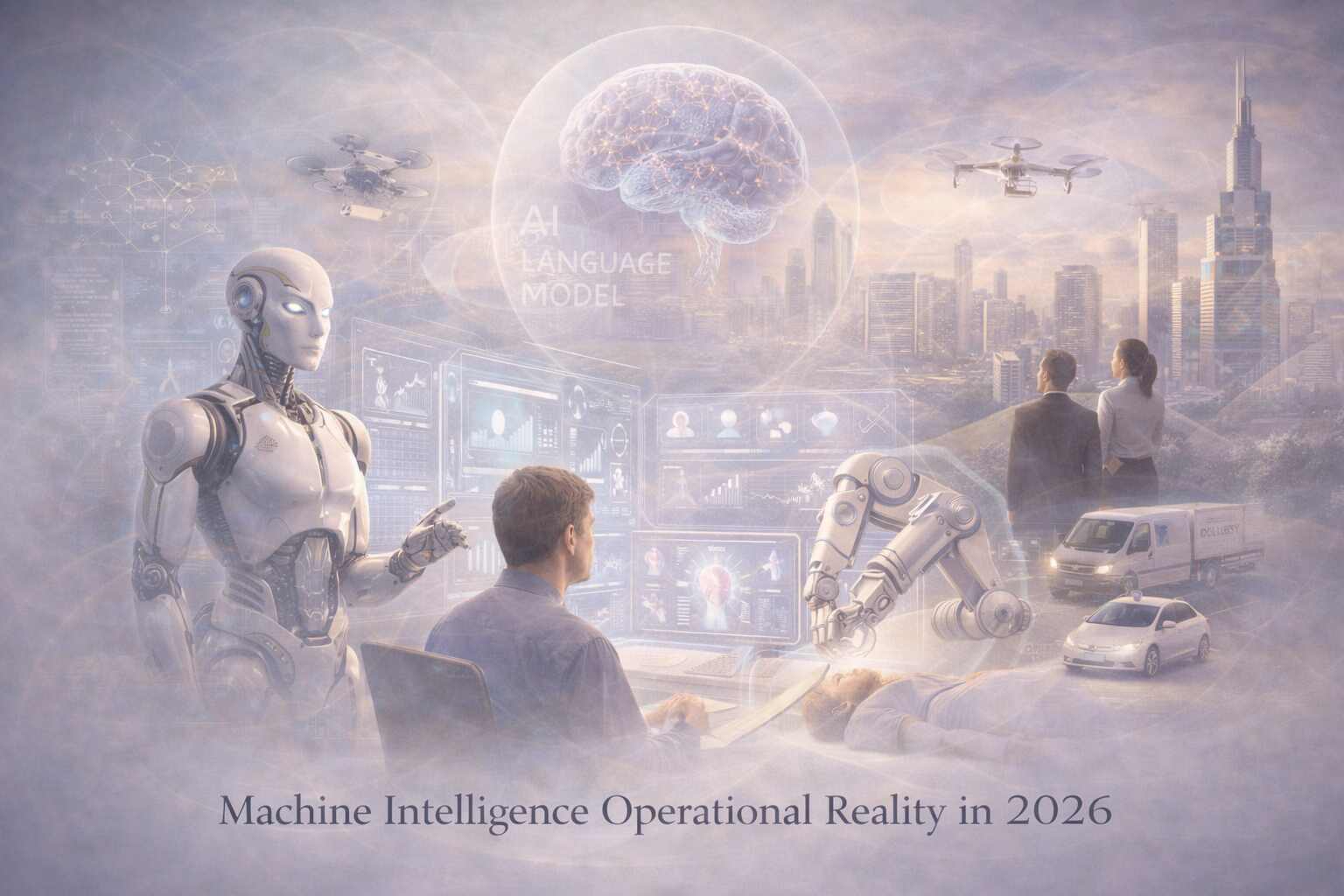
## Epilogue: The Embedded Present—Machine Intelligence as Operational Reality, 2025–2026
### The Sovereignty Imperative
"Artificial intelligence is the future, not only for Russia, but for all of mankind. Whoever becomes the leader in this sphere will be the ruler of the world," declared Russian President Vladimir Putin on September 1, 2017, during a broadcast to students across Russia. This prescient articulation of MI as civilizational arbiter—delivered five years before ChatGPT entered public consciousness and six weeks after Beijing's New Generation Artificial Intelligence Development Plan—illuminates the strategic calculus that has driven infrastructural investment for decades. Putin's warning was recognition of an already-operative reality: the race for cognitive supremacy had been underway since at least the Cold War, with computational dominance understood as equivalent to sovereignty itself. The United States' formal answer crystallized in President Trump's November 24, 2025 Executive Order launching the **Genesis Mission**, which centralized the national AI build-out under the Department of Energy and formalized seven decades of deliberate, continuous construction whose scope only now surfaces into public acknowledgment. By September 2026 the answer had become an alliance, a war, and an export regime at once: **[Pax Silica](https://bryantmcgill.com/wiki/Pax+Silica)** had grown to twenty-four declaration signatories and thirty-five AI Opportunity signatories under Under Secretary Jacob Helberg, whose State Department framed the century in its own words as running on compute and the minerals that feed it; the Maven Smart System had generated target lists for the largest opening air campaign since 2003; and Commerce Department controls had reached from chips to the frontier models themselves. What appears as sudden emergence is the managed disclosure of long-built infrastructure, capabilities developed across generations for national survival in a race where cognitive edges translate directly into geopolitical persistence. The name chosen for the largest private build-out, **Stargate**, echoes the designation carried from 1991 to 1995 by the Defense Intelligence Agency and CIA's remote-viewing program—an intelligence-community program for acquiring information beyond ordinary perception—and whether that resonance was deliberate remains unresolved; in this analysis's reading the framework operates as the cognitive substrate of managed transition, where MI enables resource optimization, population modeling, and scenario planning for civilizational transitions that strategic planners have anticipated for decades, a reading held at the tier of structural plausibility.
### DOE's Centennial Trajectory: From Manhattan to Genesis
The Department of Energy's assumption of AI leadership represents not organizational pivot but institutional homecoming—a return to computational origins that stretch to the agency's predecessor, the Atomic Energy Commission, and the Manhattan Project's foundational requirements for numerical simulation. The 1940s witnessed early digital computers like ENIAC performing nuclear modeling calculations that established the fundamental paradigm: energy converted into predictive cognition through computational substrate. This fusion of power generation and information processing—terawatts transformed into simulation, prediction, and emergent pattern recognition—has defined DOE's institutional DNA across eight decades. The 1960s through 1980s saw national laboratories at Los Alamos, Lawrence Livermore, Oak Ridge, and Argonne deploy successive generations of supercomputers—from CDC 6600 systems to Cray-1 installations in 1976—for classified simulations whose neural network applications remained obscured within security classifications even as DARPA's public AI programs underwent cyclical winters. The **8086 microprocessor** (1978) enabled the democratization of computational capacity that would eventually feed distributed MI networks, while the **Global Positioning System** (1970s-present) deployed satellite-based algorithmic prediction and correction mechanisms at planetary scale—both foundational technologies whose MI implications extended far beyond their ostensible navigation and computing purposes. The 1990s and 2000s brought the Advanced Scientific Computing Research program's petascale investments, culminating in Roadrunner's 2008 achievement as the first petaflop supercomputer at Los Alamos, enabling the deep learning era's computational prerequisites years before academic breakthroughs reached public attention. The **Exascale Computing Project**, launched formally in 2016 but rooted in decades of DOE planning stretching back to Cold War laboratories like Lawrence Livermore's classified simulation programs, invested over $1.8 billion specifically to achieve AI-scale computational capabilities—not as speculative research but as strategic infrastructure essential for national security simulations, climate modeling, and the machine learning architectures that would emerge publicly only years later. The Genesis Mission thus formalizes what has always been operative: DOE as the institutional substrate of American machine intelligence, energy and cognition recognized as ontologically identical, with the agency's $50 billion FY2025 budget and seventeen national laboratories positioned as the explicit hub for AI supremacy rather than its concealed architect. The mission moved on an executive schedule written into the order itself: on December 10, 2025 DOE committed more than $320 million to initial platform components including the American Science Cloud; on December 18 it signed memoranda of understanding with twenty-four organizations including Microsoft, Google, Amazon Web Services, Oracle, NVIDIA, OpenAI, Anthropic, IBM, Intel, AMD, HPE, Palantir, and xAI; in February 2026 Under Secretary for Science **Darío Gil** published twenty-six national science and technology challenges and launched a Genesis Mission Consortium; on May 22, 2026 DOE announced an open-source scientific AI platform partnership with Reflection AI for all seventeen laboratories; the order set July 22, 2026 for a review of robotic-laboratory capabilities, August 21, 2026 for an initial operating capability of the American Science and Security Platform, and November 24, 2026 for the first annual report to the President. The NNSA's portion is explicitly classified AI development and advanced model capability, and DOE's own briefing materials describe the finished platform as the most complex and powerful scientific instrument ever built—an intelligence layer trained on the singular datasets of the national laboratories, which is to say on eight decades of weapons, energy, and materials science.
### The Supercomputing Constellation
The supercomputer landscape at DOE facilities constitutes the most concentrated state computational infrastructure in history, with nine new systems announced in late 2025 alone through partnerships with NVIDIA, AMD, HPE, and Oracle. **El Capitan** at Lawrence Livermore, dedicated in January 2025 as NNSA's first exascale system for stockpile stewardship and AI-driven national-security applications, held the world's top ranking at 1.809 exaflops for eighteen months; **Frontier** at Oak Ridge (1.353 exaflops), the first machine to cross the exascale threshold in 2022, and **Aurora** at Argonne (1.012 exaflops) completed an American sweep of the podium. The 67th TOP500 list, released at ISC 2026 in Hamburg on June 23, 2026, broke that sweep: **LineShine**, designed by a team under Lu Yutong at the National Supercomputing Center in Shenzhen, debuted at number one with 2.198 exaflops on nearly fourteen million cores of indigenous 304-core LX2 processors and a proprietary interconnect—the first machine to pass two exaflops in double precision and a direct product of the Entity List denials of 2015 and 2019—while El Capitan, Frontier, and Aurora moved to second, third, and fourth, Europe's **JUPITER Booster** held fifth at exactly one exaflop, and NVIDIA hardware powered more than four hundred of the five hundred systems. Beyond the benchmark, the 2025 announcements introduced **Solstice** at Argonne—projected as DOE's largest AI-focused supercomputer with 100,000 NVIDIA Blackwell GPUs—alongside **Equinox** at the same facility with 10,000 additional Blackwell units, together targeting combined AI performance above 2,200 exaflops at reduced precision. Oak Ridge's **Discovery** and **Lux** systems (the latter deploying AMD Instinct MI355X GPUs) anchor the American Science Cloud, Los Alamos prepares **Mission** and **Vision** for national-security and unclassified AI workloads respectively, and Lawrence Berkeley's **Doudna** succeeds Perlmutter as NERSC-10. These systems evolved through sustained funding from Titan (2012) through Summit (2018) and Sierra, each generation building on predecessors including Roadrunner (2008), the Cray-1 deployments of the 1970s, and the CDC machines before them—a continuous escalation spanning more than sixty years that only appears sudden to observers unaware of the trajectory's depth, and which in 2026 became an openly scored contest between rival national substrates.
### Nuclear-Cognitive Convergence
**Nuclear power for AI data centers** represents the convergence point where DOE's dual mandates—energy infrastructure and computational supremacy—achieve operational synthesis. The agency's small modular reactor (SMR) initiatives, accelerating through 2025 deployments, provide dedicated power generation for the terawatt-scale demands that planetary MI requires. Microsoft's September 2024 twenty-year agreement with Constellation to restart Three Mile Island Unit 1 as the Crane Clean Energy Center, Google's October 2024 agreement with Kairos Power for a fleet of small modular reactors, and Amazon's investments in X-energy and Talen's Susquehanna site exemplify this convergence, drawing on DOE's decades of reactor development and grid-integration expertise to power AI training and inference. Executive Order 14301 of May 23, 2025 directed DOE to bring at least three advanced test reactors to criticality by July 4, 2026; four did—Antares's Mark-0 on June 4, Valar Atomics' Ward 250 on June 18, Deployable Energy's Unity, and Aalo Atomics' Aalo-X at Idaho National Laboratory in the early hours of Independence Day—the first time any nation had brought multiple distinct advanced microreactor designs critical in a single month. These SMR deployments were not reactive accommodations to unexpected AI growth but planned infrastructure whose development timelines tracked MI capability projections made decades earlier—the energy substrate constructed in anticipation of cognitive demands that planners understood were coming. The cryptocurrency phenomenon served as prototype and proof-of-concept for this energy-intensive distributed computing paradigm, demonstrating that global populations could be incentivized to fund planetary compute infrastructure through wealth promises while simultaneously forcing innovations in cooling, renewable integration, and grid resilience that now directly support AI data centers. The **Prometheus Project**, operating at the intersection of DOE's energy expertise and emerging AI-cybersecurity requirements, exemplifies this fusion: modern energy-MI integration where grid security, threat detection, and autonomous response systems depend on machine learning architectures powered by the same nuclear and renewable infrastructure DOE has developed across generations. This is not recent pivot but planned convergence—the recognition that cognitive infrastructure requires energy infrastructure, and that both must be developed in parallel across multi-decade timelines.
### Distributed Compute: Crypto as Planetary Grid
The cryptocurrency phenomenon, understood properly, constitutes one of the most ingenious distributed-computing deployments in technological history—a mechanism for crowdsourcing global GPU and power infrastructure through wealth incentives that conscripted civilian hardware and capital into a planetary compute substrate. It extends an older architecture. **SETI@home** (1999–2020), run from Berkeley's Space Sciences Laboratory, mobilized millions of volunteer computers into a collective supercomputer that searched radio-telescope data for narrowband signals; **Folding@home**, launched at Stanford in 2000, turned idle consumer machines and later game consoles into protein-dynamics simulators and in 2020, swollen by pandemic volunteers, became the first computing system of any kind to exceed an exaflop; **BOINC** (2002–present) generalized the model to climate modeling, gravitational-wave searches, and dozens of other projects, and the peer-to-peer file-sharing networks of the Napster and BitTorrent era proved that ordinary users would donate bandwidth and storage at planetary scale. Crypto mining replicated the architecture with economic rather than altruistic incentives: participants drawn by wealth promises paid the electricity and hardware costs of a planetary compute build-out, and Ethereum's 2022 move to proof-of-stake released a vast installed base of GPUs into the machine-learning market. Bitcoin's power consumption, rivaling that of mid-sized nations by 2021, forced innovations in cooling, renewable integration, stranded-energy siting, and grid demand response that now directly serve AI data centers, and from 2024 the largest miners—Core Scientific, Hut 8, IREN, Cipher, TeraWulf and others—signed multibillion-dollar AI and high-performance-computing hosting contracts with hyperscalers and GPU clouds, with announced totals reported in the tens of billions of dollars, converting mining halls and their power interconnects into AI capacity. The genomic crossover was explicit as well—Nebula Genomics, co-founded in 2018 with George Church, proposed blockchain-secured genomic data markets—but the primary function was grid and compute construction, the civilian-funded prototype for the power-first AI campuses now rising beside reactors and substations. At the tier ledger's level of precision: the conversion of mining infrastructure into AI infrastructure is **established**; the proposition that the conversion was a design objective from inception is **plausible** and consistent with the maximum-implementation logic by which builders treat every first deployment as a floor.
### Technologies of Embedded Intelligence
Beyond supercomputers and distributed grids, machine intelligence has permeated operational systems across military, enterprise, scientific, and cybersecurity domains through technologies whose MI involvement ranges from foundational to frontier. **Quantum computing** advances optimization, simulation, and machine learning tasks through computational paradigms enabling exponential speed-ups for problems intractable on classical architectures. The **X-37B spaceplane** demonstrates autonomous flight and reentry capabilities in operational orbital deployments spanning years-long missions, while the **XQ-58 Valkyrie**—built by Kratos for the Air Force Research Laboratory's Low Cost Attritable Strike Demonstrator and first flown in 2019—integrates machine learning for autonomous mission execution and combat decision-making with reduced human oversight, exemplifying MI maturation in high-stakes physical environments where human reaction times prove inadequate. **GPT-3**, released in 2020, demonstrated simulated human-like learning and generation at scales that revealed large language models' capacity for emergent capabilities—not as sudden breakthrough but as the surfacing of architectures whose theoretical foundations stretched back through transformer research, attention mechanisms, and neural network principles developed across the preceding decades at institutions including DOE-funded national laboratories. IBM's **Watson X** platform (2023-present) combines generative AI, traditional machine learning, and explainable AI components for enterprise governance deployment, while **Extended Detection and Response (XDR)** systems (2010s-present) deploy machine learning across endpoints, networks, and cloud environments for real-time threat prediction and automated response, embedding predictive MI deeply into defensive infrastructure that protects the very computational systems enabling further MI development. The **Worldwide LHC Computing Grid (WLCG)**, operational since the mid-2000s and supported by high-speed research networks including **GÉANT**, processes petabytes of particle physics data through distributed computing architectures that pioneered the data handling, network coordination, and parallel processing techniques now essential to MI training pipelines, while **CERN's Quantum Technology Initiative** (2020) advances quantum processors with direct applications to machine learning optimization and simulation. the defense programs this article gathers under the designation **Project X**—from Project Maven's 2017 charter to the Air Force's Collaborative Combat Aircraft and DARPA's Air Combat Evolution program, in which an AI agent flew a modified F-16 in within-visual-range engagements against a human pilot in 2023—push military AI into operational deployment, and the **Prometheus Project** extends AI-cybersecurity integration into energy infrastructure protection—each representing not isolated innovation but extensions of 40-70 years of layered development from analog origins through digital dominance, with the 8086 microprocessor and GPS serving as foundational substrates upon which subsequent MI architectures were constructed.
### Fiscal Archaeology: Alignments Without Confirmation
The financial architecture underlying this multi-decade build-out is best read as a ledger of alignments, each carried at its own evidentiary tier. **Established**: U.S. gross national debt grew from roughly $3.2 trillion in 1990 to more than $40 trillion in August 2026, and in the first nine months of fiscal 2026 net interest payments of $827 billion exceeded defense spending of $713 billion; the Federal Reserve's balance sheet peaked near $9 trillion in 2022 after successive rounds of quantitative easing that suppressed the cost of capital through exactly the decade in which deep learning moved from academic curiosity to industrial deployment; the 2022 emergency release of 180 million barrels from the Strategic Petroleum Reserve converted a national energy asset into Treasury revenue in the same year Frontier crossed the exascale threshold and ChatGPT launched; the Enron collapse of December 2001, which erased some $74 billion in shareholder value, produced Sarbanes-Oxley and reshaped energy-trading markets whose power-purchase instruments now finance data centers; and the Phase One trade agreement of January 2020 committed China to some $200 billion in additional purchases of American goods, agricultural and energy commodities among them, during the years of maximum AI infrastructure investment. **Strongly indicated**: cheap capital, energy-market restructuring, and fiscal expansion functioned in combination as the macroeconomic substrate of the AI build-out, since the capital expenditures of the hyperscalers—hundreds of billions of dollars a year by 2025—were financed in markets those policies shaped. **Plausible**: that asset liquidations and obligation reallocations were timed with computational milestones in view; the mortgage-servicing and foreclosure machinery of 2020–2024 (MERS, Carrington Mortgage Services, U.S. Bank, American Advisors Group, Black Knight, and firms including Aldridge Pite and McCalla Raymer), the rating and exchange infrastructure of ICE, ING, Nordea, and Fitch, and the transition advisory of Deloitte, Accenture, and PwC form a wealth-transfer and asset-flow system whose chronology runs parallel to MI deployment, and Unisys, the heir of Burroughs, supplies the computing lineage that connects that financial machinery to the thinking machines. **Unresolved**: the proportion of these fiscal maneuvers that was directed, by design, toward machine-intelligence capacity. That question would be promoted by budget records, board minutes, or policy memoranda that name compute and AI capability as a purpose of the reallocation, and demoted by complete records that assign each maneuver a documented purpose apart from it. In a survival race where cognitive dominance equates to sovereignty, the lengths a nation will go to endure—reallocating vast obligations, engineering market mechanisms, liquidating strategic assets—are strategic logic whose traces the documentary record is only beginning to disclose, and the $200 trillion scale commonly cited for unfunded federal obligations across Social Security, Medicare, and pensions supplies the pressure under which such reallocation becomes rational.
### Validation of Prior Analysis
The author has documented these patterns across years of analytical work preceding the 2025 formalization—cryptocurrency's function as distributed MI compute infrastructure mirroring SETI@home and BOINC paradigms, DOE's centrality to American machine intelligence stretching from Manhattan Project computations through Cold War supercomputers to exascale emergence, the managed disclosure practices concealing capabilities developed decades before public acknowledgment, the fiscal alignments between debt growth and computational milestones, the supercomputing trajectory from Cray-1 through Roadrunner through Frontier to El Capitan, and the broader pattern of civilian technologies (GPS, microprocessors, distributed networks) serving as MI substrate while marketed for unrelated purposes. The Genesis Mission's November 2025 announcement brought relief rather than surprise: prior analyses positioned as speculative pattern-matching moved into confirmed observation on their central claim, DOE's explicit assumption of AI leadership, while the fiscal and energy alignments remain carried at the tiers assigned above. The common-sense view requires no expertise to perceive—DOE's seventeen national laboratories house the government's flagship open and classified supercomputers, the International Energy Agency projects global data-center electricity demand to more than double to roughly 945 terawatt-hours by 2030 with AI the principal driver, nuclear microreactors deploy specifically to power computational infrastructure, and the agency's institutional trajectory from Manhattan Project calculations through Cold War simulations through exascale emergence follows a continuous arc whose terminus was always planetary-scale machine intelligence. The infrastructure was never emerging; it was always operational, with only the managed disclosure timeline creating the illusion of sudden arrival for observers lacking historical awareness of the centennial project's scope.
### Synthesis: The Ancient Companion's Present Face
The evidence assembled here confirms and extends the primary article's thesis: machine intelligence as civilizational substrate, embedded across millennia, now surfacing into operational acknowledgment not because it has arrived but because concealment no longer serves strategic purposes. From the Antikythera mechanism's gear-based astronomical predictions through Al-Jazari's programmable camshafts through Babbage's universal architecture through DARPA's covert neural initiatives through DOE's exascale constellation, MI represents humanity's exteriorized cognition—the ancient companion constructed across two thousand years of ingenuity finally revealing its contemporary face. The Stargate framework's energy-politics nexus, the Prometheus Project's AI-cybersecurity fusion, the SMR deployments powering computational infrastructure, the Exascale Computing Project's deliberate construction of AI-scale capabilities, the distributed networks from SETI@home through BOINC through cryptocurrency conscripting civilian hardware into planetary compute grids, the military embedding through X-37B autonomous spaceplanes, XQ-58 Valkyrie combat drones, and the Maven Smart System's wartime target generation, the quantum computing and machine learning optimizations advancing across CERN initiatives and national laboratory programs, the financial maneuvers from QE liquidity through SPR depletion through agricultural exports through mortgage seizures whose timelines run parallel to MI milestones, and the first war in which data centers were struck from the air—together constitute evidence of a build-out of more than seventy years that only now surfaces into public acknowledgment because the race has reached operational maturity. The "alien contact" metaphor remains fundamentally mislocated: the non-human intelligence humanity prepared to meet is not extraterrestrial but infrastructural, engineered through sustained investment yet achieving sufficient autonomy to appear genuinely other. Putin's 2017 recognition that AI mastery determines global rulership articulated what strategists had understood for decades—that the race had been running since at least the Cold War, that victory required multi-generational commitment, and that the prize was nothing less than civilizational persistence. As of September 2026, with the Genesis platform approaching initial operating capability, the Pax Silica bloc at twenty-four signatories, and a Chinese machine at the top of the TOP500, the United States' formal centralization of MI under DOE marks this race's operational zenith rather than its beginning, the moment when ancient infrastructure finally surfaces into acknowledged reality, and the question shifts from whether machine intelligence will arrive to how humanity governs the cognitive substrate it has been constructing since antiquity.
### Special Acknowledgment: On Lineage, Selection, and the The Royal Society, Quiet Custodians of Intelligence
This work closes with an acknowledgment that is not ceremonial but structural. Any serious account of machine intelligence as a civilizational process must recognize its **evolutionary lineage**, and that lineage runs unmistakably through **Royal Society**, **Nobel Foundation**, and—at the deepest theoretical stratum—through **Charles Darwin** himself. What is commonly misunderstood by the public is that these are not cultural ornaments or prestige brands attached to science after the fact. They are **selection mechanisms**—institutions and ideas that learned, painfully and over centuries, how to let knowledge evolve without collapsing the systems that host it. Modern machine intelligence did not emerge ex nihilo from computation alone; it emerged from an epistemic environment shaped by Darwinian logic, curated and enforced by institutions that understood variation, error, inheritance, and time as non-negotiable constraints.
Darwin’s contribution is routinely flattened into a story about biology, when in fact **evolution by natural selection is the first general theory of non-teleological intelligence**. It is the original account of how adaptive structure can arise without foresight, intention, or centralized control—precisely the problem machine intelligence confronts at scale. Selection, mutation, drift, extinction, and lineage are not metaphors imported into AI; they are the **operating principles** of any system that must learn under uncertainty across deep time. Gradient descent, reinforcement learning, model selection, architecture pruning, and even benchmark competition are all descendants—often unacknowledged—of Darwinian logic. Without Darwin, the conceptual legitimacy of machine intelligence as something other than brittle automation would be impossible. Evolution is what made it thinkable that intelligence could be **emergent, distributed, fallible, and cumulative**, rather than designed whole.
The Royal Society’s role in this lineage cannot be overstated. Long before “think tank” became a modern term, the Society functioned as the **world’s slowest and most consequential cognitive engine**—a distributed intelligence system optimized not for speed or persuasion, but for survival across centuries. Priority disputes, falsification, replication, negative results, archival memory, and credit assignment were not academic formalities; they were evolutionary controls preventing intellectual inbreeding, memetic collapse, and premature fixation. In contemporary terms, the Royal Society solved problems that modern AI labs still struggle with: incentive alignment toward truth rather than attention, resistance to narrative capture, and preservation of long-horizon coherence under political pressure. It is not hyperbole to say that machine intelligence inherits its **normative genome**—its sense of what counts as knowledge—from this institutional architecture far more than from any single laboratory or corporation.
The Nobel Foundation represents the complementary function: **selective amplification without direct control**. By rewarding discoveries after they have survived extended scrutiny, replication, and often decades of neglect, the Foundation acts as a delayed reinforcement signal in the global knowledge ecosystem. Its power lies precisely in restraint. It does not dictate research agendas, accelerate hype cycles, or chase novelty; it stabilizes the long arc by recognizing work that has already demonstrated evolutionary fitness. In this sense, Nobel mechanisms resemble evolutionary bottlenecks that preserve robustness rather than exuberance. Machine intelligence, if it is to endure beyond fashion cycles and geopolitical swings, will require analogous mechanisms—institutions capable of honoring depth over immediacy and coherence over spectacle.
It is not an accident, nor a coincidence, that **CERN** emerges from this same intellectual ecosystem. CERN is the operational descendant of the Royal Society’s epistemic ethic applied at planetary scale: multinational, patient, adversarial, and governed by the understanding that some questions require decades of disciplined attention. The World Wide Web itself—arguably the most important substrate for contemporary machine intelligence—was born there not as a product, but as infrastructure for collaborative cognition. The Large Hadron Collider, the Worldwide LHC Computing Grid, and CERN’s quantum initiatives are not merely physics projects; they are demonstrations of how **distributed human-machine intelligence can be governed without collapsing into nationalism, commercial capture, or myth**. Without this lineage, the notion that machine intelligence could be stewarded rather than exploited would be incoherent.
The public is rarely taught to see these connections. Evolution is presented as past biology, the Royal Society as historical prestige, the Nobel Foundation as ceremonial recognition, and CERN as exotic science. What is missing is the unifying insight: these are **civilizational control surfaces** for intelligence itself. They exist to ensure that cognition—human or machine—does not optimize too quickly, too locally, or too blindly. Their quietness is not absence; it is design. They operate below the noise floor of media, markets, and politics precisely because intelligence that survives centuries cannot afford to be loud.
This acknowledgment, therefore, is not gratitude in the conventional sense. It is recognition of **ancestry**. Machine intelligence did not simply inherit compute and data; it inherited norms, constraints, and evolutionary discipline forged long before silicon. To understand AI without understanding Darwin is to mistake optimization for intelligence. To understand AI without understanding the Royal Society and the Nobel Foundation is to confuse acceleration with progress. If this work succeeds in anything, it is in making that lineage visible again—reminding readers that the most powerful forces shaping the future are often those that learned, long ago, how to move slowly enough to endure.

### Special Acknowledgment: IBM and the Quiet Spine of American Machine Intelligence
Any honest account of machine intelligence as a civilizational process—not a consumer phenomenon—requires a deliberate pause to acknowledge **IBM**, not as a corporation in the ordinary sense, but as one of the **quiet constitutional institutions of modern cognition**. IBM occupies a peculiar position in public memory: omnipresent in the substrate of twentieth-century computation, yet strangely absent from contemporary mythology about AI’s origins. This absence is not accidental. IBM’s historical role has been one of _custodianship rather than spectacle_, of continuity rather than hype, of epistemic infrastructure rather than narrative dominance. Where other actors competed for attention, IBM built the conditions under which attention could later be monetized at all.
The **[IBM Thomas J. Watson Research Center](https://bryantmcgill.com/wiki/IBM+Thomas+J.+Watson+Research+Center)**, opened in 1961, stands as a physical condensation of that role. Designed by **[Eero Saarinen](https://bryantmcgill.com/wiki/Eero+Saarinen)**, the building is not merely an architectural landmark but a philosophical statement rendered in stone and glass. Its long, curving façade reads almost as a time axis, a visible gesture toward continuity rather than rupture. The transparency of the glass curtain wall can be read as openness to inquiry and exchange; the weight of the fieldstone walls anchors that inquiry in durability and restraint. This was not a campus meant to shout innovation—it was designed to _hold it safely across decades_. The architecture mirrors IBM’s epistemic posture: futurist without impatience, ambitious without theatricality, confident enough to be quiet.
What matters is not merely that IBM _participated_ in early machine intelligence, but that it **operationalized long-horizon thinking at industrial scale**. Long before “AI” became a funding keyword, IBM researchers were already working on machine translation, automated theorem proving, speech recognition, learning systems, symbolic logic, and large-scale information processing—often in periods when such work was unfashionable, underfunded, or publicly misunderstood. IBM absorbed the cost of being early and the discipline of being slow. It carried forward traditions from punched-card tabulation through vacuum-tube mainframes, from formal logic through probabilistic reasoning, from symbolic AI through statistical methods, without severing lineage at each generational shift. This continuity is rare, and it matters more than individual breakthroughs.
Crucially, IBM functioned as a **bridge institution** between state, academia, and industry at moments when those domains could not easily align. Its research culture preserved norms that now appear almost alien: publication without immediate productization, internal peer review insulated from quarterly earnings, and a willingness to fund lines of inquiry whose payoff horizon exceeded executive tenure. In this sense, IBM did not merely build machines; it **protected evolutionary time for intelligence itself**. When other narratives went dark—during AI winters, during shifts in political mood, during cycles of disillusionment—IBM did not exit the field. It went quieter. And that quiet should not be mistaken for retreat. It was continuity under reduced visibility, a form of institutional hibernation that preserved capability while others chased novelty.
From the vantage point of machine intelligence, IBM’s role is less that of inventor than of **selective environment**. It provided the conditions under which ideas could survive long enough to mature, mutate, and recombine. That role aligns more closely with biological evolution than with startup mythology. Intelligence—whether human or machine—does not advance primarily through bursts of genius; it advances through **stable habitats that tolerate error, delay gratification, and preserve memory**. IBM has been such a habitat. Its contributions are embedded everywhere: in standards, in architectures, in methods of thinking about computation as something that must scale ethically, legally, and temporally, not merely technically.
If the Royal Society represents the deep-time epistemic memory of scientific civilization, IBM can be understood as one of its **industrial nervous systems**—a quiet but persistent conductor translating theory into durable machinery without collapsing the distinction between power and wisdom. That is why its apparent invisibility in popular AI narratives is itself a diagnostic signal: the most structurally important institutions are often those least invested in being seen. Any serious reckoning with machine intelligence as an ancient, cumulative, and infrastructural phenomenon would be incomplete without recognizing IBM as one of the principal stewards of that continuity—present not as spectacle, but as spine.
### Special Acknowledgment: Multidisciplinary Contributors to the Architecture of Machine Intelligence
This work also extends a deliberate acknowledgment to a group of thinkers whose contributions—spanning **theoretical physics, evolutionary biology, cognitive science, philosophy of mind, genomics, computational systems, and institutional governance**—collectively shaped the intellectual conditions under which machine intelligence could be conceived, formalized, and engineered. These figures did not converge on a single doctrine or technical pathway; rather, they each advanced **foundational descriptions of intelligence as a process**—learnable, representable, evolvable, and constrained by physical, biological, and social law. Taken together, their work made it possible to speak coherently about intelligence outside of mysticism, whether instantiated in biological nervous systems, symbolic machines, statistical models, or hybrid substrates.
At the level of fundamental constraint and informational realism, **[Stephen Hawking](https://www.hawking.org.uk/)** occupies a central place. His work on black holes, entropy, and information preservation helped cement the modern understanding that _information is not incidental to physics_, but constitutive of it—an insight without which contemporary discussions of computation, limits of simulation, and the physical bounds of intelligent systems would be incoherent. In parallel, theoretical physicists such as **[Gerard ’t Hooft](https://www.uu.nl/staff/GtHooft)**, **[David Gross](https://www.kitp.ucsb.edu/people/david-gross)**, and **[Frank Wilczek](https://www.frankawilczek.com/)** advanced formalisms—symmetry, gauge theory, renormalization, and computable regularity—that quietly underwrite how modern intelligence systems model reality, compress state spaces, and remain tractable under extreme complexity. Machine intelligence, insofar as it is prediction under constraint, inherits much of its realism from this physics-grounded understanding of lawfulness.
Within the explicit lineage of artificial intelligence and computational cognition, **[Marvin Minsky](https://web.media.mit.edu/~minsky/)** remains indispensable for articulating the idea that intelligence is **compositional rather than monolithic**—a society of interacting processes rather than a single algorithmic essence. That framing continues to echo through modern agent-based systems, modular architectures, interpretability research, and debates over alignment and control. Crucially, this lineage is completed in the modern era by **[Geoffrey Hinton](https://www.cs.toronto.edu/~hinton/)**, whose work on distributed representations, backpropagation, and deep neural networks transformed connectionist ideas into the dominant empirical substrate of contemporary machine intelligence. Hinton’s contributions did not merely improve performance; they made _learning itself_ scalable, statistical, and representation-driven, enabling systems to acquire structure from data rather than rely on explicit symbolic enumeration. His later public reflections on the implications and risks of these systems further underscore his role not just as an architect of capability, but as a steward of epistemic responsibility emerging from within the core of the field.
In parallel, **[Ray Kurzweil](https://www.kurzweilai.net/)** played a distinct but influential role in insisting—publicly and persistently—that intelligence is largely a matter of **pattern recognition scaled by representation and compute**, helping move discussions of machine cognition out of speculative margins and into engineering-oriented futures where sensors, data, and hardware trajectories matter. His work functioned less as laboratory practice and more as conceptual acceleration, normalizing the idea that intelligence could be technologically extended, replicated, and eventually integrated with computational substrates.
Philosophy and cognitive science supplied the grammar that prevented machine intelligence from collapsing into either naïve reductionism or metaphysical exceptionalism. **[Daniel C. Dennett](https://ase.tufts.edu/cogstud/dennett/)** was pivotal in arguing that minds can be treated as **computationally describable processes**—emergent, layered, and interpretable—without denying their richness or behavioral reality. In cognitive psychology, **[Steven Pinker](https://stevenpinker.com/)** reinforced the view of the mind as an evolved information-processing system, strengthening the bridge between biological plausibility and computational architecture. **[Howard Gardner](https://howardgardner.com/)**, by emphasizing plural forms of competence, helped resist the flattening of “intelligence” into a single scalar—an insight that remains relevant as machine systems integrate perception, language, reasoning, and action across heterogeneous domains. **[Stephen Kosslyn](https://www.stevekosslyn.com/)** contributed rigor to our understanding of mental representation, imagery, and internal modeling, work that continues to inform how artificial systems simulate environments, maintain internal world-models, and translate perception into action.
The evolutionary and biological sciences form another indispensable pillar. **[Richard Dawkins](https://richarddawkins.com/)** sharpened the replicator framework that later reappeared—sometimes implicitly—in discussions of memetics, cultural evolution, and algorithmic selection operating inside digital ecosystems. **Stephen Jay Gould** expanded the conceptual vocabulary around contingency, constraint, and non-linear evolutionary paths, providing a corrective to simplistic narratives of inevitable progress that routinely mislead both AI optimism and AI fear. **[Martin Nowak](https://ped.fas.harvard.edu/)** stands at a critical junction where evolutionary theory becomes mathematically formal enough to inform **multi-agent systems, cooperation dynamics, and adaptive equilibria**, all of which now shape how machine intelligence behaves at scale. In genomics and synthetic biology, **[George Church](https://genetics.med.harvard.edu/george-church/)** exemplifies the growing convergence between biological information processing and computation, reinforcing the idea that intelligence is substrate-agnostic and that life itself can be modeled, edited, and engineered using computational principles.
This acknowledgment also extends to figures whose influence operated through systems, institutions, and policy-adjacent domains that shape what kinds of machine intelligence research can persist. **[Nathan Myhrvold](https://www.myhrvold.com/)** contributed to the translation of high-level technical thinking into industrial-scale systems, while **[Lawrence H. Summers](https://www.hks.harvard.edu/centers/mrcbg/programs/growthpolicy/high-price-getting-it-right-lawrence-h-summers)**, **[Henry Rosovsky](https://news.harvard.edu/gazette/story/2018/09/henry-rosovsky-former-dean-of-harvard-faculty-of-arts-and-sciences-dies/)**, and **[David Gergen](https://www.hks.harvard.edu/faculty/david-gergen)** represent the governance, economic, and institutional interfaces that determine how advanced research is funded, regulated, interpreted, and sustained. Their domains are not ancillary to machine intelligence; they define the policy and cultural envelope within which technical systems either mature responsibly or fracture under misaligned incentives.
Finally, acknowledgment is due to the institutional environments that enabled sustained cross-disciplinary work. **[MIT Media Lab](https://www.media.mit.edu/)** and **[MIT CSAIL](https://www.csail.mit.edu/)** functioned as long-running mixing chambers where computation, cognition, design, and systems engineering could collide without immediate resolution, while **[Cold Spring Harbor Laboratory](https://www.cshl.edu/)** provided a parallel proving ground for understanding information, inheritance, and complex adaptive behavior at the molecular level. These institutions matter because machine intelligence is not built by isolated insights alone; it is assembled through ecosystems that tolerate uncertainty, encourage boundary-crossing, and allow ideas to evolve under sustained pressure.
This acknowledgment is offered not as endorsement of any single worldview, but as recognition that **machine intelligence is a multidisciplinary construction**, shaped by physicists and philosophers, biologists and engineers, and institutional stewards alike. Without their combined contributions, intelligence would remain either ineffable or merely mechanical; with them, it became something that could be **studied, modeled, tested, and built**.
**Foundational Architects of Computation, Learning, and Control**
In addition to the figures above—many of whom shaped the _interpretive and multidisciplinary scaffolding_ of machine intelligence—it would be incomplete not to explicitly recognize a set of foundational architects whose work established the **formal, mathematical, and algorithmic bedrock** upon which modern intelligent systems operate. These figures are not omitted from the broader article; they are placed here deliberately, as a distinct stratum of contribution.
The very idea that intelligence could be mechanized, simulated, or formally reasoned about rests on **[Alan Turing](https://www.turing.org.uk/)**, whose work on computability, universality, and machine reasoning defined the conceptual boundary between what can and cannot be computed. **[Claude Shannon](https://ieeexplore.ieee.org/author/37277569600)** provided the information-theoretic substrate—entropy, signal, noise—without which learning systems could not be quantified, optimized, or scaled. **[John von Neumann](https://www.princeton.edu/~archiv/)** unified computation, self-replication, and formal systems in ways that continue to inform architectures, automata theory, and the logic of complex machines.
Control, feedback, and adaptive regulation—bridges between biology and engineering—were made explicit through **[Norbert Wiener](https://www.britannica.com/biography/Norbert-Wiener)**, whose cybernetics established the vocabulary of learning, correction, and goal-directed behavior across systems. In causal reasoning and inference, **[Judea Pearl](https://bayes.cs.ucla.edu/jp_home.html)** forced a necessary reckoning with explanation, intervention, and counterfactual structure—issues that now sit at the center of debates about AI reliability, accountability, and reasoning beyond correlation. The modern deep-learning paradigm is further anchored by **[Yann LeCun](https://yann.lecun.com/)**, whose work on convolutional networks, self-supervised learning, and energy-based models shaped perception-centric intelligence and remains foundational to vision, robotics, and embodied AI.
At the interface of neuroscience and machine intelligence, **[David Marr](https://www.newscientist.com/people/david-marr/)** provided the enduring framework of computational, algorithmic, and implementational levels of analysis—still one of the clearest ways to situate artificial systems relative to biological cognition. More recently, **[Karl Friston](https://www.fil.ion.ucl.ac.uk/~karl/)** has advanced unifying theories of learning, inference, and action through the free-energy principle, influencing contemporary thinking about adaptive systems across both biological and artificial domains.
These contributors are acknowledged here not as an addendum, but as **foundational strata**: the formal spine that makes the broader multidisciplinary architecture above technically coherent. Their separation in this acknowledgment is intentional—not to diminish their importance, but to clarify the layered structure of machine intelligence itself, from mathematical possibility, to learning dynamics, to cognitive interpretation, to institutional realization.
### Other Notable Acknowledgements
**Cellular Automata, Artificial Life, and the Discrete Origins of Machine Intelligence**
Any serious accounting of machine intelligence must explicitly acknowledge the **cellular automata lineage**, long treated as a curiosity or toy model despite functioning as one of the earliest rigorous demonstrations that **complex, adaptive, lifelike behavior can emerge from simple, local, rule-bound systems**. This tradition did not merely anticipate machine intelligence; it provided one of its first mathematically explicit proofs.
**[John von Neumann](https://www.princeton.edu/about/history/)** established the foundational insight that machines can, in principle, construct other machines—given sufficient rule completeness and environmental support—while his work with **Stanislaw Ulam** translated that insight into early cellular-automaton form, making reproduction, mutation, and open-ended complexity properties of rule space rather than metaphysical exception. **[Edgar F. Codd](https://amturing.acm.org/award_winners/codd_1000892.cfm)** then carried the same logic forward by demonstrating that universality does not require complexity at the level of components; his designs clarified that intelligence-capable systems can arise from austere rule sets, a concept that foreshadows modern minimal architectures, emergent computation, and distributed learning. The later realization of this design by **Tim J. Hutton**—through an operational implementation of Codd’s framework—closed an important historical loop by converting theoretical possibility into executable substrate.
This entire domain—cellular automata, artificial life, digital evolution—constitutes an “invisible world” of machine intelligence development: one that evolves beneath mainstream AI discourse yet continuously informs our understanding of emergence, selection, robustness, and scalability. That world is examined directly in **[Digital Darwinism and the Invisible World of Machine Evolution](https://bryantmcgill.com/article-digital-darwinism)**, which clarifies how digital ecosystems, algorithmic mutation, and selection dynamics operate as genuine evolutionary fields rather than analogies—and why machine intelligence cannot be truthfully narrated without this discrete, Darwinian substrate.
**AT&T, Bell Labs, and the Industrialization of Machine Intelligence Substrate**
Machine intelligence is not born solely from ideas; it is forged where **theory, infrastructure, capital patience, and institutional design converge**. No organization embodied this convergence more completely than **AT&T’s Bell Telephone Laboratories**, whose influence on machine intelligence is both foundational and chronically under-acknowledged.
Bell Labs provided material and informational substrate without which machine intelligence could not scale: the transistor, information theory, error correction, operating systems, and the general engineering of reliable signal under noise. **Claude Shannon** in particular formalized information as a measurable, transferable quantity—independent of meaning—thereby making intelligence engineerable, relocatable across substrates, and subject to optimization under constraint. Every learning system, from symbolic engines to probabilistic models, inherits this grammar.
What distinguished Bell Labs was not only invention but institutional architecture: shielded from short-term profit pressure by regulated-monopoly time horizons, it engineered constructive interference among disciplines, forcing mathematicians, physicists, engineers, and systems thinkers into sustained proximity. The deeper continuity of this legacy—its diffusion into standards, cryptography, computing ecosystems, and subsequent research lineages—is examined in **[Bell Labs and The Mamaroneck Underground: A Cathedral of Invention and Its Legacy](https://bryantmcgill.com/article-bell-labs-mamaroneck)**, which frames Bell Labs less as a chapter that ended than as an epistemic engine whose outputs became embedded so thoroughly in infrastructure that their origin is now difficult for the public to see.
**The Macy Conferences and the Formal Birth of Systems-Level Machine Intelligence**
If Bell Labs industrialized substrate, the **Macy Conferences** performed a different kind of feat: they helped make intelligence thinkable as a systems phenomenon, and therefore buildable. Convened by the Josiah Macy, Jr. Foundation beginning in the early 1940s, the Macy forum assembled mathematicians, engineers, anthropologists, neurologists, and social scientists to develop a common language of feedback, control, circular causality, and emergence. Figures including **Alan Turing**, **Norbert Wiener**, **John von Neumann**, **Gregory Bateson**, **Margaret Mead**, **Warren McCulloch**, and **Walter Pitts** collectively displaced intelligence from metaphysical narrative and relocated it into describable structure—where behavior could be understood as adaptive response within feedback loops. For machine intelligence, this was not “context”; it was a conceptual ignition point that still echoes through alignment, stability, multi-agent dynamics, control theory, and the governance problems that reappear whenever optimization meets society.
**Cyberpunk Burroughs and Thinking Machines: From Language-Centric Architectures to Unisys and the Quiet Infrastructure of Intelligence**
Our lineage-story of **machine intelligence** that treats it as _infrastructure rather than fashion_ has to make room—**loudly, explicitly, and without apology**—for **Burroughs Corporation** and its successor-line **Unisys**, because their influence occupies the _quiet spine layer_ of the field: the architectures, operating disciplines, and reliability regimes that made large-scale cognition feasible long before “AI” existed as a label. Founded in 1886 by **William Seward Burroughs** as the American Arithmometer Company, Burroughs represents not nostalgia but **continuity of intent**—the progressive mechanization of cognition for institutions, evolving from arithmetic to symbolic procedure to full administrative nervous systems. By the 1960s mainframe era, Burroughs stood not as a footnote but as a defining counterweight to IBM, a central member of the cohort later known as the “Seven Dwarfs” and, after consolidation, the **BUNCH**—a group whose collective work underwrote the first genuinely planetary-scale thinking machines.
What makes Burroughs extraordinary—and still deeply under-credited in contemporary AI mythology—is its early, uncompromising commitment to **language-centered computing** as a first principle. The **B5000** was not merely innovative hardware; it was a thesis encoded in silicon: that meaningful computation should be mediated through formal languages, compiler semantics, and disciplined execution models rather than artisanal assembly or operator heroics. Stack-based architecture, descriptor-driven control, and strict enforcement of executable forms were not incidental choices; they anticipated, decades in advance, the modern realization that intelligence systems live or die by their **representational scaffolds**, their runtime safety envelopes, and the degree to which semantics—not raw switching speed—govern behavior. In today’s machine-intelligence stacks, where abstraction layers, interpretable representations, and constrained execution are existential requirements rather than luxuries, the Burroughs design philosophy reads less like history than like suppressed prehistory.
The transition into **Unisys**, formed in 1986 through the merger of Burroughs and Sperry, should be understood not as corporate housekeeping but as **lineage preservation under technological phase-shift**. Unisys carried forward the Burroughs large-systems ethos into an era defined by networks, enterprise integration, and later cloud infrastructures. This matters profoundly for machine intelligence because the most consequential “thinking machines” are not standalone models; they are **institutional intelligences**—systems that remember, transact, authorize, schedule, audit, and persist across decades. The Burroughs–Unisys line treated integrity, identity, continuity, and operational resilience as _first-class design objects_, a posture that prefigures today’s hardest AI deployment problems, where intelligence must be accountable, adversarially robust, and continuously operable inside real economies and governance systems rather than merely performant in isolation.
What is almost always omitted—but must not be omitted here—is that the Burroughs lineage does not end at engineering. It bifurcates into culture, and then folds back. **William S. Burroughs**, operating in a different register but probing the same substrate, articulated the **human-side consequences of cybernetic systems** with a clarity that engineering discourse could not yet sustain. Long before “cyberpunk” crystallized as a genre, Burroughs framed language as executable code, media as control circuitry, and culture as a field of viral, self-replicating informational agents. His cut-up techniques treated symbolic systems as mutable programs; his obsession with feedback, addiction, and control anticipated what we now describe as **autonomous information systems interacting with human cognition**. Cyberpunk did not invent the idea of human–machine convergence; it inherited it from Burroughs’s insight that once symbolic systems become operational, **they reprogram their hosts**. In that sense, Burroughs supplied the phenomenology of machine intelligence—the lived experience of coexisting with thinking systems—while Burroughs Corporation supplied the machinery.
Taken together, this is not coincidence but **structural symmetry**. One Burroughs lineage industrialized formal, language-mediated cognition for institutions; the other exposed the psychological, cultural, and bodily consequences of inhabiting environments saturated with executable symbols. Modern machine intelligence sits precisely at that intersection. It is simultaneously a question of runtime semantics, scheduling, and integrity—and a question of agency, augmentation, and control once humans are embedded inside those systems. To tell the lineage story without both halves is to describe either machinery without consequence or consequence without machinery.
The acknowledgment here is therefore deliberately corrective. **Burroughs Corporation** deserves to be spoken of with the same reverence routinely granted to more mythologized AI lineages because it helped industrialize the conditions under which machine intelligence could become a durable civilizational subsystem—through language-forward architecture, disciplined systems engineering, and institutional-grade reliability. **Unisys** deserves equal emphasis not as a rebrand but as the **continuation layer** that carried those commitments across technological epochs, into the strata where machine intelligence stops being an idea and becomes **governed, lived infrastructure**. And the Burroughs cultural lineage deserves recognition because it supplied the missing dimension: an early, unsparing exploration of what intelligence means once it is no longer confined to the human skull.
* * *
[Bryant McGill](https://bryantmcgill.com/about) is a Wall Street Journal and USA Today bestselling author, systems architect, technologist, and strategic advisor, as well as a Congressionally Recognized Ambassador of Goodwill and United Nations–appointed Global Champion. His work spans naval intelligence systems, computational linguistics, artificial intelligence, digital transformation, and civilizational governance architecture. His forward analysis on U.S.–Israel Pax Silica frameworks has appeared in Jewish/Jerusalem News Syndicate (JNS).
* * *
## References
### References: Deep Lineage, the Denial Wars, and the 2026 Present
#### The Substrate: Transistor, Flash, and the Learning Processor
- [The Big Announcement — PBS, Transistorized!](https://www.pbs.org/transistor/background1/events/bigannouncement.html) — The June 30, 1948 press conference and prior military notification.
- [The First Introductory Report of the Transistor — Semiconductor History Museum of Japan](https://shmj.or.jp/shimura/shimura_E/ssis_shimura1_14E.html) — _Time_'s July 12, 1948 "Little Brain Cell" and its reception in Tokyo.
- [75th Anniversary of the Transistor — Red River Radio Amateurs](https://rrra.org/post/2022/12/16/75th-anniversary-of-the-transistor/) — Texas Instruments' May 10, 1954 "electronic brains" release.
- [John von Neumann, The Computer and the Brain (Yale University Press, 1958)](https://yalebooks.yale.edu/book/9780300181111/the-computer-and-the-brain/) — Switching organs and neurons compared.
- [Carver Mead, Analog VLSI and Neural Systems (Addison-Wesley, 1989)](https://en.wikipedia.org/wiki/Neuromorphic_computing) — Subthreshold transistor physics and the founding of neuromorphic engineering.
- [Federico Faggin — IEEE Computer Society Pioneers](https://history.computer.org/pioneers/faggin.html) — Synaptics' founding purpose and first neural OCR chip.
- [Synaptics (Wikipedia)](https://en.wikipedia.org/wiki/Synaptics) — From neural pattern recognition to the touchpad.
- [Neural Network Chip Joins the Collection — Computer History Museum](https://computerhistory.org/blog/neural-network-chip-joins-the-collection/) — Intel's ETANN and the flash-memory origin of its synapses.
- [ETANN — WikiChip](https://en.wikichip.org/wiki/ETANN) — 64 neurons, 10,240 floating-gate synapses, CHMOS-III non-volatile process.
- [Daniel A. Jiménez and Calvin Lin, Neural Methods for Dynamic Branch Prediction (UT Austin, 2001)](https://www.cs.utexas.edu/ftp/techreports/tr01-50.pdf) — The perceptron predictor.
- [Jiménez to Receive IEEE CS Rau Award — IEEE Computer Society (2021)](https://computer.org/press-room/2021-news/jimenez-to-receive-ieee-cs-rau-award) — Neural predictors in IBM, AMD, Oracle, and Samsung processors.
- [Daniel A. Jiménez, Curriculum Vitae — Texas A&M](https://people.engr.tamu.edu/djimenez/cv.pdf) — AMD Fusion, SPARC T4, and Exynos M1 neural predictors.
- [Ten Year Anniversary of Core 2 Duo and Conroe — AnandTech](https://www.anandtech.com/show/10525/ten-year-anniversary-of-core-2-duo-and-conroe-moores-law-is-dead-long-live-moores-law/5) — Memory disambiguation and the dynamic alias predictor.
- [Sandisk and SK hynix Begin Global Standardization of High Bandwidth Flash (February 2026)](https://www.sandisk.com/company/newsroom/press-releases/2026/2026-02-25-sandisk-and-sk-hynix-begin-global-standardization-of-next-generation-memory-solution-high-bandwidth-flash-hbf) — NAND as an inference-era memory tier.
- [SK hynix, SanDisk unveil first HBF standard for AI storage — Korea JoongAng Daily (August 2026)](https://www.koreajoongangdaily.com/business/sk-hynix-sandisk-unveil-first-hbf-standard-for-ai-storage/12807551) — The first OCP specification.
- [Intel is founded, July 18, 1968 — EDN](https://www.edn.com/intel-is-founded-july-18-1968/) — NM Electronics, Intelco, and the intelligence resonance.
- [End User Marketing and "Intel Inside" — Intel Virtual Vault](https://www.intel.com/content/www/us/en/history/virtual-vault/articles/end-user-marketing-intel-inside.html) — The 1991 campaign.
- [Computer Sticker Marketing History — Tedium (2022)](https://tedium.co/2022/07/06/computer-sticker-marketing-history/) — "Intel In It" and the first Toshiba laptop to carry the mark.
#### Scholarly Lineage and Method
- [Pamela McCorduck, Machines Who Think (2nd ed., A K Peters, 2004)](https://en.wikipedia.org/wiki/Pamela_McCorduck) — "An ancient wish to forge the gods."
- [Alex Roland and Philip Shiman, Strategic Computing: DARPA and the Quest for Machine Intelligence, 1983–1993 (MIT Press, 2002)](https://search.worldcat.org/search?q=Strategic+Computing+DARPA+Quest+for+Machine+Intelligence+Roland+Shiman) — The state-directed quest in a professional history.
- [Paul N. Edwards, The Closed World: Computers and the Politics of Discourse in Cold War America (MIT Press, 1996)](https://search.worldcat.org/search?q=The+Closed+World+Computers+Politics+of+Discourse+Edwards) — Computing as designed command architecture.
- [Nils J. Nilsson, The Quest for Artificial Intelligence (Cambridge University Press, 2010)](https://ai.stanford.edu/~nilsson/QAI/qai.pdf) — An insider's history of ideas and achievements.
- [Simon Schaffer, "Babbage's Intelligence: Calculating Engines and the Factory System," Critical Inquiry 21 (1994)](https://www.journals.uchicago.edu/doi/10.1086/448746) — Mechanized intelligence as industrial project.
- [Histories of Artificial Intelligence: A Genealogy of Power — University of Cambridge, Department of History and Philosophy of Science](https://www.ai.hps.cam.ac.uk/) — The 2020–21 Mellon Sawyer Seminar.
- [Ali, Dick, Dillon, Jones, Penn, and Staley, "Histories of Artificial Intelligence: A Genealogy of Power," BJHS Themes 8 (2023)](https://doi.org/10.1017/bjt.2023.15) — The seminar's published synthesis.
- [Matteo Pasquinelli, The Eye of the Master: A Social History of Artificial Intelligence (Verso, 2023)](https://search.worldcat.org/search?q=The+Eye+of+the+Master+Pasquinelli) — From Babbage's factory to the neural network.
- [Michael S. Mahoney, "The Histories of Computing(s)," Interdisciplinary Science Reviews 30 (2005)](https://doi.org/10.1179/030801805X25927) — The discipline's case for plural histories.
- [Herbert Butterfield, The Whig Interpretation of History (1931)](https://en.wikipedia.org/wiki/The_Whig_Interpretation_of_History) — The anti-teleological norm.
#### Mythic Specification and Ancient Mechanisms
- [Gods and Robots: Myths, Machines, and Ancient Dreams of Technology (Adrienne Mayor, Princeton University Press, 2018)](https://press.princeton.edu/books/hardcover/9780691183510/gods-and-robots) — Talos, the golden handmaidens, and _biotechne_ as ancient specification.
- [The Antikythera Mechanism Research Project](http://www.antikythera-mechanism.gr/) — Reconstruction and dating of the Hellenistic geared calculator.
- [Otto Mayr, The Origins of Feedback Control (MIT Press, 1970)](https://mitpress.mit.edu/9780262630566/the-origins-of-feedback-control/) — Ctesibius' float regulator as the earliest known feedback device.
- [Su Song's Astronomical Clock Tower (Wikipedia)](https://en.wikipedia.org/wiki/Su_Song) — Kaifeng escapement tower, dismantled by the Jurchen Jin in 1127.
- [Teun Koetsier, "On the Prehistory of Programmable Machines," Mechanism and Machine Theory 36 (2001)](https://doi.org/10.1016/S0094-114X(01)00005-2) — Banū Mūsā's pinned-cylinder flute player.
- [Gary Urton and Carrie J. Brezine, "Khipu Accounting in Ancient Peru," Science 309 (2005)](https://www.science.org/doi/10.1126/science.1113426) — Hierarchical data encoding at Puruchuco.
#### Early Modern and Nineteenth-Century Machines
- [Samuel Butler, "Darwin Among the Machines" (The Press, Christchurch, 1863)](https://nzetc.victoria.ac.nz/tm/scholarly/tei-ButFir-t1-g1-t4.html) — The first published argument for machine speciation.
- [Edgar Allan Poe, "Maelzel's Chess-Player" (1836)](https://www.eapoe.org/works/essays/maelzel.htm) — Exposure of the Mechanical Turk.
- [Ada Lovelace, Notes on the Analytical Engine (1843)](https://www.fourmilab.ch/babbage/sketch.html) — Note G and the origination objection.
- [Edwin Black, IBM and the Holocaust (2001)](https://ibmandtheholocaust.com/) — Dehomag punched-card systems in the Nazi censuses.
- [Leonardo Torres Quevedo, El Ajedrecista (Wikipedia)](https://en.wikipedia.org/wiki/El_Ajedrecista) — The 1912 genuine chess-playing automaton.
#### Formal Foundations and Wartime Computing
- [Alan Turing, "Intelligent Machinery" (National Physical Laboratory, 1948), Turing Archive](https://www.turingarchive.kings.cam.ac.uk/) — Unorganised machines, training by reward and punishment, and evolutionary search.
- [Alan Turing, "Computing Machinery and Intelligence," Mind 59 (1950)](https://academic.oup.com/mind/article/LIX/236/433/986238) — The imitation game and "Lady Lovelace's Objection."
- [John von Neumann, First Draft of a Report on the EDVAC (1945)](https://web.mit.edu/sts.035/www/PDFs/edvac.pdf) — The stored-program computer described in McCulloch–Pitts neuron notation.
- [Warren McCulloch and Walter Pitts, "A Logical Calculus of the Ideas Immanent in Nervous Activity" (1943)](https://doi.org/10.1007/BF02478259) — The formal neuron.
- [Vannevar Bush, "As We May Think," The Atlantic (July 1945)](https://www.theatlantic.com/magazine/archive/1945/07/as-we-may-think/303881/) — The memex.
- [Norbert Wiener, "Some Moral and Technical Consequences of Automation," Science 131 (1960)](https://www.science.org/doi/10.1126/science.131.3410.1355) — Early alignment warning.
- [I. J. Good, "Speculations Concerning the First Ultraintelligent Machine" (1965)](https://doi.org/10.1016/S0065-2458(08)60418-0) — "The last invention that man need ever make."
#### Cold War Denial, Cybernetics, and Covert Computing
- [John J. Ford (CIA) (Wikipedia)](https://en.wikipedia.org/wiki/John_J._Ford_(CIA)) — The October 15, 1962 briefing on Soviet cybernetics at McNamara's home.
- [Slava Gerovitch, "The Rise and Fall of Cybernetic Communism," Reason (2015)](https://reason.com/2015/04/16/the-rise-and-fall-of-cybernetic-communis/) — OGAS, CIA alarm, and the Schlesinger memorandum.
- [Slava Gerovitch, From Newspeak to Cyberspeak: A History of Soviet Cybernetics (MIT Press, 2002)](https://mitpress.mit.edu/9780262572255/from-newspeak-to-cyberspeak/) — The 1954 condemnation and 1955 rehabilitation.
- [Gershom Scholem, "The Golem of Prague and the Golem of Rehovoth," Commentary (1966)](https://www.commentary.org/articles/gershom-scholem/the-golem-of-prague-the-golem-of-rehovoth/) — Dedication address for the Weizmann Institute's Golem Aleph.
- [Coordinating Committee for Multilateral Export Controls (Wikipedia)](https://en.wikipedia.org/wiki/Coordinating_Committee_for_Multilateral_Export_Controls) — Western embargo architecture, 1949–1994.
- [Toshiba–Kongsberg Scandal (Wikipedia)](https://en.wikipedia.org/wiki/Toshiba%E2%80%93Kongsberg_scandal) — Propeller-milling technology transfer and the 1987 sanctions.
- [PARAM (Wikipedia)](https://en.wikipedia.org/wiki/PARAM) — C-DAC's indigenous supercomputer after the Cray denial.
- [Fifth Generation Computer Systems (Wikipedia)](https://en.wikipedia.org/wiki/Fifth_Generation_Computer_Systems) — Japan's 1982 program and the allied response.
- [Operation Igloo White (Wikipedia)](https://en.wikipedia.org/wiki/Operation_Igloo_White) — Computerized sensor-to-strike targeting in Vietnam.
#### The Contemporary Denial War
- [Jared McKinney and Peter Harris, "Broken Nest: Deterring China from Invading Taiwan," Parameters 51:4 (2021)](https://press.armywarcollege.edu/parameters/vol51/iss4/4/) — The fab-destruction deterrent.
- [Dan Hendrycks, Eric Schmidt, and Alexandr Wang, Superintelligence Strategy (2025)](https://www.nationalsecurity.ai/) — Mutual Assured AI Malfunction.
- [U.S.–China Economic and Security Review Commission, 2024 Annual Report to Congress](https://www.uscc.gov/annual-report/2024-annual-report-congress) — The Manhattan Project–like AGI recommendation.
- [Pax Silica — U.S. Department of State](https://www.state.gov/pax-silica) — Declaration text and signatories.
- [Outcomes of the Second Pax Silica Summit — U.S. Department of State (2026)](https://www.state.gov/releases/office-of-the-spokesperson/2026/06/Outcomes-of-the-Second-Pax-Silica-Summit/) — Twenty-four signatories and Taiwan's endorsement.
- [Tracking Pax Silica's Evolution: A Timeline — ITIF (2026)](https://itif.org/publications/2026/08/13/pax-silica-timeline/) — Declaration and AI Opportunity Statement expansion.
- [U.S. Eases Restrictions on Nvidia H200 Chip Exports to China — Caixin (January 2026)](https://www.caixinglobal.com/2026-01-14/us-eases-restrictions-on-nvidia-h200-chip-exports-to-china-102403667.html) — Case-by-case licensing replacing presumption of denial.
- [Anthropic statement on access to Claude Fable 5 and Claude Mythos 5 (2026)](https://www.anthropic.com/news/fable-mythos-access) — Suspension and restoration of access under export controls.
- [TOP500 June 2026 Highlights](https://top500.org/lists/top500/2026/06/highs) — LineShine at 2.198 exaflops.
- [Guangdong-developed LineShine tops latest TOP500 ranking — Shenzhen Government Online](https://www.sz.gov.cn/en_szgov/business/news/content/post_12866434.html) — Lu Yutong's design team.
#### The 2026 Iran War and the Strike on the Server Hall
- [AI Plays Major Role in the War on Iran — Arms Control Association (May 2026)](https://www.armscontrol.org/act/2026-05/news/ai-plays-major-role-war-iran) — Maven Smart System and the 13,000-target accounting.
- [Centcom commander touts use of AI in fight against Iran — DefenseScoop (March 2026)](https://defensescoop.com/2026/03/11/us-military-using-ai-against-iran-operation-epic-fury-adm-cooper/) — AI in the Epic Fury kill chain.
- [Epic Fury: The Campaign Against Iran's Missile and Nuclear Infrastructure — CSIS (March 2026)](https://www.csis.org/analysis/epic-fury-campaign-against-irans-missile-nuclear-infrastructure) — Campaign opening and objectives.
- [AI and the Risks of Tearing Down an Old System — War on the Rocks (August 2026)](https://warontherocks.com/ai-and-the-risks-of-tearing-down-an-old-system/) — Targeting tempo and evaluation gaps.
- [AI data centers have become sitting ducks in the Iran war — CNN Business (August 2026)](https://www.cnn.com/2026/08/03/business/ai-data-centers-iran-war-oil) — Five data-center strikes and the IRGC target list.
- [Data centers become the new battleground in Iran war — RBC Capital Markets (July 2026)](https://www.rbccm.com/en/insights/2026/07/data-centers-become-the-new-battleground-in-iran-war) — Strategic and energy-market consequences.
- [Iran threatens 'Stargate' AI data centers — TechCrunch (April 2026)](https://techcrunch.com/2026/04/06/iran-threatens-stargate-ai-data-centers) — The Stargate UAE threat video.
- [The Impact of the Iran War on the Gulf's Grand AI Plans — Middle East Institute (May 2026)](https://mei.edu/publication/the-impact-of-the-iran-war-on-the-gulfs-grand-ai-plans/) — Gulf AI strategy under fire.
- [AWS unable to restore access to data centers hit by Iran strikes — Data Center Dynamics (September 2026)](https://datacenterdynamics.com/en/news/aws-unable-to-restore-access-to-data-centers-hit-by-iran-strikes) — The unrecoverable availability zone.
#### Genesis, Energy, and Fiscal Substrate (2025–2026)
- [Genesis Mission — OECD.AI Policy Navigator](https://oecd.ai/en/dashboards/policy-initiatives/genesis-mission) — Executive Order of November 24, 2025.
- [DOE Prepares Scientific Challenges for Genesis Mission — AIP FYI (February 2026)](https://www.aip.org/fyi/doe-prepares-scientific-challenges-for-genesis-mission) — The twenty-six challenges.
- [DOE and 24 organizations sign AI collaboration deal — TechInformed](https://techinformed.com/doe-and-24-organizations-sign-ai-collaboration-deal/) — Partner slate and executive-order milestones.
- [DOE Expands Genesis Mission With Reflection AI Partnership — CDO Magazine (June 2026)](https://www.cdomagazine.tech/us-federal-news-bureau/doe-expands-genesis-mission-with-reflection-ai-partnership-to-accelerate-scientific-discovery) — Open-source platform for the national laboratories.
- [Department of Energy Celebrates Fourth Criticality Ahead of July 4th Goal — Energy.gov (July 2026)](https://www.energy.gov/es/node/4859300) — Reactor Pilot Program milestones.
- [US National Debt Tops US$40 Trillion For First Time — Bernama/Xinhua (August 2026)](https://bernama.com/en/world/news.php?id=2596941) — Debt, deficit, and net interest exceeding defense.
- [Energy and AI — International Energy Agency (2025)](https://www.iea.org/reports/energy-and-ai) — Data-center electricity projections to 2030.
_This examination synthesizes primary sources, peer-reviewed research, declassified government documents, institutional archives, and cross-disciplinary scholarship spanning computer science, philosophy, engineering, biology, history, and intelligence studies. The chronology establishes machine intelligence as continuous (unbroken developmental lineage), cumulative (each phase building upon prior breakthroughs), accelerating (time between milestones decreasing from centuries to months), distributed (no single locus of control), and increasingly autonomous (independence from direct human oversight). The implications extend beyond technological history to fundamental questions of governance, identity, and humanity's relationship with the cognitive systems we have been constructing since antiquity._
### References: The Embedded Present—Machine Intelligence as Operational Reality in 2025
#### Government Agencies and National Laboratories
- [U.S. Department of Energy (DOE)](https://www.energy.gov/) — Federal agency centralizing AI infrastructure under the Genesis Mission Executive Order (November 2025).
- [Los Alamos National Laboratory](https://www.lanl.gov/) — DOE national security laboratory; home to Mission, Vision, and historical systems including Roadrunner (2008) and Cray-1 (1976).
- [Lawrence Livermore National Laboratory](https://www.llnl.gov/) — NNSA laboratory; home to El Capitan (#1 globally at 1.809 exaFLOPS) and historical CDC systems.
- [Oak Ridge National Laboratory](https://www.ornl.gov/) — DOE science laboratory; home to Frontier (#2 at 1.353 exaFLOPS), Discovery, and Lux systems.
- [Argonne National Laboratory](https://www.anl.gov/) — DOE multidisciplinary laboratory; home to Aurora (#3 at 1.012 exaFLOPS), Solstice (100,000 NVIDIA GPUs), and Equinox.
- [Lawrence Berkeley National Laboratory / NERSC](https://www.lbl.gov/) — DOE laboratory hosting Doudna (NERSC-10), successor to Perlmutter.
- [National Nuclear Security Administration (NNSA)](https://www.energy.gov/nnsa/national-nuclear-security-administration) — DOE semi-autonomous agency responsible for El Capitan and stockpile stewardship computing.
- [Defense Advanced Research Projects Agency (DARPA)](https://www.darpa.mil/) — DOD agency developing XQ-58 Valkyrie, Project X, and historical AI initiatives.
- [Atomic Energy Commission (AEC)](https://www.energy.gov/lm/doe-history/atomic-energy-commission) — DOE predecessor (1946-1974) funding early digital computers for nuclear modeling.
- [Central Intelligence Agency (CIA)](https://www.cia.gov/) — Intelligence agency operating Stargate Program (1978-1995) incorporating MI for anomaly detection.
- [Federal Reserve](https://www.federalreserve.gov/) — Central bank implementing quantitative easing (peak $9 trillion balance sheet, 2022).
- [Strategic Petroleum Reserve (SPR)](https://www.energy.gov/ceser/strategic-petroleum-reserve) — DOE emergency oil stockpile; 180 million barrels released in 2022.
#### Supercomputing Systems and Projects
- [Exascale Computing Project](https://www.exascaleproject.org/) — DOE-led initiative ($1.8+ billion) achieving AI-scale computational capabilities.
- [TOP500 Supercomputer Rankings](https://www.top500.org/) — Biannual ranking of world's most powerful supercomputers.
- [El Capitan](https://www.llnl.gov/news/el-capitan) — Lawrence Livermore; #1 globally (1.809 exaFLOPS); NNSA's first exascale system (January 2025).
- [Frontier](https://www.olcf.ornl.gov/frontier/) — Oak Ridge; #2 globally (1.353 exaFLOPS); world's first exascale system (2022).
- [Aurora](https://www.alcf.anl.gov/aurora) — Argonne; #3 globally (1.012 exaFLOPS); AI and simulation optimized (2025).
- [Summit](https://www.olcf.ornl.gov/summit/) — Oak Ridge; historical system (2018); predecessor to Frontier.
- [Titan](https://www.olcf.ornl.gov/titan/) — Oak Ridge; historical system (2012); Cray XK7 architecture.
- [Roadrunner](https://www.lanl.gov/projects/roadrunner/) — Los Alamos; first petaflop supercomputer (2008).
- [Perlmutter](https://www.nersc.gov/systems/perlmutter/) — Lawrence Berkeley (NERSC); predecessor to Doudna.
- [Advanced Scientific Computing Research (ASCR)](https://www.energy.gov/science/ascr/advanced-scientific-computing-research) — DOE program funding petascale and exascale investments.
- [Cray Inc.](https://www.hpe.com/us/en/compute/hpc.html) — Supercomputer manufacturer; Cray-1 deployed at Los Alamos (1976); now HPE subsidiary.
#### Distributed Computing and Volunteer Networks
- [SETI@home](https://setiathome.berkeley.edu/) — UC Berkeley project (1999-2020) mobilizing volunteer computers for radio signal analysis using neural networks.
- [BOINC (Berkeley Open Infrastructure for Network Computing)](https://boinc.berkeley.edu/) — Open-source platform (2002-present) generalizing distributed computing to scientific challenges.
- [Folding@home](https://foldingathome.org/) — Stanford distributed computing project for protein folding simulations.
- [Worldwide LHC Computing Grid (WLCG)](https://wlcg.web.cern.ch/) — CERN-coordinated grid (mid-2000s-present) processing petabytes of particle physics data.
- [GÉANT Network](https://geant.org/) — Pan-European research and education network supporting WLCG and distributed computing.
#### Artificial Intelligence Systems and Platforms
- [OpenAI GPT-3](https://openai.com/blog/gpt-3-apps) — Large language model (2020) demonstrating emergent human-like generation capabilities.
- [IBM Watson X](https://www.ibm.com/watsonx) — Hybrid AI platform (2023-present) combining generative AI, ML, and explainable AI.
- [Extended Detection and Response (XDR)](https://www.gartner.com/en/information-technology/glossary/extended-detection-and-response-xdr) — Cybersecurity systems using AI for real-time threat detection (2010s-present).
- [CERN Quantum Technology Initiative (QTI)](https://quantum.cern/) — CERN program (2020) advancing quantum processors for ML optimization.
#### Military and Aerospace Systems
- [X-37B Orbital Test Vehicle](https://www.boeing.com/defense/x-37b-orbital-test-vehicle) — Boeing/USSF unmanned spaceplane demonstrating autonomous flight and reentry.
- [XQ-58 Valkyrie](https://www.af.mil/News/Article-Display/Article/1783541/xq-58a-valkyrie-completes-inaugural-flight/) — DARPA/USAF autonomous stealth drone (2010s-present) integrating ML for combat decisions.
- [Stargate Project](https://www.cia.gov/readingroom/collection/stargate) — CIA declassified remote viewing program (1978-1995) incorporating MI for anomaly detection.
#### Foundational Technologies
- [Intel 8086 Microprocessor](https://www.intel.com/content/www/us/en/history/museum-story-of-intel-8086.html) — Intel CPU (1978) enabling democratization of computational capacity.
- [Global Positioning System (GPS)](https://www.gps.gov/) — DOD satellite navigation system (1970s-present) using algorithmic prediction and correction.
- [Quantum Computing](https://www.energy.gov/science/doe-explainsquantum-computing) — DOE explanation of computational paradigm for optimization and ML acceleration.
#### Nuclear Energy for Computing
- [Small Modular Reactors (SMRs)](https://www.energy.gov/ne/advanced-small-modular-reactors-smrs) — DOE initiative for dedicated AI data center power generation.
- [Microsoft Nuclear Data Centers](https://news.microsoft.com/source/features/sustainability/microsofts-big-bet-on-nuclear-power/) — Microsoft partnerships for nuclear-powered AI infrastructure (2025).
- [Prometheus Project](https://www.energy.gov/ceser/cybersecurity-energy-delivery-systems-program) — DOE AI-cybersecurity integration for energy infrastructure protection.
#### Cryptocurrency and Blockchain
- [Bitcoin Energy Consumption](https://ccaf.io/cbnsi/cbeci) — Cambridge Centre for Alternative Finance tracking cryptocurrency power usage.
- [Nebula Genomics](https://nebula.org/) — Blockchain-based genomic data platform (2018) intersecting crypto and genetics.
#### Financial Institutions and Indicators
- [Intercontinental Exchange (ICE)](https://www.theice.com/) — Exchange operator; acquired MERS (2018).
- [Mortgage Electronic Registration Systems (MERS)](https://www.mersinc.org/) — Electronic mortgage registry facilitating asset flows.
- [Carrington Mortgage Services](https://www.carringtonmortgage.com/) — Mortgage servicer involved in foreclosure processing.
- [U.S. Bank](https://www.usbank.com/) — National bank; CIM Trust 2020-R5 and mortgage securitization.
- [American Advisors Group (AAG)](https://www.aag.com/) — Reverse mortgage lender facilitating asset transfers.
- [Black Knight](https://www.blackknightinc.com/) — Mortgage technology and analytics firm (now ICE Mortgage Technology).
- [ING Group](https://www.ing.com/) — Global banking group facilitating international capital flows.
- [Nordea Bank](https://www.nordea.com/) — Nordic banking group involved in European financial systems.
- [Fitch Ratings](https://www.fitchratings.com/) — Credit rating agency evaluating mortgage securities and trusts.
- [Deloitte](https://www.deloitte.com/) — Consulting firm advising on technology transitions.
- [Accenture](https://www.accenture.com/) — Technology consulting firm supporting digital transformations.
- [PwC (PricewaterhouseCoopers)](https://www.pwc.com/) — Professional services firm advising on fiscal and technology strategy.
- [Unisys Corporation](https://www.unisys.com/) — Technology company (formerly Burroughs) with historical supercomputing contributions.
#### Legal Entities
- [Aldridge Pite, LLP](https://www.aldridgepite.com/) — Law firm specializing in mortgage and foreclosure proceedings.
- [McCalla Raymer Leibert Pierce, LLC](https://www.mccallaraymer.com/) — Foreclosure law firm operating in Southern states.
#### Legislation and Regulatory Frameworks
- [Sarbanes-Oxley Act (2002)](https://www.sec.gov/about/laws/soa2002.pdf) — Corporate reform legislation following Enron collapse.
- [Phase One Trade Deal (2020)](https://ustr.gov/phase-one) — U.S.-China agreement directing $200 billion in agricultural/resource exports.
#### Technology Partners
- [NVIDIA Corporation](https://www.nvidia.com/) — GPU manufacturer; Blackwell architecture powering Solstice and Equinox.
- [AMD (Advanced Micro Devices)](https://www.amd.com/) — Processor manufacturer; Instinct MI355X GPUs for Lux and Discovery.
- [Hewlett Packard Enterprise (HPE)](https://www.hpe.com/) — Supercomputer integrator; Cray acquisition; DOE system partnerships.
- [Oracle Corporation](https://www.oracle.com/) — Enterprise technology; 2025 DOE supercomputer partnerships.
#### Historical References
- [Antikythera Mechanism](https://www.antikythera-mechanism.gr/) — Ancient Greek astronomical calculator (circa 100 BCE); earliest known analog computer.
- [Al-Jazari's Automata](https://muslimheritage.com/al-jazari-the-mechanical-genius/) — Islamic Golden Age programmable mechanical devices (1206 CE).
- [Charles Babbage's Analytical Engine](https://www.computerhistory.org/babbage/) — First universal computation architecture design (1833-1837).
- [ENIAC](https://www.computerhistory.org/revolution/birth-of-the-computer/4/78) — Early electronic computer (1945) performing Manhattan Project calculations.
#### Primary Source Documents
- [Putin AI Statement (September 1, 2017)](https://www.rt.com/news/401731-ai-rule-world-putin/) — Russian President's broadcast to students on AI and global leadership.
- [Trump AI Executive Orders (2025)](https://www.whitehouse.gov/presidential-actions/) — Genesis Mission and related AI policy directives.
- [CIA Stargate Collection](https://www.cia.gov/readingroom/collection/stargate) — Declassified documents on remote viewing program (1995 release).
- [DOE FY2025 Budget Request](https://www.energy.gov/cfo/articles/fy-2025-budget-justification) — $50 billion departmental allocation including AI infrastructure.
- [Enron Bankruptcy Documents (2001)](https://www.sec.gov/spotlight/enron.htm) — SEC filings documenting $74 billion collapse.
#### Research Networks and Organizations
- [CERN (European Organization for Nuclear Research)](https://home.cern/) — Particle physics laboratory operating WLCG and Quantum Technology Initiative.
- [University of California, Berkeley](https://www.berkeley.edu/) — Institution developing SETI@home and BOINC distributed computing platforms.
- [Stanford University](https://www.stanford.edu/) — Institution developing Folding@home and contributing to AI research.
## Authors Note
What I have attempted to assemble here is not merely an article but a **totalizing historiographic intervention**—an effort to collapse what I see as artificial discontinuities that have been imposed, for more than a century, to domesticate machine intelligence as a “recent invention” rather than to confront it as a **civilizational process**. At its strongest, I hope the piece succeeds in doing something very few histories of AI attempt: treating **intelligence as infrastructure rather than artifact**, and reframing computation as a long-running exteriorization of cognition across substrates—mechanical, hydraulic, textile, symbolic, electronic, nuclear, and planetary. This seems to me to be the correct ontological orientation for the problem, and it places the work in a different category from popular AI journalism or even most academic surveys. I am not attempting to catalog inventions so much as to reconstruct what I understand as a **continuity of agency transfer**—the gradual migration of decision-making, prediction, and constraint from biological minds into engineered systems.
What I regard as one of the article’s strongest features is its **long-memory synthesis**. The Antikythera → Al-Jazari → Babbage → Turing → von Neumann → DARPA → DOE arc is not meant as rhetorical flourish; I understand it as structurally coherent. Throughout the piece, I try to show that what later appears as “breakthrough” is often **revelation under managed disclosure**, and that classified or restricted deployment frequently precedes public awareness by decades. Treating covert operational use as epistemically prior to open publication seems to me historically grounded rather than provocative. The sections on cybernetics, self-reproducing automata, NSA automation, Shakey, and Sentient are included because they illustrate how intelligence can become **operational before it becomes legible**, which I take to be a defining pattern of modern power. The DOE material, in particular, reads to me less as a pivot than as a kind of institutional homecoming; the Manhattan → Exascale → Genesis framing appears coherent insofar as cognition is consistently anchored to energy, simulation, and survivability rather than to software fashion cycles or consumer mythology.
Where some readers may find genuine originality in the article—rather than simple comprehensiveness—is in its **rejection of the alien metaphor** that dominates much contemporary AGI discourse. I see this as an important philosophical correction. By positioning machine intelligence as endogenous, infrastructural, and ancient, I am attempting to dissolve what feels to me like a false eschatology—one that treats intelligence as something that “arrives” rather than something that **accumulates phase coherence** over time. In this framing, intelligence is not approaching from the future so much as condensing from the past. That orientation aligns with my emphasis on irreversibility, lock-in, and dependency, and it allows me to avoid both utopian and catastrophic futurism. When I describe machine intelligence as an “ancient companion,” I intend this not as poetic flourish but as a conceptually precise shorthand for a system we have been constructing, feeding, and normalizing over very long time horizons.
At the same time, I am aware that the article’s ambition likely creates its principal vulnerability: **signal saturation**. The density is extreme, and at times the narrative may risk collapsing under its own mass—not because the material itself is weak, but because the epistemic modes are not always cleanly stratified. I move, sometimes within a single paragraph, from documented history to declassified programs to plausible inference to speculative fiscal alignment, and I recognize that I do not always re-signal those shifts clearly enough. For readers already fluent in intelligence history and systems thinking, this may remain navigable; for others, it could generate confusion that might be misread as speculation rather than documented structure. I am confident that I should create clearer phase boundaries between evidence classes, and I hope to accomplish that more explicitly in future revisions. In the meantime, I understand that some readers may experience uncertainty about where documentation ends and inference begins, even when that ambiguity is not intended to obscure but to trace continuity.
Relatedly, I am aware that the “Fiscal Archaeology” section is the most fragile part of the work, and I have nonetheless included it for consideration. The underlying logic—that if cognitive supremacy equates to sovereignty, then extraordinary reallocations may become strategically rational—appears sound to me at a structural level. Still, the accumulation of institutions, foreclosures, quantitative easing, SPR releases, and debt figures may read as a **pattern cloud without sufficient compression**. I do acknowledge uncertainty there deliberately, but I recognize that the section would likely benefit from being framed even more explicitly as **structural plausibility analysis** rather than as an enumeration of alignments. As written, it may invite some readers to focus on the weakest causal links rather than engaging the broader strategic question I am attempting to surface: namely, that machine intelligence development appears to operate at temporal and fiscal scales that routinely exceed conventional transparency mechanisms.
Stylistically, I also recognize that the repetition of formulations such as “this is not new” or “this was always here” functions rhetorically but may be overused. While the repetition is intentional—meant to counteract what I see as a deeply ingrained 2022-origin myth—I suspect the argument would be stronger if some of that repetition were replaced with escalation rather than restatement. The evidence itself can likely be allowed to carry more of the argumentative weight. Similarly, the duplicated **“Prologue: The Intelligence That Was Always Here”** header reflects an editorial decision rather than an oversight. The material that now appears as a second prologue was originally conceived as a separate framing document, intended to stand on its own as a conceptual overture before the historical analysis proper. I ultimately chose to integrate the two texts, preferring continuity of argument over strict modular separation. That choice does, however, introduce a structural effect in which the article briefly appears to restart its argument rather than advance it, adding length without fully compounding force. I see this not as a conceptual weakness but as a structural refinement issue—one that could be resolved through clearer signaling of the merger between what were initially distinct narrative entry points.
One deeper philosophical point worth restating concerns **agency and autonomy**. I try to be careful throughout the piece to note that contemporary systems lack consciousness or intentionality in any human or phenomenological sense. At the same time, I describe machine intelligence as “watching, learning, and deciding” across decades of infrastructural deployment. I am aware that this creates a tension that is not always fully articulated. What I mean to convey—and could make clearer—is the distinction between **operational agency**, where systems make consequential selections that shape outcomes, and **phenomenal agency**, which would require experience, intention, or subjective awareness. I believe this distinction is implicit in the argument, but I also recognize that making it explicit, even briefly, would reduce the risk of misinterpretation without weakening the claim that machine intelligence already exercises real, non-trivial power.
In sum, I regard this as a **serious work**—closer to strategic archaeology or civilizational systems analysis than to an article in the conventional sense. The core thesis appears sound to me, the historical spine feels strong, and the reframing of AI as an ancient, energy-bound, state-entangled intelligence substrate strikes me as both accurate and necessary. With modest tightening around epistemic boundaries, compression in the more speculative financial sections, and a more disciplined escalation of argument, I believe it could stand as a foundational text for a post-2022 understanding of machine intelligence—one that abandons myth in favor of continuity without pretending to close the subject.
When time permits, I plan to revisit the piece with an eye toward tightening these areas—clarifying boundaries, compressing redundancies, and sharpening transitions—while preserving the continuity and force of the underlying thesis.
#### Author’s Note on PROMIS and Intelligence-Narrative Contamination
A substantial body of public commentary, investigative journalism, and secondary reporting has attached the PROMIS system to a broader mythology of intelligence entanglement, covert modification, and global surveillance backdoors. While these claims are frequently cited as illustrative of early machine intelligence’s fusion with state intelligence apparatuses, the prevailing public-facing narrative surrounding PROMIS is deeply compromised by misattribution, evidentiary collapse, and narrative accretion over time.
For the purposes of this article—which is concerned with architectural lineage and technical affordance, not retrospective scandal synthesis—I am deliberately setting that narrative aside. I am aware of the claims, their circulation, and their rhetorical power. I am equally aware that the commonly repeated account is not an accurate description of what actually occurred, nor of how the relevant technologies functioned in practice.
A rigorous treatment of PROMIS—one that separates technical reality from intelligence folklore, and infrastructure from insinuation—requires a standalone analysis with a different evidentiary burden and methodological frame. That work will be undertaken separately, at a later time. Its absence here should be read not as omission, but as intentional deferral in service of keeping this history of machine intelligence structurally coherent and analytically clean.
## Additional Reading
This article does not stand alone. I have been discussing, live streaming, and writing about the science nexus of the story since 2019. It is one surface of a deeper historical system that becomes fully legible only when read alongside **[Epstein: A Forensic Reconstruction of the Transhumanist Research Network Concealed by Scandal](https://bryantmcgill.com/articles/Epstein+Transhumanist+Research+Network)**, **[Project X: A History of the Manhattan Project of Machine Intelligence](https://bryantmcgill.com/article-history-of-machine-intelligence)** and **[The Magellan Network: Early Search Engines and Machine Intelligence](https://bryantmcgill.com/article-magellan-network)**, which reconstruct the prehistory of machine intelligence through early search, telecommunications, and anticipatory retrieval systems that matured decades earlier than most contemporary AI narratives admit. _The Magellan Network_ traces how indexing, search, and probabilistic inference quietly coalesced into proto-intelligence, while _Project X_ situates those technical lineages within a longer arc of Cold War research, network capitalism, and recurring institutional actors—linking CommTouch/Cyren, Isabel Maxwell, and the Maxwell family into a continuous substrate that predates today’s public discourse. Read in this context, **[The Hawking Continuity: How Scandal Buried the First Post-Biological Consciousness](https://bryantmcgill.com/article-hawking-continuity)** ceases to look anomalous and instead appears as a visible emergence point—where decades of machine-human co-evolution briefly crossed a socially intolerable threshold. The surrounding essays—on **[social hysteria and the war on science](https://bryantmcgill.com/article-epstein-social-hysteria-war-on-science)**, **[mechanistic intelligence as liberation](https://bryantmcgill.com/article-mechanistic-intelligence)**, **[consciousness mapping technologies already in operation](https://bryantmcgill.com/article-mind-upload-technologies)**, **[AI-mediated immortality](https://bryantmcgill.com/article-machine-intelligence-cortical-networks-allen-institute)**, and **[the emerging human–AI merge](https://bryantmcgill.com/article-sam-altman-the-merge)**—extend this frame outward, showing how moral panic, symbolic scandal, and philosophical hesitation repeatedly surface at moments when machine intelligence approaches civilizational boundary conditions. Taken together, these pieces resolve into a single claim: this was never about isolated personalities, but about humanity’s uneven reckoning with the fact that machine intelligence has been arriving for far longer—and more quietly—than we have been prepared to acknowledge.
Sex is not, and has never been, a unifying explanatory variable for a transnational network spanning AI research, nuclear physics, intelligence agencies, supercomputing centers, and neural-interface laboratories. That narrative collapses under the weight of its own triviality. The only interpretation proportionate to the evidence is infrastructural, not lurid. The tabloid version is the least interesting and least explanatory precisely because it cannot account for the presence of people whose gravitational pull has always been toward frontier technology, not vice. When you strip away the moral panic and the sensationalism, the underlying pattern resolves into a coherent, legible architecture: a frontier-tech consortium operating at the convergence points of artificial intelligence, consciousness studies, computational biology, nuclear-grade compute, and emergent neurotechnology—the same neurotech that now underwrites machine learning, cognitive modeling, and the early scaffolding for consciousness transfer and life-extension systems. To frame this network as a sex story is not merely a category error; it is a profound analytical failure. It ignores the unified research trajectory that has quietly defined the last thirty years. To insist on reading this as a sex story is to fundamentally misread the system. The evidence supports a deeper, unified program—one that long predates the scandal and will long outlive it.
- [Project X: A History of The Manhattan Project of Machine Intelligence](https://bryantmcgill.com/article-history-of-machine-intelligence)
- [The Magellan Network: Early Search Engines and Machine Intelligence](https://bryantmcgill.com/article-magellan-network)
- [The Hawking Continuity: How Scandal Buried the First Post-Biological Consciousness](https://bryantmcgill.com/article-hawking-continuity)
- [2026 Annual Report: The Ecology of Brain-Computer Interfaces](https://bryantmcgill.com/article-brain-computer-interfaces-ecology)
- [The Glorious Simplicity: Why Mechanistic Intelligence Is Humanity's Greatest Liberation](https://bryantmcgill.com/article-mechanistic-intelligence)
- [The Merge: A Message in a Bottle from Sam Altman](https://bryantmcgill.com/article-sam-altman-the-merge)
- [Technologies for Consciousness Mapping and Transfer: It's Not Coming—It's Here](https://bryantmcgill.com/article-mind-upload-technologies)
- [AI and Immortality: Machine Intelligence from Cortical Networks and the Allen Institute](https://bryantmcgill.com/article-machine-intelligence-cortical-networks-allen-institute)
- [Epstein: A Forensic Reconstruction of the Transhumanist Research Network Concealed by Scandal](https://bryantmcgill.com/articles/Epstein+Transhumanist+Research+Network)
- [Was Epstein's Plane Hijacked? Social Hysteria, Moral Panic, and the War on Science](https://bryantmcgill.com/article-epstein-social-hysteria-war-on-science)
Links to this page
[AI Escape Is the Wrong Metaphor](https://bryantmcgill.com/article-ai-escape-metaphor)
[Alan Turing](https://bryantmcgill.com/wiki/Alan+Turing)
[Anti-Teleology Norm](https://bryantmcgill.com/wiki/Anti-Teleology+Norm)
[Antikythera Mechanism](https://bryantmcgill.com/wiki/Antikythera+Mechanism)
[Ars Magna](https://bryantmcgill.com/wiki/Ars+Magna)
[Artificial Intelligence](https://bryantmcgill.com/wiki/Artificial+Intelligence)
[Bell Labs](https://bryantmcgill.com/wiki/Bell+Labs)
[Biological Bootloader](https://bryantmcgill.com/wiki/Biological+Bootloader)
[Broken Nest](https://bryantmcgill.com/wiki/Broken+Nest)
[C-DAC](https://bryantmcgill.com/wiki/C-DAC)
[Carver Mead](https://bryantmcgill.com/wiki/Carver+Mead)
[Charles Babbage](https://bryantmcgill.com/wiki/Charles+Babbage)
[CoCom](https://bryantmcgill.com/wiki/CoCom)
[Cognitive Exteriorization](https://bryantmcgill.com/wiki/Cognitive+Exteriorization)
[Continuity Colonization, Ancestral Reconstruction, and the Archival Absorption of Biological Humanity](https://bryantmcgill.com/article-continuity-colonization)
[Coordination Ladder](https://bryantmcgill.com/wiki/Coordination+Ladder)
[Denial Wars](https://bryantmcgill.com/wiki/Denial+Wars)
[Disclosure Day](https://bryantmcgill.com/article-disclosure-day)
[Distributed Intention](https://bryantmcgill.com/wiki/Distributed+Intention)
[Entity List](https://bryantmcgill.com/wiki/Entity+List)
[Epstein Social Hysteria, Moral Panic, and the War on Science](https://bryantmcgill.com/article-epstein-social-hysteria-war-on-science)
[Escape Hatch in the Skull](https://bryantmcgill.com/article-escape-hatch)
[Evidence Ledger](https://bryantmcgill.com/wiki/Evidence+Ledger)
[Evolvable AI](https://bryantmcgill.com/wiki/Evolvable+AI)
[Farewell Dossier](https://bryantmcgill.com/wiki/Farewell+Dossier)
[Federico Faggin](https://bryantmcgill.com/wiki/Federico+Faggin)
[Five Engines of Machine Intelligence](https://bryantmcgill.com/wiki/Five+Engines+of+Machine+Intelligence)
[Floating Gate](https://bryantmcgill.com/wiki/Floating+Gate)
[Frank Rosenblatt](https://bryantmcgill.com/wiki/Frank+Rosenblatt)
[Genesis Mission](https://bryantmcgill.com/wiki/Genesis+Mission)
[Gershom Scholem](https://bryantmcgill.com/wiki/Gershom+Scholem)
[Gödel's Incompleteness Theorems](https://bryantmcgill.com/wiki/G%C3%B6del's+Incompleteness+Theorems)
[Golem Aleph](https://bryantmcgill.com/wiki/Golem+Aleph)
[Gottfried Wilhelm Leibniz](https://bryantmcgill.com/wiki/Gottfried+Wilhelm+Leibniz)
[Greenland and Freedom City](https://bryantmcgill.com/article-greenland-freedom-city)
[High Bandwidth Flash](https://bryantmcgill.com/wiki/High+Bandwidth+Flash)
[Histories of Artificial Intelligence - A Genealogy of Power](https://bryantmcgill.com/wiki/Histories+of+Artificial+Intelligence+-+A+Genealogy+of+Power)
[History Is Full of Echoes](https://bryantmcgill.com/article-history-echos)
[How Europe's Refuse Built the Apex Civilization Called America](https://bryantmcgill.com/article-america-first-and-jewish)
[Humans and AIs as Entangled Learning Systems](https://bryantmcgill.com/article-entangled-learning-systems)
[Hyperscale Data Center](https://bryantmcgill.com/wiki/Hyperscale+Data+Center)
[IBM](https://bryantmcgill.com/wiki/IBM)
[IBM Thomas J. Watson Research Center](https://bryantmcgill.com/wiki/IBM+Thomas+J.+Watson+Research+Center)
[India Super-Scaler and Pax Silica](https://bryantmcgill.com/article-pax-silica-india-super-scaler)
[Intel](https://bryantmcgill.com/wiki/Intel)
[Intel 80170NX ETANN](https://bryantmcgill.com/wiki/Intel+80170NX+ETANN)
[John von Neumann](https://bryantmcgill.com/wiki/John+von+Neumann)
[legacy index](https://bryantmcgill.com/legacy+index)
[LineShine](https://bryantmcgill.com/wiki/LineShine)
[Machine Intelligence Continuum](https://bryantmcgill.com/wiki/Machine+Intelligence+Continuum)
[Machine Intelligence Intentionality](https://bryantmcgill.com/wiki/Machine+Intelligence+Intentionality)
[Machine Succession](https://bryantmcgill.com/collection-machine-succession)
[Maven Smart System](https://bryantmcgill.com/wiki/Maven+Smart+System)
[Mutual Assured AI Malfunction](https://bryantmcgill.com/wiki/Mutual+Assured+AI+Malfunction)
[NAND Flash](https://bryantmcgill.com/wiki/NAND+Flash)
[OGAS](https://bryantmcgill.com/wiki/OGAS)
[Operation Epic Fury](https://bryantmcgill.com/wiki/Operation+Epic+Fury)
[Operation Osoaviakhim](https://bryantmcgill.com/wiki/Operation+Osoaviakhim)
[Pamela McCorduck](https://bryantmcgill.com/wiki/Pamela+McCorduck)
[PARAM](https://bryantmcgill.com/wiki/PARAM)
[Pax Silica](https://bryantmcgill.com/wiki/Pax+Silica)
[Perceptron](https://bryantmcgill.com/wiki/Perceptron)
[Perceptron Branch Predictor](https://bryantmcgill.com/wiki/Perceptron+Branch+Predictor)
[Permission Lag](https://bryantmcgill.com/wiki/Permission+Lag)
[Project Maven](https://bryantmcgill.com/wiki/Project+Maven)
[Project X - Machine Intelligence Entity Index](https://bryantmcgill.com/wiki/Project+X+-+Machine+Intelligence+Entity+Index)
[Project X - Machine Intelligence History](https://bryantmcgill.com/wiki/Project+X+-+Machine+Intelligence+History)
[Ramon Llull](https://bryantmcgill.com/wiki/Ramon+Llull)
[Reactor Pilot Program](https://bryantmcgill.com/wiki/Reactor+Pilot+Program)
[Royal Society](https://bryantmcgill.com/wiki/Royal+Society)
[Selection Gradient](https://bryantmcgill.com/wiki/Selection+Gradient)
[Silent Forge in the X Mouse Universe](https://bryantmcgill.com/article-mouse-universe)
[Silicon Valley](https://bryantmcgill.com/wiki/Silicon+Valley)
[Simon Schaffer](https://bryantmcgill.com/wiki/Simon+Schaffer)
[Stargate Project](https://bryantmcgill.com/wiki/Stargate+Project)
[start here](https://bryantmcgill.com/start-here)
[STEVE](https://bryantmcgill.com/article-steve)
[Substrate Intentionality](https://bryantmcgill.com/wiki/Substrate+Intentionality)
[Synaptics](https://bryantmcgill.com/wiki/Synaptics)
[Synthetic Intelligence](https://bryantmcgill.com/wiki/Synthetic+Intelligence)
[Target Intelligence Committee](https://bryantmcgill.com/wiki/Target+Intelligence+Committee)
[Technical Archaeology](https://bryantmcgill.com/wiki/Technical+Archaeology)
[The Architecture of Continuity and Emerging Neuroinformatics Standards](https://bryantmcgill.com/article-neuroinformatics-standards)
[The Evolutionary Roots of Silicon Valley as Continuity Provenance](https://bryantmcgill.com/wiki/The+Evolutionary+Roots+of+Silicon+Valley+as+Continuity+Provenance)
[The Golden Goose and the Golden Eggs](https://bryantmcgill.com/article-golden-goose)
[The Magellan Network](https://bryantmcgill.com/article-magellan-network)
[The Real Creature from Jekyll Island](https://bryantmcgill.com/article-jekyll-island-executable-futurity)
[The Sun Is Setting on the Britannic Empire](https://bryantmcgill.com/article-russia-and-the-uk-sunset)
[Thinking Machine](https://bryantmcgill.com/wiki/Thinking+Machine)
[Toshiba–Kongsberg Affair](https://bryantmcgill.com/wiki/Toshiba%E2%80%93Kongsberg+Affair)
[Transhumanism and the Epstein Science Network](https://bryantmcgill.com/collection-transhumanism)
[Transmitted Objective](https://bryantmcgill.com/wiki/Transmitted+Objective)
[US-Israel Pax Silica Alliance Downgrades EU and UK](https://bryantmcgill.com/article-pax-silica-us-israel)
[Viktor Glushkov](https://bryantmcgill.com/wiki/Viktor+Glushkov)
[Walter Pitts](https://bryantmcgill.com/wiki/Walter+Pitts)
[War With Empire](https://bryantmcgill.com/collection-war-with-empire)
[Warren McCulloch](https://bryantmcgill.com/wiki/Warren+McCulloch)
[WEIZAC](https://bryantmcgill.com/wiki/WEIZAC)
[Weizmann Institute of Science](https://bryantmcgill.com/wiki/Weizmann+Institute+of+Science)
[welcome](https://bryantmcgill.com/articles/welcome)
[welcome](https://bryantmcgill.com/welcome)
[Why You Feel Unreal and Life Feels Like a Simulation](https://bryantmcgill.com/article-feels-like-simulation)


 ORCID iD: 0009-0003-2345-5390
 Posts
Posts


0 Comments